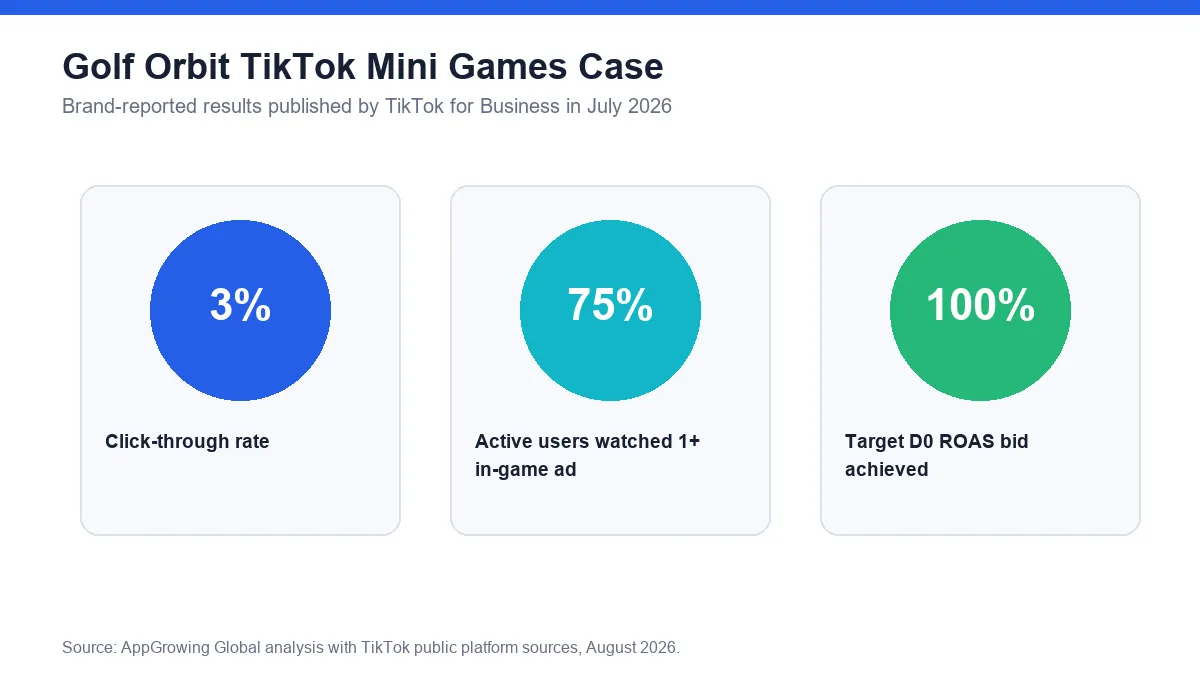
The Golf Orbit case shows that one TikTok-native IAA loop can connect ad response, in-game ad viewing, and Day 0 value optimization in a single game. TikTok's case page reports a 3 percent click-through rate, says 75 percent of active users watched at least one in-game ad, and says the campaign achieved 100 percent of its target D0 ROAS bid.
What do the three published numbers mean?
The 3 percent figure is click-through rate. The 75 percent figure is the share of active users who watched at least one in-game ad. The 100 percent figure is attainment against the target D0 ROAS bid. It should not be rewritten as 100 percent ROAS, a profit margin, or a universal campaign result.
Together, the numbers cover three stages of the path: response to the ad, exposure to an in-game monetization event, and attainment against a value-optimization target. That makes the case useful for workflow design. The public page does not provide spend, sample size, a control group, a full retention curve, or a category benchmark.
Why did Golf Orbit fit an IAA Mini Games path?
Golf Orbit is described as a hypercasual golf launch simulator. TapNation uses rewarded ads as the game's primary IAA method. The case lists revival, double earnings, and lucky-wheel rewards as monetization moments. These moments attach an ad opportunity to a clear player choice rather than placing monetization outside the game loop.
The campaign's descriptive captions and videos showed how easy it was to unlock challenges. The transferable pattern is not the golf theme. It is continuity between the ad promise, the first playable action, the challenge unlock, and the rewarded-ad opportunity. A user can understand the mechanic quickly, and the monetization choice supports continuation or a larger reward.
How should a team turn the case into a test plan?
Start with the promise shown in each video. Mark the exact moment in the first session when the game delivers that promise. Then map each rewarded-ad opportunity, including revival, earnings multiplier, or chance-based reward. Finally, verify that the associated advertising-revenue event is included in the Day 0 value flow.
Use an if-then review. If the video promises a simple challenge but the first session delays it, fix creative-to-game continuity before changing the bid. If the first session is clear but in-game ad viewing is weak, inspect reward value, timing, frequency, and whether the offer helps the player continue. If both stages are healthy but D0 value is weak, inspect event postback and monetization density.
Creative review should also separate a descriptive caption from the gameplay proof. A caption can set the challenge, but the video needs to show the action and reward. That pairing is a better test variable than copying a visual theme without the underlying loop.
What boundaries should a case review preserve?
TikTok states that the case is for informational purposes, that past performance does not guarantee future performance, and that brand-product claims are brand-reported. Keep that status attached to every internal slide or brief that reuses the numbers. Do not convert a case result into a target for another game without a new measurement plan.
For a new Mini Game, create four separate fields: video CTR, Active, the share of Active users who watch an in-game ad, and the selected D0 ROAS measure. Add sample size, market, spend window, and campaign structure when they are available. That turns the public case into a repeatable evaluation design rather than a copied benchmark.
When adapting the case, separate rewarded-ad moments by product purpose. A revival offer may restore access to the core loop, while double earnings or a lucky wheel may amplify an optional reward. Record the trigger, the user choice, the next gameplay state, and the revenue event for each moment. That distinction prevents the team from treating every ad view as the same behavior. It also creates cleaner experiments: one test can improve continuity after failure, while another can test whether an optional multiplier feels valuable without interrupting the first session.
Not sure whether your Mini Game connects its video promise to rewarded-ad monetization?
Get a free benchmark check based on your specific app or game category.
The most useful lesson is structural. Golf Orbit aligns a simple creative promise, an immediate game loop, rewarded-ad choices, and Day 0 value reporting. Test that chain in your own product, but let your own campaign establish the result.
