Google Gemini ads create product proof by showing the task, visible input, generation state, verifiable output, and CTA as one continuous loop.
Why should a generative AI ad show more than a polished result?
When an ad jumps from a problem to a perfect result, viewers cannot tell whether the product created it or how they could reproduce it. The reviewed Gemini ads preserved the input action: a thumb tapped the microphone, a camera captured an object, text entered a prompt box, or a file moved into the interface. A short streaming cursor, sparkle animation, or interface change then signaled processing. That sequence made the AI feel like an understandable tool rather than an unexplained black box.
Which tasks opened the 12 sampled videos?
The sample used concrete tasks such as redesigning a room, organizing books, planning a recipe, identifying an image, understanding a word, creating a headshot, and analyzing a PDF. The highest cumulative-impression record showed 5,386,116 impressions, 271 active days, and 32 linked ads. These openings avoided generic claims about productivity. They showed a physical object or unresolved situation first, so the viewer understood the problem before seeing the product interaction.
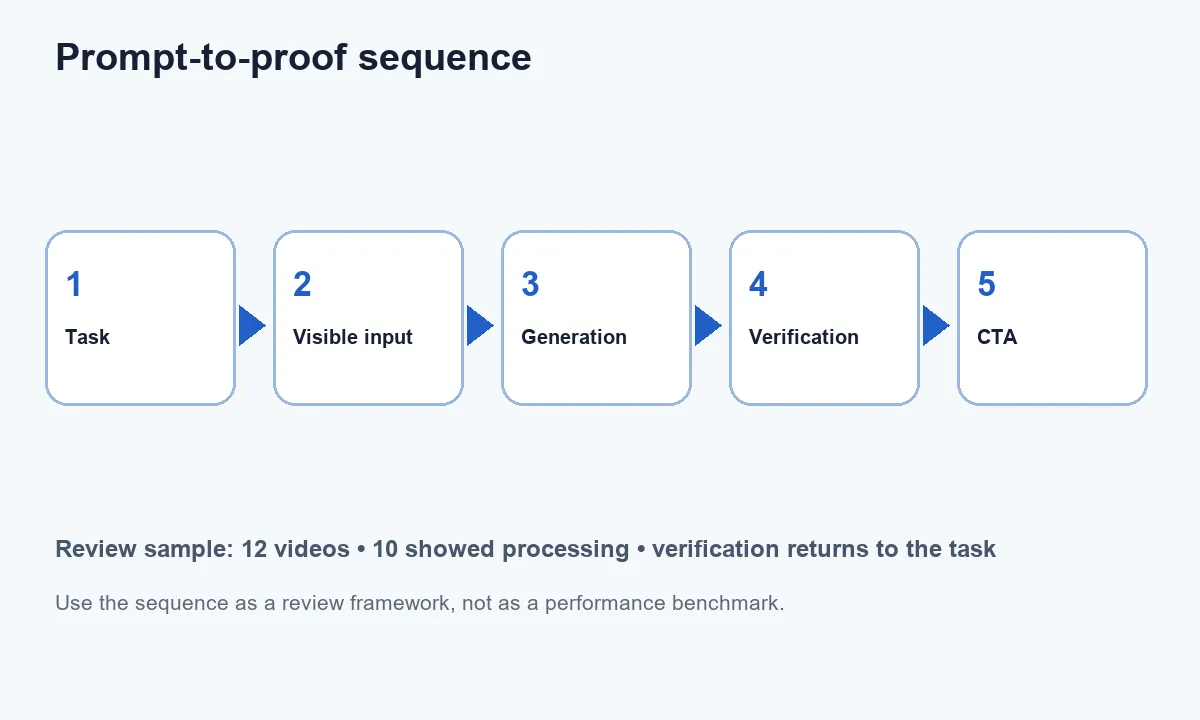
What is the five-step path from prompt to product proof?
The reusable sequence is task, input, generation, verification, and CTA. The task must be concrete. The input must be visible. Processing can be brief, but it should not disappear entirely. Verification deserves the longest share of the runtime. The CTA should identify where the demonstrated capability lives. Ten of the 12 sampled videos explicitly showed a processing state, and at least nine displayed a Google trust mark somewhere in the creative.
What makes a generated output verifiable?
A generated image by itself proves that an output exists, not that it solved the user's task. Stronger verification returns the output to the original situation. A room plan becomes a reorganized physical room. A recipe becomes food on the table. A generated portrait appears in a professional use case. Several style variants appear side by side. During review, ask whether the viewer can compare before and after and whether the result is used in the context that created the prompt.
How should AI-tool ads handle trust signals?
Trust should not depend on a logo alone. Interface recordings, visible input history, disclaimer text, real-world use, and multiple output variants all reduce the black-box effect. Keep those signals separate from performance promises. A visible interface can show how the process works, but it cannot prove that the model is always correct. A before-and-after comparison can demonstrate a task path, but it cannot establish satisfaction, conversion, or retention.
What belongs in the next generative AI creative brief?
Specify the user task, input mode, processing cue, verification method, and CTA. Give each short ad one primary value instead of listing writing, image generation, translation, and document analysis at once. Test whether the input is visible, whether verification returns to the real task, and whether the CTA arrives after proof is complete. The reusable asset is not one attractive output. It is the complete task loop that lets a viewer understand what happened and how to try it.
How should teams compare different verification modes?
A room redesign, a completed recipe, a professional headshot, and a multi-style gallery solve different communication problems and should not enter one performance ranking. Classify the verification task first. Then compare whether the input is visible, whether the output returns to the original task, whether real-world use appears, and whether the CTA remains continuous. This reveals which proof mode fits each creative job instead of collapsing every generated result into a generic “AI feature” label.
Which claims should remain outside the sample conclusion?
The creatives can show how the product appears to complete a task, but they cannot prove that every output is accurate, that users are satisfied, or that one use case converts better. Multiple language versions also do not establish country targeting. The publishable conclusion is limited to how the reviewed materials construct product proof and which steps a team can reproduce. Accuracy rates, commercial performance, and verified audience behavior require separate evidence.
Not sure whether your generative AI ad turns a prompt into credible product proof?
Get a free benchmark check based on your specific app or game category.
How can the task loop become a controlled test matrix?
Place task types on the rows and input visibility, processing cue, verification mode, and CTA on the columns. Change one column at a time. Keep the same room-redesign task and compare voice input with photo input, or keep the same input and compare a before-and-after result with real-world execution. This matrix lets the team compare proof devices directly instead of mixing outcomes from unrelated use cases. It also gives reviewers a shared vocabulary for identifying exactly where a demonstration loses credibility during a weekly creative review.
