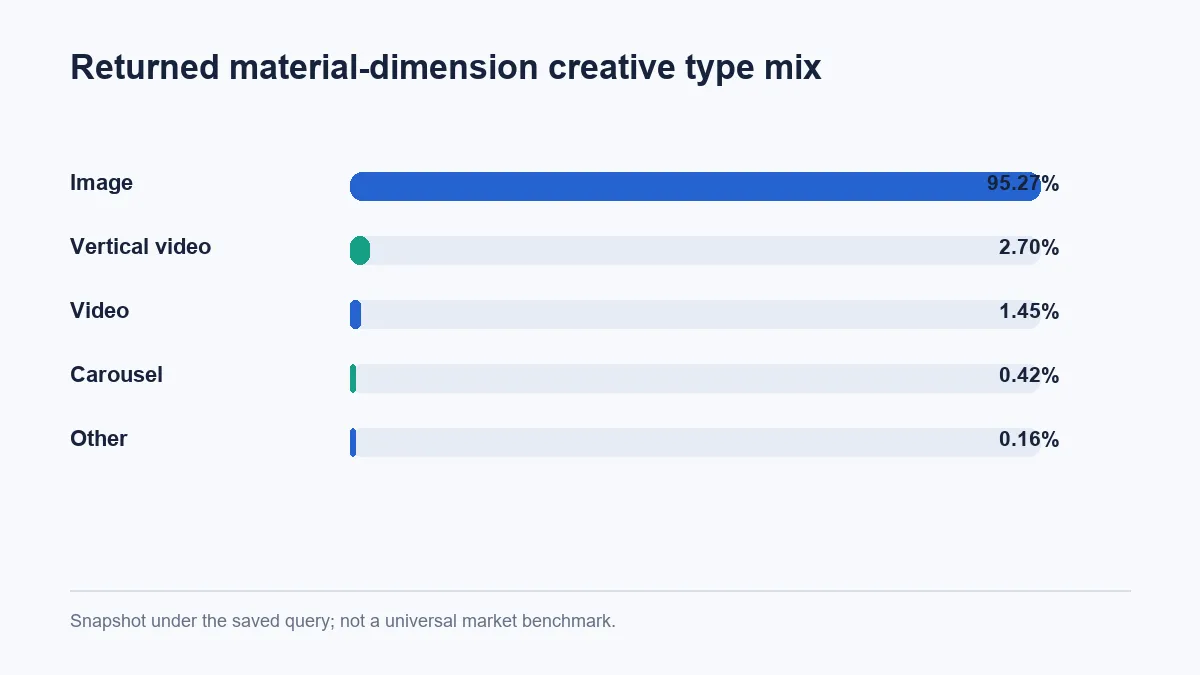
A creative brief can become biased before production starts if the team assumes the visible sample represents the format mix it should copy. The better approach is to audit the returned creative types, check the analysis dimension, and then decide whether the sample is balanced enough for the task. In the AppGrowing Global snapshot for July 30 through August 28, 2026, the material-dimension overview returned 22,738 image materials, 645 vertical videos, 347 videos, and 101 carousels. Images represented 95.27% of that response. This is a query-specific distribution, not a universal prescription for mobile game production.
What must be checked before reading the mix?
Confirm the promoted-object type, date window, filters, and dimension. Material dimension deduplicates around creative resources rather than ad IDs, so it answers a production-oriented question. Keep creative type separate from advertising format. An image, vertical video, or carousel describes the asset structure; feed, rewarded video, interstitial, or native describes how an ad may be placed or delivered. In this batch, the separate format-overview response was empty, so no format-share claim is published. Treating the two taxonomies as interchangeable would invent data that the source did not return.
What did the current creative-type response contain?
The saved response contained 22,738 images at 95.27%, 645 vertical videos at 2.70%, 347 videos at 1.45%, and 101 carousels at 0.42%. It also contained 21 web assets, 15 icons, and one image set; together those smaller groups account for roughly 0.16%. The returned counts sum to 23,868. These numbers are internally consistent with the displayed percentages after rounding, but they should not be joined to the much larger material-search total because the two tools may apply different coverage, aggregation, or eligibility rules.
How should teams diagnose an imbalanced sample?
First ask whether the imbalance is a property of the market, the query, the data product, or the review selection. Repeat the overview with the intended category, market, media, and entity filters before changing a brief. Then inspect representative records from each meaningful type. If images dominate only in a broad query but the target placement requires vertical video, the broad mix should not drive production allocation. The decision rule is simple: if the overview and the target placement describe different populations, use the overview as a sampling warning and build the brief from placement-relevant materials instead.
- Check query population
- Check production objective
- Inspect minority types
- Reweight the review set
What should a type-balanced review sheet include?
Create one section per creative type and use the same fields across sections: material ID, dimensions, duration, media, format, campaign, opening device, gameplay proof, text density, interaction cue, end card, and localization. Add two sample-count columns: returned count and manually reviewed unique materials. This distinction prevents a large platform result from disguising a tiny human sample. Set a minimum review quota for strategically important minority types, especially vertical video or carousel when they match the planned channel. The quota is a research design choice, not a claim about the market's ideal mix.
How does the audit improve a production brief?
Use the audit to separate mandatory deliverables from exploratory variants. Mandatory deliverables follow the actual channel plan and available production constraints. Exploratory variants cover under-reviewed types that could reveal a different way to express the same mechanic or promise. For every requested asset, specify aspect ratio, maximum duration, opening requirement, proof requirement, text allowance, and end-card behavior. Link each instruction to an observed material or an internal platform specification. Do not ask the team to produce mostly images merely because one broad overview returned 95.27% images; first verify that the target campaign shares that population.
Not sure whether your mobile game creative sample is balanced for the next brief?
Get a free benchmark check based on your specific app or game category.
What is the practical takeaway?
A creative-type audit is a check on the sample before it becomes a production plan. The current response is useful because it makes the image-heavy distribution visible and quantifiable. It is also limited: it does not provide a universal benchmark, and the separate format response was empty. Save the overview beside the reviewed material IDs and document any manual reweighting, so the next analyst can reproduce the selection. Confirm the dimension, separate asset type from placement format, inspect minority types, and reweight the review set around the campaign you actually plan to run.
SEO Metadata
SEO Title How to Audit Mobile Game Creative Type Mix Before Writing a Brief
SEO Description Audit mobile game image, video, vertical video, and carousel samples before converting ad intelligence into a production brief.
SEO Keywords mobile game creative type mix, game ad format audit, mobile game creative brief, vertical video game ads, game image ads, creative sample bias, mobile game UA, AppGrowing Global, ad intelligence workflow, creative production planning
Article Tags how-to, diagnosis, mobile-games, ua, ad-intelligence, verified-data, creative-analysis
