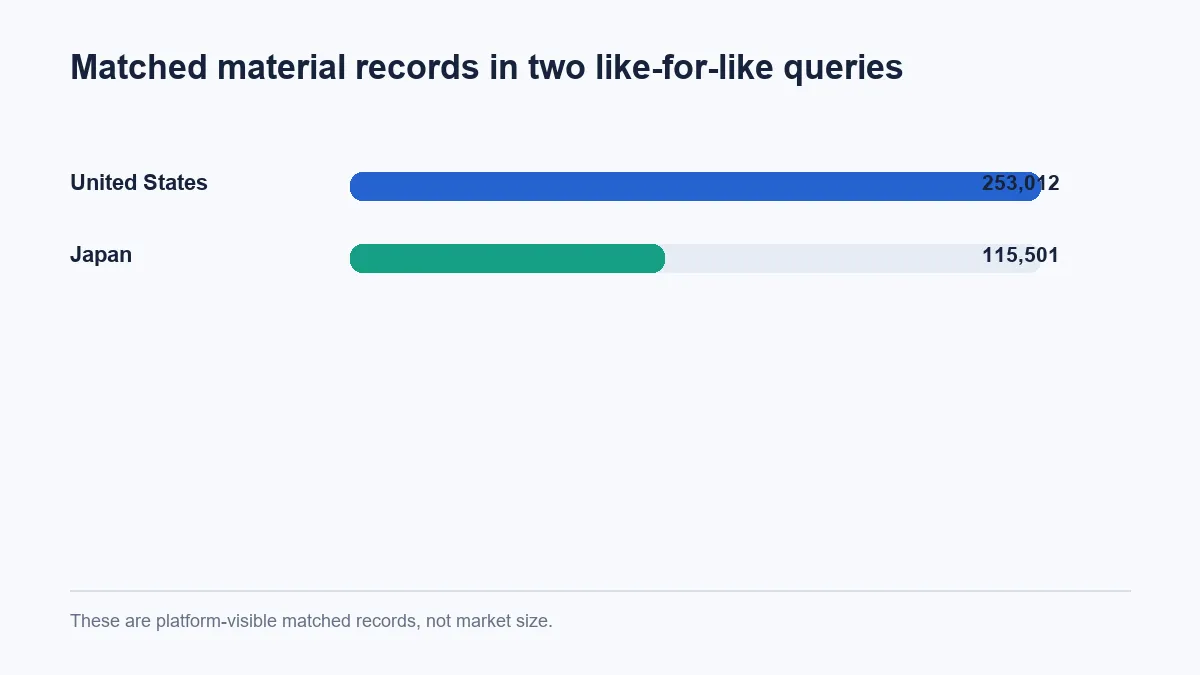
Cross-market creative reviews often fail before anyone watches an ad. One analyst pulls the United States by recent activity, another pulls Japan by lifetime exposure, and the team then treats the two pages as comparable. The safer answer is simple: lock the same object, date window, area rule, sort order, page size, and review fields before interpreting creative differences. In the AppGrowing Global snapshot checked on August 28, 2026, like-for-like queries returned 253,012 matched material records for the United States and 115,501 for Japan. Those counts define the review workload inside this data source; they do not measure market size or performance.
What makes two market samples comparable?
Start with the query contract, not with a creative conclusion. Use the same promoted-object type, equal dates, identical ranking field, the same page number, and a single-area restriction for each market. This batch used mobile games, July 30 through August 28, 2026, page one, and a descending lifetime-exposure field. That last choice matters because it favors durable, historically visible materials rather than only newly launched work. A different sort order could produce a very different creative mix. Record the contract at the top of the review sheet so every analyst knows exactly what the sample can and cannot answer.
- Same purpose and dates
- One market per query
- Same ranking and page
- Same review fields
What did the current US and Japan queries return?
The United States query returned 253,012 matched material records, while the Japan query returned 115,501 under the same date and ordering rules. The first US page included WordTrip: Connect Crossword, Builder Master 3D, and Cover Fire: Gun Shooting Games. The first Japan page included Yo-kai Watch Puni Puni, Just Kill Me 3, and The Battle Cats. These names are sample observations from the first 100 records, not a ranking of all advertisers in either country. They are useful because they give the team concrete creative families to inspect while preserving the limits of the query.
Which fields belong in the review sheet?
Use one row per material ID and separate observation from interpretation. Capture campaign name, slogan or voice-over language, first and last observed dates, duration, media, format, creative type, dimensions, linked-ad count, and similar-material count. Then add human review columns for opening device, gameplay proof, emotional promise, visual density, localization method, and call to action. The structured columns make the sample auditable; the human columns turn it into a creative decision. If one material is linked to several campaigns, flag it for entity resolution instead of assigning it to whichever name looks most familiar.
How should teams interpret differences without overclaiming?
Compare distributions inside the reviewed sample, not the two platform totals as if they were spend or demand. Ask whether one page contains more square video, more native placements, more local-language slogans, or more repeated campaign families. Then verify the pattern across enough unique material IDs and resolved apps. The rule is straightforward: if the query contract is identical and a pattern repeats across several resolved materials, treat it as a sample-level hypothesis worth testing. If the pattern depends on one unusual record or an unresolved multi-campaign association, keep it as a review note and do not turn it into a market claim.
How does the comparison change the next creative brief?
Turn the review into controlled variants rather than a vague instruction to localize. Keep the game mechanic and offer constant, then vary one market-facing element at a time: opening language, character framing, UI density, pacing, cultural reference, or end-card proof. Each proposed variant should point back to at least two sample materials and include a reason for the change. Add a rejection rule as well. For example, do not reproduce a localized slogan if the underlying footage, interface, or store destination remains inconsistent with the target market. The deliverable is a test matrix with comparable cells, not a mood board of attractive ads.
Not sure how to compare US and Japan mobile game creatives?
Get a free benchmark check based on your specific app or game category.
What is the practical takeaway?
A reliable US-versus-Japan creative review is therefore a sampling discipline. Match the query first, resolve entities second, code the same creative fields third, and only then compare patterns. The current counts tell the team how large the platform-visible result sets are, while the first-page examples give analysts a place to start. Neither proves which market is larger or which creative performs better. Used with that boundary, the workflow produces a cleaner localization brief and a repeatable baseline for the next review cycle.
