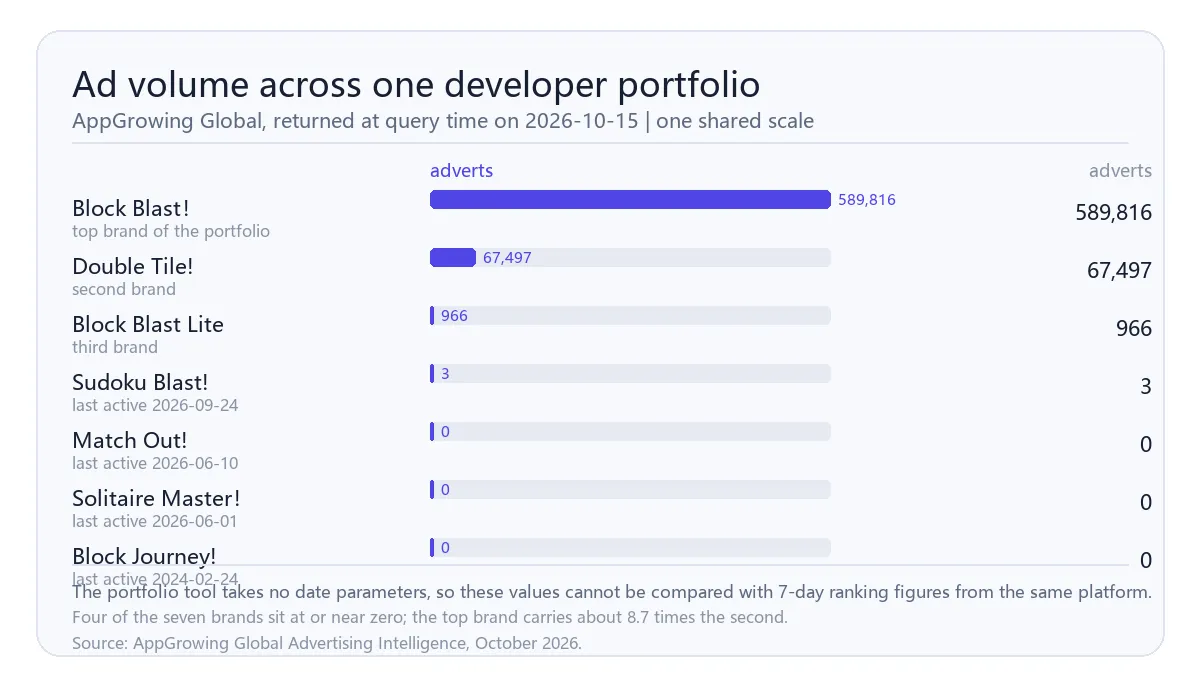
To monitor a competitor properly, query the developer or publisher portfolio rather than one title, then read two signals: concentration at the top of the portfolio and dormancy in the tail. One portfolio returned by AppGrowing Global holds seven app brands with ad volumes of 589,816, 67,497, 966, 3, 0, 0 and 0, meaning four of the seven have effectively stopped, including one whose most recent ad activity dates to 2024-02-24.
Why does a single-title watchlist miss portfolio movement?
Because resources can move inside a portfolio without changing how the flagship performs. In the worked example the top brand carries roughly 8.7 times the ad volume of the second, and the remaining brands sit at or near zero, which is a highly concentrated shape. Watching only the flagship cannot tell you whether the second tier is being retired or tested, and it cannot show whether the portfolio is consolidating spend into one product.
What does a portfolio query actually return?
Querying by developer identifier returns every app brand in that portfolio, each with its own identifier, type, developer information, ad volume and most recent ad activity date. That last field is what turns dormancy into a readable signal, because a stale date is direct evidence that a brand is no longer running rather than an inference from a low count. The response also carries a total for the portfolio, which is useful for spotting a portfolio that has grown since the last cycle, but it counts brands rather than independent products, so it should not be read as a product count.
How should a portfolio be read?
Two signals, read together. Concentration asks how much of the portfolio the top brand holds, which separates a single-point structure from a broad one. Dormancy asks how many brands sit at or near zero and how far back their last activity goes, which separates a shrinking portfolio from one testing a new direction. Combining them puts a portfolio into one of three shapes, single-point, broad, or shrinking-and-dormant, and each shape deserves a different monitoring effort. A single-point portfolio needs watch on the top brand and a scan of the tail; a broad portfolio needs per-brand tracking; a shrinking one needs a decision about whether the quiet brands are retired or being rebuilt. The value of separating the shapes is that it stops a team from spending the same effort on a dormant brand as on the brand carrying the portfolio.
What are the caliber traps in this layer?
Three. The portfolio tool takes no date parameters, so its values arrive on an unspecified internal window and cannot be compared against seven-day ranking numbers. Brand-level ad records are not a count of independent products or a market size. And the tools are not interchangeable: querying a publisher-level tool with a publisher identifier returned the general app-brand list rather than a scoped portfolio, which is exactly the kind of mismatch that produces wrong attribution in a report. When a scoped query silently falls back to a global list, the safest response is to discard the result rather than to filter it by hand.
What should teams run each cycle?
- Query the portfolio by developer identifier and record every brand with its ad volume and last activity date.
- Compute the top brand's share to see whether concentration moved.
- Flag brands at or near zero, or whose last activity is more than a quarter old, as dormant.
- Escalate only the brands gaining concentration or changing state into creative-level review.
- Store portfolio results separately from the single-title watchlist so the two calibers never mix in one trend table.
Run the cycle on a fixed cadence rather than when a question comes up, because the two signals only become readable through change: a top brand's share moving, or a dormant brand's last-activity date staying put while its neighbours move forward.
Not sure what your competitor's wider portfolio is doing outside its flagship title?
Get a free benchmark check based on your specific app or game category.
A portfolio is a budget map rather than a list of products. Reading concentration and dormancy together shows where a developer's attention currently is, which is usually more useful than any single title's week-to-week movement, and it gives the monitoring team a rule for when to widen a check from one title to the whole set.
