Total Battle failure hooks become command proof only when the viewer can see a decision that could have changed the result.
Why can failure work as a command hook?
Failure is not strategy by itself. Its value comes from making the viewer believe that a different decision could have changed the result. In the reviewed Total Battle ads, a small blue force often meets a dense red army on a narrow bridge. A wrong lane, insufficient troop growth, or late upgrade then triggers a failure state. The viewer can immediately imagine the alternative: choose another path, collect more units, or deploy a stronger troop type.
Which signals in the 12 samples proved army scale?
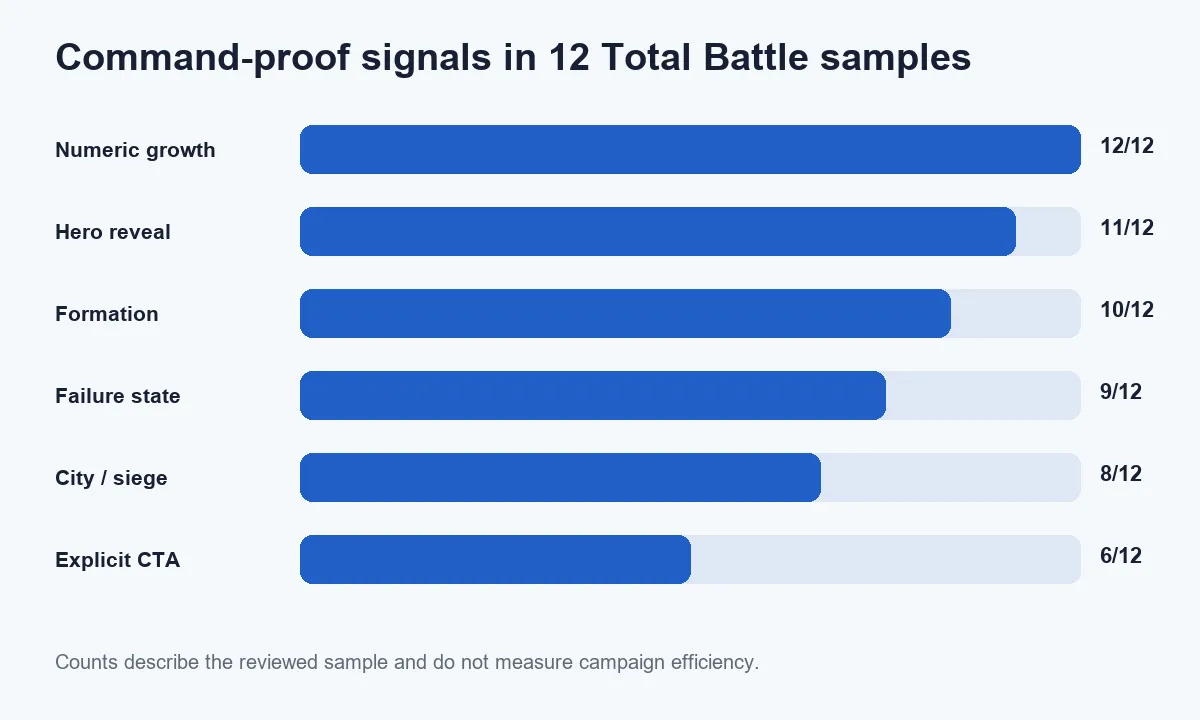
All 12 sampled videos showed a visible number, multiplier, score, or troop-growth device. Nine displayed FAIL, DEFEAT, or RETRY, while 10 showed a readable formation. The highest cumulative-impression record showed 16,474,566 impressions, 179 active days, and 196 linked ads. That makes it a priority review item, not a current-period winner. The consistent creative move was to make growth visible rather than describe army power in abstract voice-over.
How does the bridge layout simplify strategy proof?
A bridge or narrow lane compresses a complex SLG system into one instantly readable problem. Enemies approach from the front, and the player can only choose a path, collect troops, or upgrade the unit. The top-down view clarifies the numerical gap. Single-file movement keeps the formation understandable. Burning cities, towers, and ruins then add a larger war context. The ad is not demonstrating the full game; it is establishing the minimum evidence needed to support a command fantasy.
When does failure stop supporting strategy?
Failure becomes noise when the preceding action contains no observable choice. Review three points. Can the viewer see an alternative route or upgrade? Can the loss be traced to troop size, class, or timing? Does the next shot reveal a stronger commander identity or a deeper system clue? If two of those points are missing, classify the execution as a frustration hook rather than a strategy reference. The distinction prevents teams from copying defeat imagery without copying the logic that makes defeat useful.
How should teams audit the next SLG brief?
Require five fields in the brief: threat, choice, troop proof, system clue, and CTA. The threat must be legible in the opening three seconds. The choice must appear changeable. Troop proof must be visible through numbers or unit transformation. The system clue should show at least one tower, city, siege, territory, or multiplayer-war element. The CTA should arrive after the result or commander reveal. Every field should point to a planned shot, not just an emotion word.
What variable deserves the next controlled test?
Test the placement of failure and the commander reveal before changing the entire art package. Version A can fail at mid-video and then show a troop-class upgrade. Version B can show a victory before revealing the commander. Version C can keep the same bridge and remove the failure frame as a control. If failure helps the viewer understand a decision that could be changed, it supports strategy proof. If it does not, it merely adds runtime.
How should these counts enter the review sheet?
Failure frequency, formation frequency, and commander reveals are sample counts and should be stored beside the material IDs that support them. Record semantic coverage as well. When a transcript or closing frame is missing, “CTA not observed” is more accurate than “no CTA.” Keep cumulative impressions, active days, and linked-ad counts as raw descriptive fields. Do not convert them into efficiency, revenue, or period-new delivery. This separation makes the next review reproducible instead of dependent on memory.
Which structures can safely become a new script?
Reuse the relationship between threat scale, a changeable decision, troop growth, and consequence—not the specific warrior, bridge, or fire treatment. A new script can move the same logic to a canyon, city gate, or naval passage as long as it preserves one readable choice and one visible result. The commander reveal should also emerge from the troop change shown earlier. If it appears as an unrelated hero poster, the creative loses the causal link that made the command fantasy credible.
Not sure whether a failure hook proves command decisions in your strategy-game ads?
Get a free benchmark check based on your specific app or game category.
How can teams avoid mistaking a casual mechanic for full SLG proof?
A bridge runner and a plus-one growth loop establish an accessible rule, but they do not represent the depth of the strategy product. The brief should include at least one macro-system clue, such as a tower upgrade, damaged city, siege objective, territory, or multiplayer-war layer. When the micro choice and macro system appear in the same chain, the casual hook can support an SLG promise instead of remaining a disconnected mini-game.
