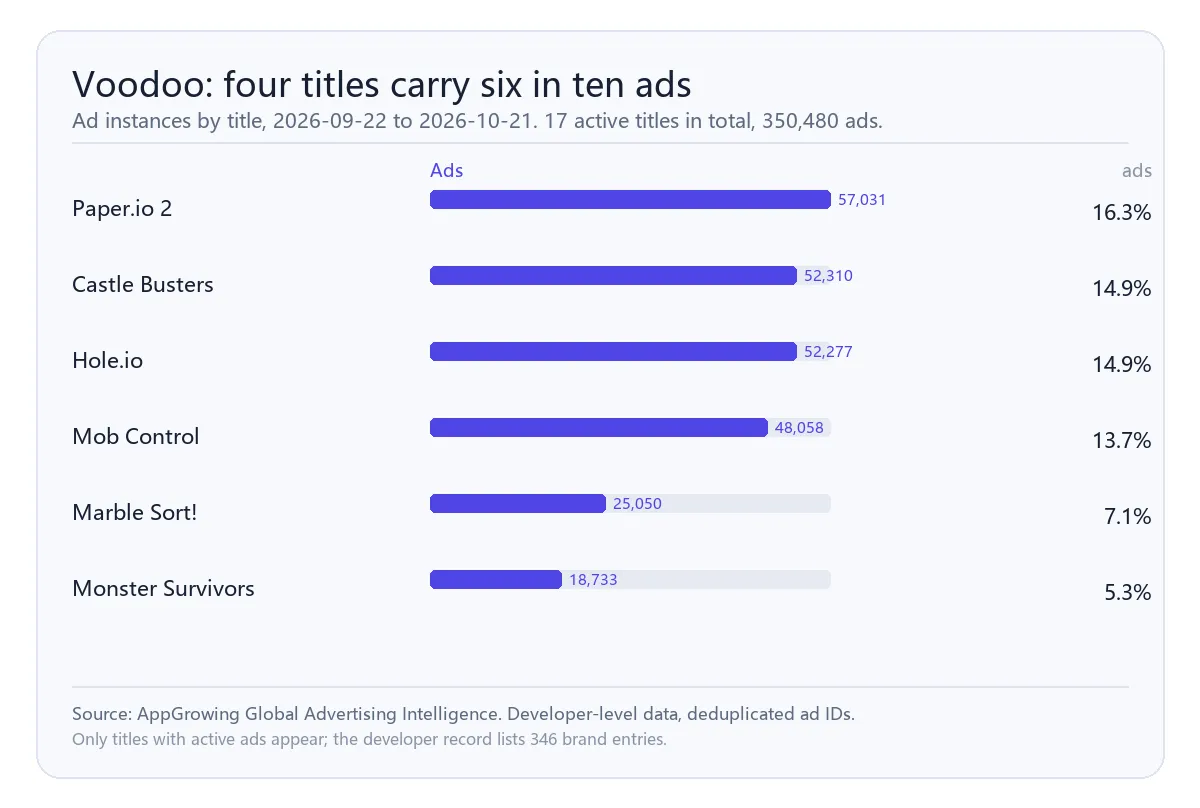
Voodoo's developer record lists 346 brand entries, but only 17 ran ads in the 30 days to October 21, 2026, for a combined 350,480 ad instances. Four titles — Paper.io 2, Castle Busters, Hole.io and Mob Control — account for 209,676 of them, or 59.8%. The top title runs 11.6 times the ad volume of the smallest. Reading a publisher through its flagship is how you miss which titles are actually being pushed.
How concentrated is this portfolio?
Four of 17 titles take roughly 60% of the ads; the other 13 share 40%. That is more concentrated than the usual picture of a hyper-casual publisher spraying tests across a wide field.
The tail is not noise either. Loop Sort (15,404), Marble Sort (25,050) and Monster Survivors (18,733) all clear ten thousand and sit in a second tier that could move up within a month.
That shape matters if you plan to benchmark against the publisher. A four-title core means roughly 60% of the company's visible ad output sits behind a handful of creative libraries, so a teardown of the top four covers most of what you will actually meet in auction. The remaining 40% is where format experiments happen, and it is cheaper to watch than to copy.
Ad volume across the 17 active titles
Why does "look at the flagship" mislead?
Because the flagship's position says nothing about the portfolio. Mob Control runs 48,058 ads and ranks fourth, not first; Paper.io 2 leads at 57,031. Rank by brand recognition and you will misplace the ad weight entirely.
Searching the publisher name has its own trap: a query for "voodoo" returns adjacent brands such as Crazy Kick or BeReal rather than Voodoo's own portfolio, which is why developer-level data has to come from the developer record rather than from a name search. That single step is also what turns a vague "they publish a lot of games" into a list you can rank, band and re-check monthly.
Is Sand Loop worth a separate look?
Yes. Three sand-related keywords — sand blocks, sand block and sand — entered the weekly search-interest ranking at the same time, and Voodoo owns Sand Loop: Color Sort Puzzle at 8,580 ads, near the back of the second tier.
The mapping is useful but loose: search interest can point at a product family, yet only the publisher list tells you which title actually carries the spend. A keyword is not a product ID, and the gap between the two is where most competitor watchlists drift.
How should a publisher list drive monitoring?
Three steps. First, split titles into three bands by ad volume: above 40,000 (core), 10,000 to 40,000 (second tier), below 10,000 (watch). Second, compare creative structure only within a band, because cross-band comparisons mislead. Third, re-sort monthly — hyper-casual portfolios rotate fast, and last month's second tier is often this month's core.
What not to do: do not read 346 brand entries as 346 active products; do not treat ad count as spend; and do not read a developer total as any single title's intensity.
One more caveat worth stating plainly: a 350,480 total is a count of ad instances across geographies. It tells you how widely the portfolio is distributed; it says nothing about whether those ads worked, and it cannot be converted into a budget estimate without a price model this dataset does not contain.
Want a portfolio view of your competitors?
Get a free benchmark check based on your specific app or game category.
