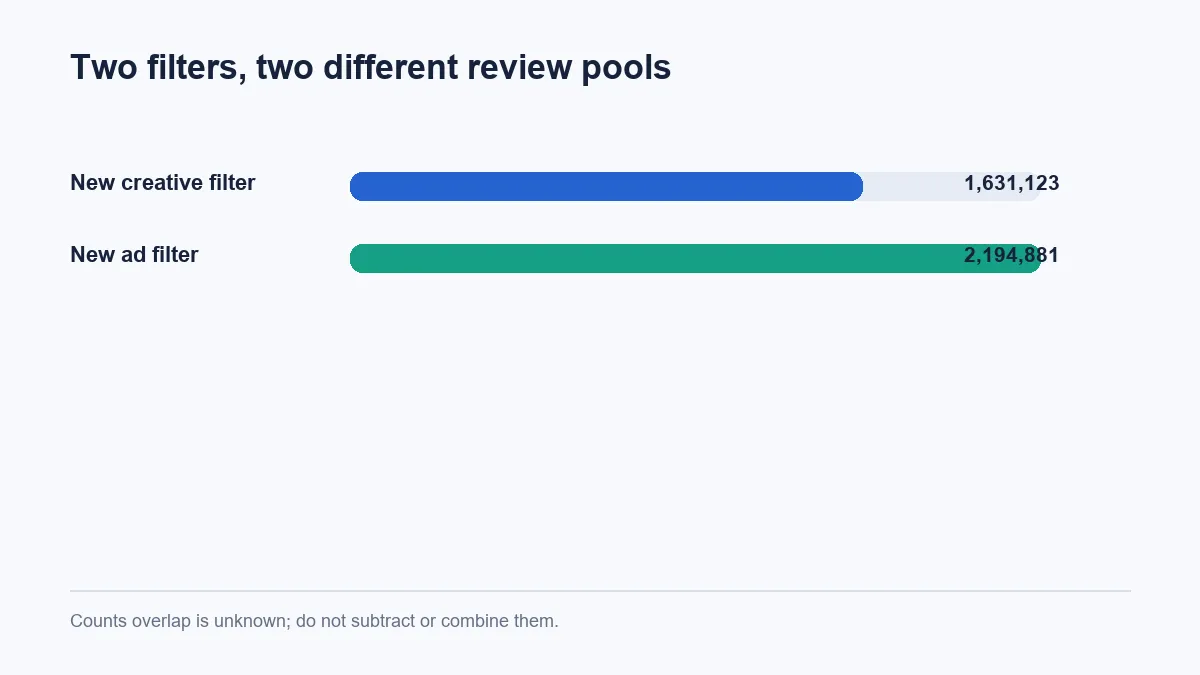
UA teams often use new creative and new ad as if they were interchangeable filters. They answer different questions. A new-creative filter helps find material records newly observed in the selected period, while a new-ad filter can surface newly observed ad instances that use older material. In matched AppGrowing Global queries for July 30 through August 28, 2026, the new-creative filter returned 1,631,123 records and the new-ad filter returned 2,194,881. The sets may overlap, so the counts must not be added or subtracted. Choose the filter from the review task, then verify dates and IDs before assigning production work.
When should teams use the new-creative filter?
Use new creative when the question is about production output: which material files, visual variants, or creative executions appeared recently? In the saved sample, Paper Delivery Boy had a first observed date of July 30, 2026, a last observed date of August 28, and a 1080 by 1920 vertical video resource. Several nanogram records also appeared with different image sizes and a repeated slogan. That pattern is useful for a production review because it distinguishes multiple material executions around one campaign. It still does not prove that the assets were expensive, successful, or unique outside the platform's matching logic.
When should teams use the new-ad filter?
Use new ad when the question is about activation or distribution: which ad instances became newly visible, even if their underlying creative is old? The current sample demonstrates the difference. A Candy Show material returned by the new-ad query had a first observed date of February 27, 2018 and a last observed date of August 28, 2026. Other returned materials for political simulators and Puzzle & Dragons also had multi-year histories. The filter therefore cannot be translated into freshly produced creative. It is better read as a route to newly observed ad activity that requires a material-level date check.
What do the two current result counts mean?
The new-creative query matched 1,631,123 records, and the new-ad query matched 2,194,881 under the stated filters. These are separate platform result counts, not mutually exclusive populations. Without a material-ID and ad-ID intersection export, the overlap is unknown. Do not calculate a gap, ratio, or conversion from one set to the other. The useful interpretation is operational: each filter creates a different review queue. One queue is suited to creative production monitoring; the other is suited to distribution and activation monitoring. A combined workflow should join records on stable IDs rather than compare headline totals.
How should a weekly review route the two queues?
Send new-creative records to creative strategists and producers. Ask them to group variants by concept, aspect ratio, opening, slogan, and gameplay proof. Send new-ad records to media and competitive-intelligence reviewers. Ask them to check where an existing asset reappeared, whether the media mix changed, and whether multiple ad IDs point to one material. Escalate a record to both teams only when a stable material ID connects recent production and recent activation. This routing prevents a media relaunch from being mistaken for a new concept and prevents a newly produced file from being mistaken for scaled distribution.
- New creative leads to a production review
- New ad leads to an activation review
- Stable IDs connect the two
- Performance remains a separate evidence layer
Which fields prevent false conclusions?
For every row, retain material ID, resource ID, first date, last date, duration, campaign association, media, format, creative type, linked-ad count, and similar-material count. Add a classification column with four allowed values: new production, old production in new activation, unresolved, or both signals confirmed. Require the reviewer to cite the date and ID evidence behind the label. If an old first date appears inside the new-ad queue, the row must not be called a new creative. If a newly observed material has no delivery or performance data, it must not be called scaled or winning.
Not sure whether your team should review new creatives or new ads?
Get a free benchmark check based on your specific app or game category.
What is the practical takeaway?
The filter choice should follow the decision. Use new creative to monitor production, new ad to monitor activation, and a stable-ID join when the team needs both. The August snapshot shows why the distinction matters: a new-ad result can contain material first observed years earlier. Treat the two result totals as workload indicators only, keep overlap unknown unless it is calculated directly, and leave performance claims to a separate first-party evidence layer.
