In 23 TikTok mini-game creatives with a readable ending, 43% carry no call to action at all: the frame simply stops on gameplay, a failure, or an unresolved board. Another 26% close on a play entrance — "PLAY NOW", "GAME START", a multi-card game picker — and the same 26% show an install button somewhere in frame. The voiceover layer is stricter still: of 20 creatives with speech, exactly one mentions installing. The install ask has not been optimised away; it has been moved out of the creative and handed to the ad frame and the store page.
How often does a TikTok mini-game ad actually ask for an install?
In frame, 26%. In voiceover, 5%. Read together, that gap says the install button is not part of the story even when it exists — it is a layer pasted onto the last frame.
The more common behaviour is to ask for nothing. In 43% of the sample the creative ends mid-play, on a loss, or on a puzzle left open, with no instruction at all.
How the 23 endings break down
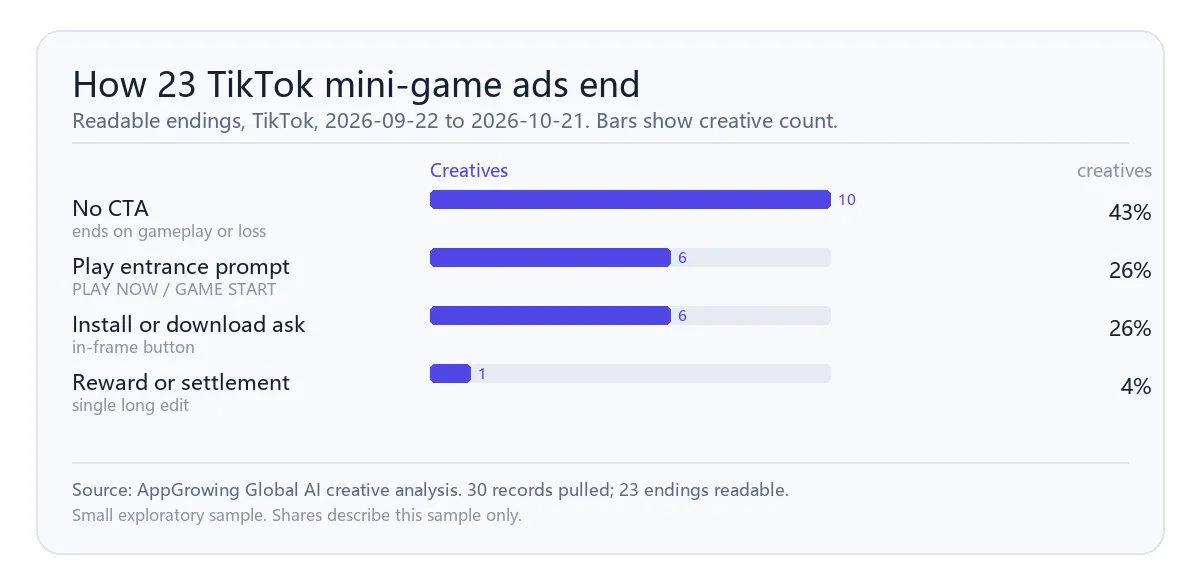
What closes an ad that is not selling anything?
Three endings cover almost everything: an entrance prompt (26%), an install button (26%), and nothing at all (43%). The remaining 4% is a single reward-settlement close, and it belongs to the one 138-second edit in the sample.
The entrance prompt deserves its own note. It downgrades the ask from "install an app" to "start playing now", which is a lower-friction action and matches the in-feed loop these ads run in.
Where do length and hook land?
16–30 seconds accounts for 47% of the sample, 46–60 seconds for 27%, and the median is 31 seconds. That does not match the usual "hook in three seconds, finish in fifteen" advice — half of these creatives are willing to spend more than half a minute.
Longer edits also close more completely: the only reward-settlement ending sits in the longest creative. Short edits tend to end open.
What does the reuse pattern tell you?
Inside the same pull, one creative is reused across 10 to 14 different mini-game packs, and a single publisher accounts for 52 of 100 records in the category slice. Production is one master asset skinned across many products.
For competitor teardowns that cuts both ways: one teardown covers ten titles, but one structure is not the category consensus.
It also sets a ceiling on how much variety you should expect. If a single master travels across more than ten packs, the observable difference between competitors is rarely the idea itself — it is which frame gets cut, which language track is swapped and which ending is attached. That is where a teardown earns its keep, and it is also why copying a hook in isolation usually fails: the hook was never the variable being tested.
How should your team rebuild the ending?
Three steps. First, decide whether the creative needs a CTA at all: for in-feed placement, use an entrance close; for install campaigns, write the install into the narrative instead of pasting it on the last frame. Second, hold the final frame for at least three seconds so any text or button is readable. Third, default the emotional landing to "failure that can still be fixed" — it is closer to how these creatives actually end than a celebration.
What not to do: do not drop the CTA just because 43% of this sample has none — that is a distribution, not a performance finding; and do not mix an entrance close and an install close in the same edit.
Want your mini-game endings benchmarked?
Get a free benchmark check based on your specific app or game category.
