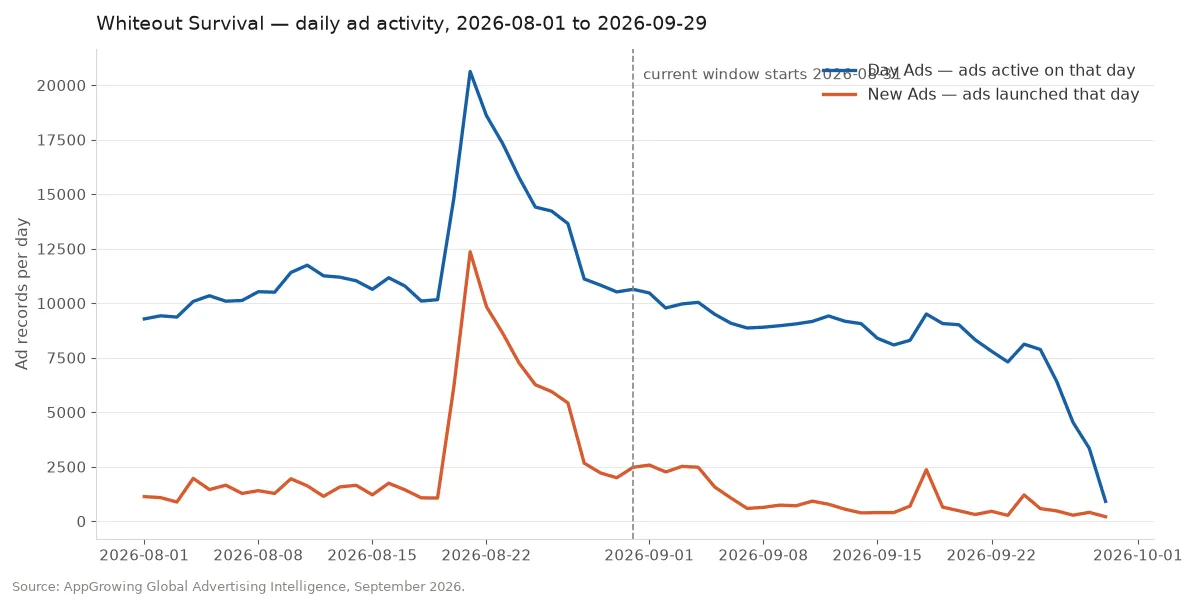
Whiteout Survival cut ad records 63.4 percent, from 104,483 to 38,291, while raising creative records 40.2 percent, from 4,489 to 6,293, in the 30 days to 2026-09-29. The sharper signal is inside the trend: average daily new-ad launches fell from 3,175 to 977, so the title stopped adding new ads without stopping the ads it already runs.
Why did Whiteout Survival cut 63% of its ads?
Inside this window Whiteout Survival moved from 104,483 ad records to 38,291, a fall of 63.4 percent, while creative records rose from 4,489 to 6,293, up 40.2 percent. The two totals point in opposite directions, and neither explains what happened on its own.
Daily data separates the two ends. Average daily active ads fell from 12,034 to 8,300, down 31.0 percent. Average daily new ad launches fell from 3,175 to 977. The new-launch end contracted far more than the active end, which means the title stopped adding new ads without retiring the ads already running at the same rate.
That is consolidation, not a clear-out. Reading only the ad total makes a structural contraction look like a retreat.
What do the assets that kept running have in common?
The material query for this window returned 3,382 video assets. Ranked by active days and cumulative impressions, a set of long-surviving assets shares a consistent four-act structure.
| Act | Content | Presence in sample |
|---|---|---|
| Opening hook (first 3s) | Top-down 3D snow scene already in motion: a sausage-cutting machine, a hammer cracking ice, a village queue, a snowman army around the camp. No intro card, no human face | About 10 of 15 long-lifecycle samples |
| Crisis trigger (mid first act) | Resource or threat alarm: food supply low, fire dying, counter position descending, customer overload. A thermometer UI carries continuous pressure | About 9 of 15 |
| System proof (the 40–65s middle) | One sustained loop from automation lines, camp and building progression, or combat defence, with on-screen counters for gold, wood or fish | 14 of 15 |
| Result and CTA (fixed 3–4s outro) | White or colour-block transition, silhouette figure with a torch walking in snow, game logo, Play Free / free-to-play button | All samples with visual data |
Between long-lifecycle and newer assets, the middle and the outro barely change. Verbatim CTA strings returned include "White out survival. play free now." alongside Japanese and Korean localisations. The outro composition is fixed; only the CTA language moves.
Act boundaries and shares are semantic derivation from returned visual descriptions, not interface fields.
What changed in the newest assets?
Isolate the newer cohort and the difference concentrates at the start. Long-lifecycle assets almost never use a human face; they open on gameplay motion. Newer high-impression assets open at 0:00 on a UGC talking head or first-person voice, and the script points at problems in other games: slow time-to-fun, too many pop-up ads, falling behind after a few days offline.
A second type delivers the crisis as a facility system log: fish station, log station, polar drink shop, the last warm zone. The announcements read like operations alerts — food supply critically low, customer count excessive, fire is dying. The crisis comes from a facility operating system rather than a character shouting.
In the newer cohort the system-proof middle compresses to roughly 30 to 45 seconds and is often intercut with the streamer in a picture-in-picture frame. The torch silhouette and free-play button template in the outro is unchanged.
Linked-ad counts also stratify. Long-lifecycle assets commonly run 20 to 99 linked ads, and one extreme survivor still carried 100 ads after 1,255 active days. Newer high-impression assets cluster at 65 to 139 linked ads inside 5 to 48 days. This field is interface-direct.
What should a team do when new-ad launches collapse?
When a competitor's new-launch end drops sharply, do three things. First, split the ad total into average daily active and average daily new launches to locate which end moved. Second, pull the assets that still hold high linked-ad counts and long active-day runs, and treat them as a retained set. Third, run the four-act review on that retained set and log the opening, crisis trigger, system proof and closing CTA.
The second step matters because a contracting launch period is exactly the window in which you can see which structures survive long term. The retained pool here shows strong continuity in the mid-act system proof and the outro CTA template. The only part actively iterating is the opening three to fifteen seconds.
Track Whiteout Survival separately from its sibling title. Tasty Travels raised ad records 27.3 percent over the same period, so a combined developer-level reading would lose both signals at once. All figures are advertising-activity records returned for the queried sample; they do not establish spend, CPI, ROI or market size.
Not sure whether a competitor's ad drop means retreat or asset consolidation?
Get a free benchmark check based on your specific app or game category.
