Attribution windows change App campaign reports because they define how long an install or in-app action can receive credit after an ad interaction. A longer window usually records more delayed conversions, while a shorter window stays closer to recent interactions but can miss legitimate late outcomes. The objective is not to select the window that produces the largest number. It is to align event latency, the business cycle, and the campaign decision cadence.
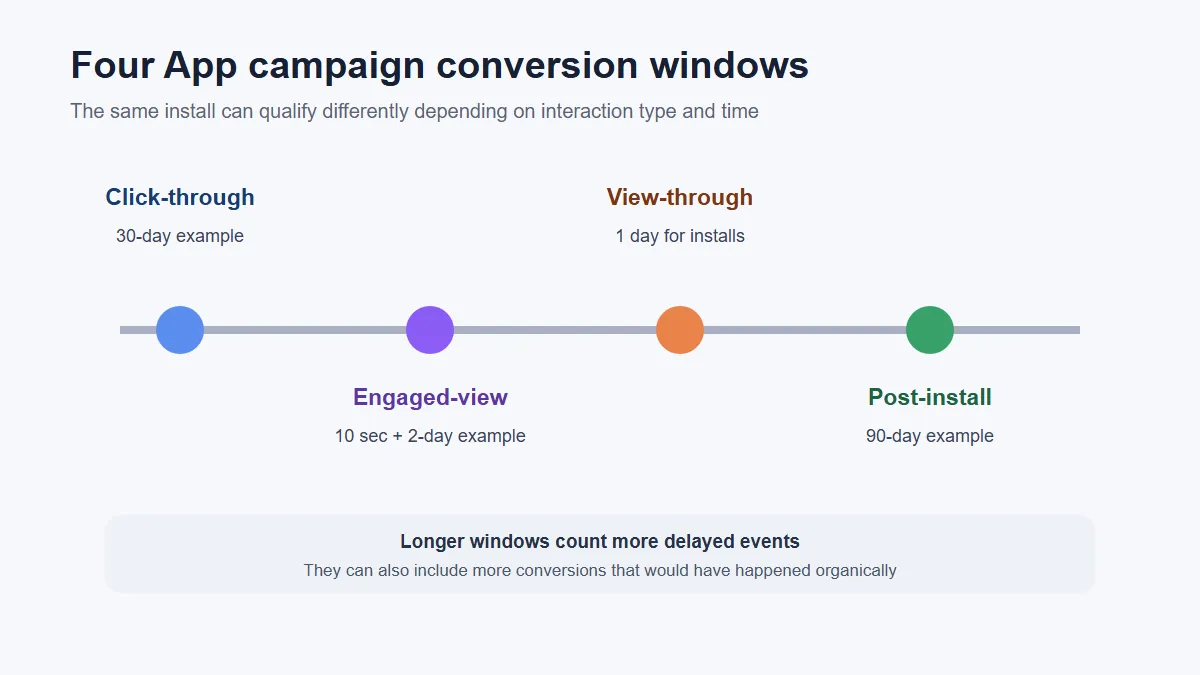
What does each conversion window count?
A click-through window counts an install when someone clicks an ad and installs within the selected period. Google uses a 30-day click window as an explanatory App campaign example. That number illustrates how the setting works and should not be copied automatically into every measurement plan.
An engaged-view conversion can be counted when someone does not click but watches at least 10 seconds of a skippable video, or the entire video when it is shorter than 10 seconds, and then converts inside the selected window. Google uses a 2-day engaged-view window in its example.
A view-through window counts an install after a qualifying view. Google sets the App campaign view-through install window at 1 day. The referenced viewability standard requires at least 50 percent of an image to be visible for 1 second, or at least 50 percent of a playing video to be visible for 2 seconds. A post-install window measures an in-app action after installation. Google uses a 90-day window to illustrate this later-stage category.
Why do longer windows usually report more conversions?
Extending a window makes more delayed events eligible for credit. That can be appropriate when purchases, subscriptions, upgrades, or advanced game levels take time. Google also warns that longer windows increase the probability of capturing organic conversions that may be less incremental.
Shortening a window reduces that probability and creates faster reporting cohorts, but it can remove valid delayed behavior. A falling conversion count after a window change therefore does not prove that creative quality declined. The measurement rule changed before the campaign result was interpreted.
How should teams select a window for each event?
Start with the Days to conversions report or an equivalent internal latency distribution. Measure how long first open, registration, purchase, subscription, or a key game milestone takes after the eligible interaction. Record the median, the useful tail, the promotion length, and the time required for reports to mature.
Fast events can use shorter windows than slow value events. Teams that edit campaigns frequently may prefer shorter feedback loops. Campaigns with long consideration or progression cycles may require longer observation. If most target events have not matured, do not judge the newest creative cohort. If the remaining tail is negligible, do not lengthen the window only to increase the reported total.
Why do platform comparisons break when windows differ?
Two dashboards may both display installs while using different interaction definitions, viewability thresholds, lookback periods, modeling, and update timing. Before calculating a platform gap, build a definition table with the event, window, eligible interaction, observed or modeled status, and data freshness.
Compare like with like. A 1-day view-through result should not be placed beside a 30-day click-through result and labeled channel efficiency. Those rows answer different attribution questions even when both ultimately contain installs.
What should the UA team check next?
Plot latency separately for installs, registrations, purchases, and the game or app event used for bidding. Choose a stable reporting window for each event and keep it constant across comparable cohorts. After a budget or creative change, allow the same maturation period before making a decision.
Finally, place the interaction type and window in the report title, experiment record, and decision note. If the definition changes, annotate the date instead of presenting the break as performance movement. Conversion windows should make measurement more consistent, not provide an invisible lever for changing the answer.
For every window edit, retain the date, old value, new value, reason, and affected conversion action. Do not splice pre-change and post-change rows into an uninterrupted trend. If the platform applies the setting only to future records, mark a dashboard break and wait until a complete cohort has matured under the new rule.
