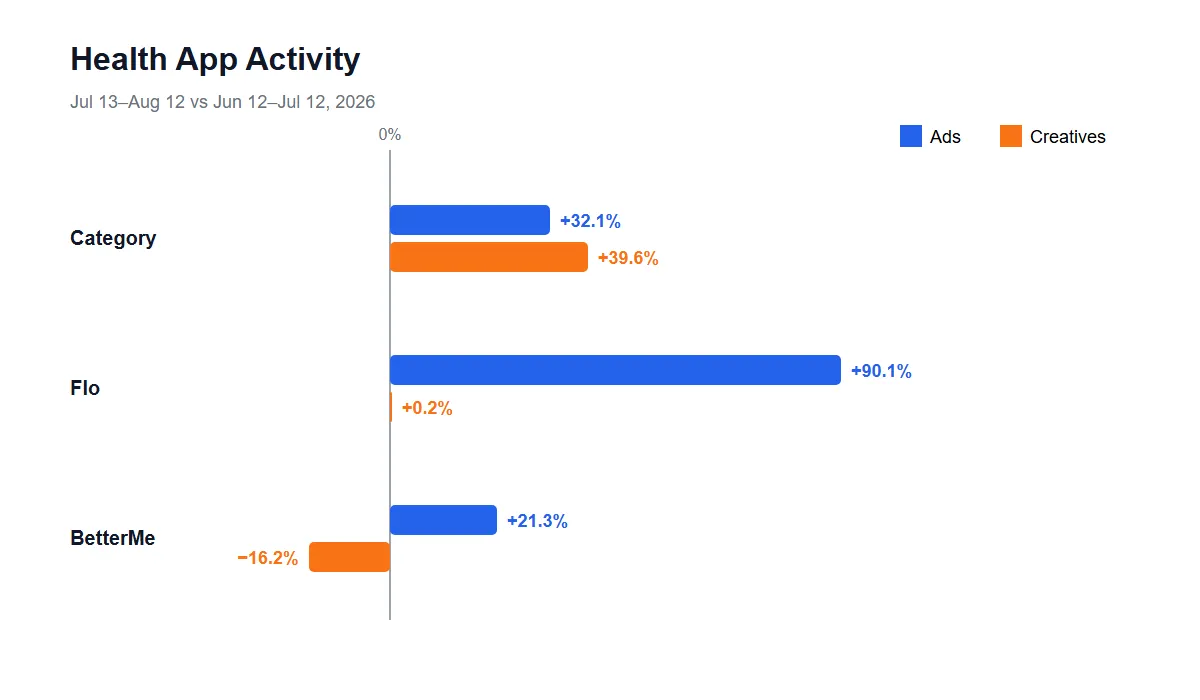
Health app category growth does not mean every competitor is expanding its creative pool. From July 13 to August 12, 2026, category ad records rose 32.1 percent and creative records rose 39.6 percent. Flo nearly doubled ad activity while its creative count stayed flat. BetterMe increased ads while reducing creatives. Growth teams should diagnose script-family concentration before increasing production.
Why does category growth not describe every app?
Health app ad records increased from 2,594,679 to 3,427,823, while creative records increased from 9,057 to 12,647. Flo ads rose from 27,804 to 52,860, a 90.1 percent increase, while creatives moved only from 8,455 to 8,469. BetterMe ads rose from 101,387 to 122,958 while creatives fell from 32,348 to 27,100.
The entity-level pattern therefore indicates much stronger creative concentration than the category average. Use entity direction to determine the review task. If ads rise and creatives stay flat, inspect long-running reuse and language variants. If ads rise and creatives fall, inspect template concentration and variant efficiency. If both rise, then investigate new-concept expansion.
How do Flo and BetterMe frame different problems?
The official-entity aggclaw retrieval matched 6,062 Flo materials and 26,343 BetterMe materials. Flo frames the problem as uncertainty about the body. Symptom questions, cycle changes, self-assessment scores, and first-person experiences lead into calendars, prediction cards, symptom logging, pregnancy progress, or an assistant interface. The narrative moves from not understanding a body signal to gaining organized information and control.
BetterMe frames the problem as visible body dissatisfaction and delayed action. Body areas, age, BMI, postpartum identity, or years without exercise open the story. Real workout demonstrations, 28-day calendars, progress bars, and unlocked stages then make the plan visible. The narrative moves from not starting to joining a challenge and maintaining a routine.
The proof objects are different. Flo must show that the app organizes and explains personal information. BetterMe must show that the plan is understandable, the movement is executable, and progress is visible. Copying the surface image without this problem-to-product bridge removes the strategic value of the creative.
The visual rhythm also needs separate treatment. Flo often moves from anxiety or a question into calm interfaces, calendars, and explanation cards, creating a journey from uncertainty to understanding. BetterMe moves from a challenge promise into real movement, calendar progress, and visible completion. A useful adaptation preserves this transition instead of copying only soft colors or workout footage.
Which claims need a separate review?
Flo materials include health anxiety, expert authority, accuracy language, self-assessment scores, and virtual-assistant framing. BetterMe materials include deadline-based transformation, body-area improvement, age or BMI grouping, and before-and-after narratives. These are observable creative expressions, not verified medical facts or guaranteed outcomes.
A claim-review sheet should record the exact expression, proof image, product function, population wording, time promise, and CTA. When a claim involves diagnosis, accuracy, expert endorsement, or a definite transformation, require an official evidence path. When the material sample contains an expression that cannot be verified, keep it in the risk watchlist rather than carrying it into a new script.
Creative audience intent must also remain separate from real audience evidence. Wording for a particular age, BMI, or life stage shows whom an ad attempts to address; it does not prove whom the platform reached or converted. Teams can use these labels to organize script tests, but effectiveness still requires advertising-platform or attribution data.
How should UA teams decide between more concepts and more variants?
Group Flo materials into symptom questions, score reveals, body education, and personal journey. Group BetterMe into challenge invitations, transformation timelines, body-problem solutions, and segment recruitment. Add active days, linked-ad count, language version, and claim-review status to each family.
Not sure whether Flo or BetterMe signals call for new concepts, safer claims, or stronger variants?
Get a free benchmark check based on your specific app or game category.
The current data supports concentration diagnosis before production expansion. Flo expanded observed ad activity far faster than its creative pool, and BetterMe expanded ads while shrinking creatives. Teams should identify the families receiving broader use before assigning budget to entirely new concepts.
