Hollywood Merge gained new industry-search visibility while its observed advertising activity cooled. The title newly entered AppGrowing’s weekly TOP50 with 13 UV. In the latest monthly comparison, game ads declined from 11,805 to 9,811 and creatives declined from 2,347 to 1,852. The practical response is to identify which creative structures survived the cooldown. The data does not show that player demand or campaign efficiency declined.
Why does a new TOP50 entry not mean advertising expansion?
Industry lookup interest and advertising activity answer different questions. Search UV shows that more AppGrowing users are looking at a keyword or entity relative to the visible list. It does not measure App Store searches, downloads, revenue, or player demand. Ad and creative counts show the size of observed activity around the matched title.
From June 30 to July 30, Hollywood Merge game ads decreased 16.9 percent against the previous equal-length period. Creative volume decreased 21.1 percent. Creatives per 10,000 ads moved from 1,988.1 to 1,887.7, a 5.1 percent decline. The title therefore presents a useful mismatch. Attention has become visible while the advertising pool has contracted.
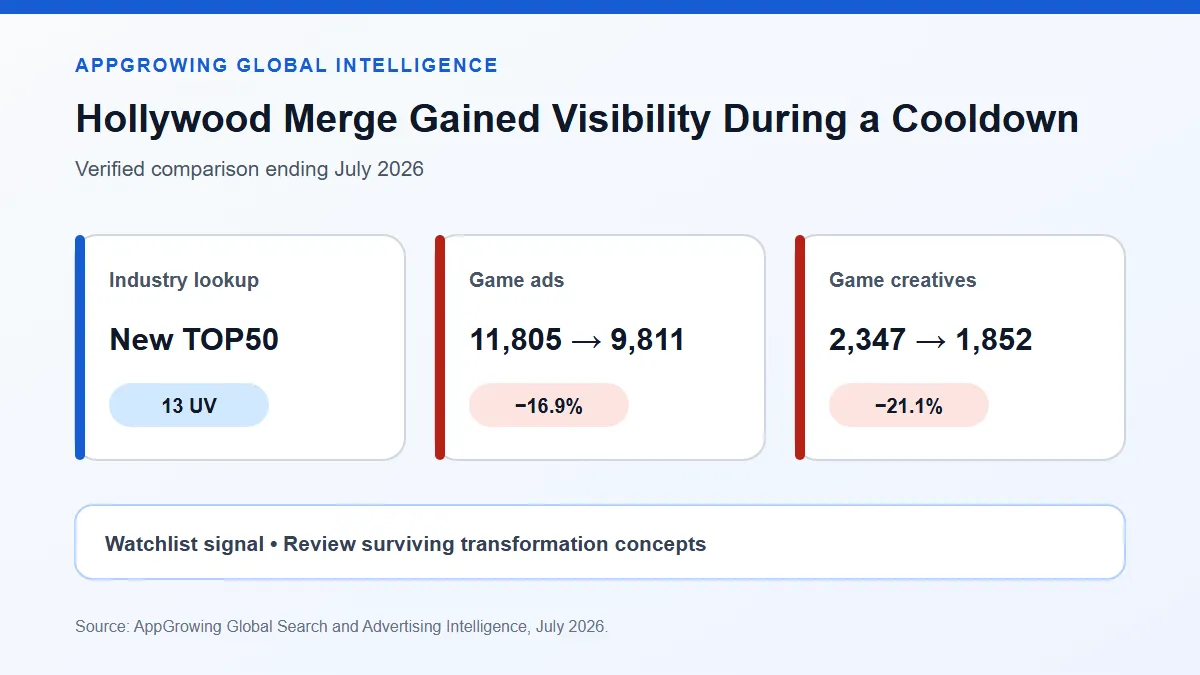
The chart helps a UA team avoid a common mistake. A new lookup signal can justify adding a title to the watchlist, but it cannot prove that the advertiser is scaling. The monthly trend tells the team to review survivors, retained messages, and delivery concentration rather than assume broad expansion.
This sequencing matters for production planning. Reviewing what survived the decline gives writers a cleaner evidence base than starting with every historical material or treating the newest search entry as a creative brief by itself.
Which Hollywood Merge materials survived the cooldown?
AppGrowing’s aggclaw review ranked five materials at 240,251, 179,927, 178,189, 96,897, and 96,237 impressions. Their openings covered nail repair, a hair-salon simulation, absurd vacuum-cleaner humor, dessert and class contrast, and a dense sequence of styling scenes. These are distinct hooks, but they share a transformation promise.
The nail material begins with a visible imperfection and immediate correction. The salon materials turn a service interaction into a makeover. The vacuum material uses a confusing physical gag before moving into body transformation, makeup, and a ballroom payoff. Another material links craving, fashion progression, and social contrast. The common thread is not a single prop. It is the movement from an unsatisfactory state to visible improvement.
Several of the reviewed materials then connect that opening to wardrobe selection, ranking, campus contrast, romance, or lifestyle scenes. This creates a risk for creative clarity. If the opening task and the later game proof do not feel related, the ad can become a montage rather than a coherent promise. Teams should record the exact transition point and ask whether the game action resolves the opening problem.
How should UA teams review retained transformation concepts?
Start with a survivor map. Group the remaining materials by opening task, not by costume or background. Useful groups include repair, salon service, absurd intervention, status contrast, and lifestyle progression. For every group, record the first problem, the first visible game action, the transformation result, and the CTA.
If a concept appears across several high-impression materials and still has multiple distinct proofs, retain it for closer review. If many variants share the same problem, operation, and payoff, treat them as one concept family rather than separate ideas. If a material promises transformation but never shows the operation that creates it, rewrite the proof segment before producing more variants.
What should the next monitoring cycle decide?
Use an if-then rule. If ads and creatives keep falling, focus on the messages that remain active and identify what the advertiser is preserving. If ads stabilize while creatives continue falling, inspect whether distribution is concentrating around fewer materials. If both measures recover and new opening tasks appear, treat that as renewed concept expansion.
Here’s a pattern I keep seeing. Merge ads often add more story scenes when the clearer need is a stronger bridge between the opening problem and the game action. Hollywood Merge should be monitored for that bridge. The current evidence supports a retained-structure review, not a conclusion about installs, CPI, or revenue.
