What must a puzzle ad prove when the sound is off?
A casual-puzzle ad does not need to show many levels first. It needs to make one solvable problem legible at a glance. The reviewed Block Blast videos placed the board in the opening, kept one or two near-complete gaps visible, and presented selectable pieces below it. The viewer could understand the current state, the available action, and the likely result without narration. That causal chain explains the product more clearly than an abstract claim about relaxation or challenge.
How did the 12 samples make the first move readable?
All 12 sampled videos showed a board within the first three seconds, and 11 showed a preview or piece-selection area. Eight completed the first piece-to-line-clear cycle in under three seconds. The highest cumulative-impression material showed 37,561,169 impressions, 224 active days, and 477 linked ads. Its structure was simple: a partly filled board, an obvious gap, one placement, and an immediate glowing clear. Those lifetime fields prioritize review; they do not establish current efficiency.
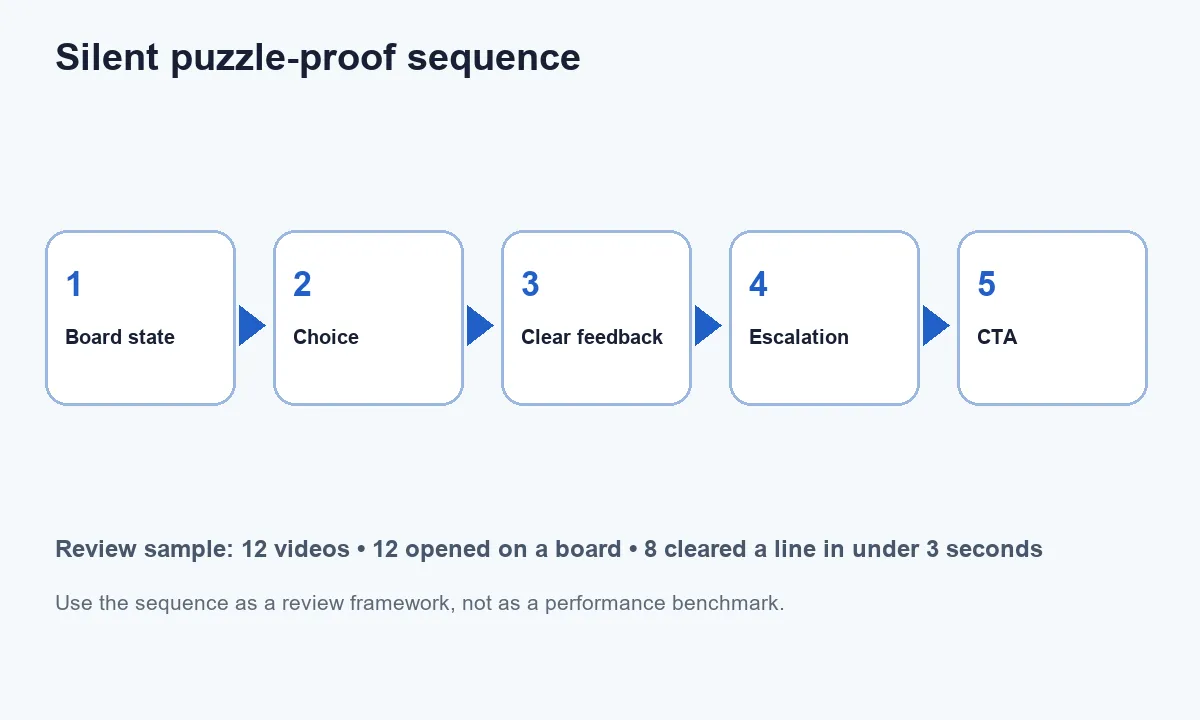
What is the five-beat path from board state to CTA?
The stable sequence is state, choice, feedback, escalation, and CTA. State makes the gap visible. Choice highlights a compatible shape. Feedback confirms causality through disappearance, glow, or a score increase. Escalation uses combos, timers, or multi-line clears to show depth. The CTA converts understanding into action. Seven of the 12 samples used a combo or cascade as the emotional peak, which kept the climax inside the puzzle rule instead of importing unrelated drama.
When can a visible board still be hard to understand?
An overfilled board hides the intended target, while an empty board removes pressure from the choice. Another failure occurs when the piece moves but the clear feedback is too subtle to explain why the score changed. Pause the first three seconds during review. If the team cannot point to the gap, the available piece, and the first result, the composition needs revision. Adding more subtitles will not repair a broken visual cause-and-effect chain for sound-off viewing.
How should creative teams design a controlled puzzle test?
Keep the same board state and vary only one factor. Version A can use an arrow to indicate the correct position. Version B can remove the hint. Version C can show a wrong placement followed by a correction. In a second test, hold the action constant and change only the reward expression: subtle disappearance, a strong flash, or a combo cascade. Keep the CTA and duration stable so the team can separate rule comprehension from reward intensity.
Which review output belongs in the creative brief?
Save the opening board frame, available piece, time to first clear, feedback type, escalation device, and CTA. Avoid labels such as “relaxing” or “satisfying” unless the brief identifies the action and response that create that feeling. When state, choice, and feedback form a coherent chain without sound, the ad has reusable gameplay proof. When they do not, the asset remains a polished screen recording rather than a clear product demonstration.
How should long and short cuts divide the work?
The sample included nine-second loops and screen recordings longer than a minute. Short loops are suited to rule and reward proof, so the first clear has to arrive quickly. Long cuts can show sustained rhythm, combo escalation, and spatial planning, but they still need to explain the rule in the opening three seconds. Duration is not a quality score. The useful question is whether each added segment introduces a new layer of puzzle proof or merely repeats another placement with no new information.
How should the end card close a sound-off sequence?
The end card does not need to teach the full rule again, but it should preserve the game name, a recognizable icon, and one clear action. If the entire demonstration relies on visual cause and effect, a dense wall of copy at the end breaks that rhythm. A stronger close continues the board colors or block language and uses a PLAY button, finger cue, or brand icon as the natural next step after the final clear.
Not sure whether your puzzle ad explains the first move clearly without sound?
Get a free benchmark check based on your specific app or game category.
How can a team decide whether feedback deserves another iteration?
The best feedback is not necessarily the loudest. It is the version that makes causality easiest to read. Compare the frames before and after the move. Did the piece fill the visible gap? Did the line clear immediately? Did the score change at the same moment? Did a combo visibly follow from the previous placement? When one link is delayed or ambiguous, viewers may read the effect as decoration instead of a response to their action. Preserve the clearest version as the control for later tests.