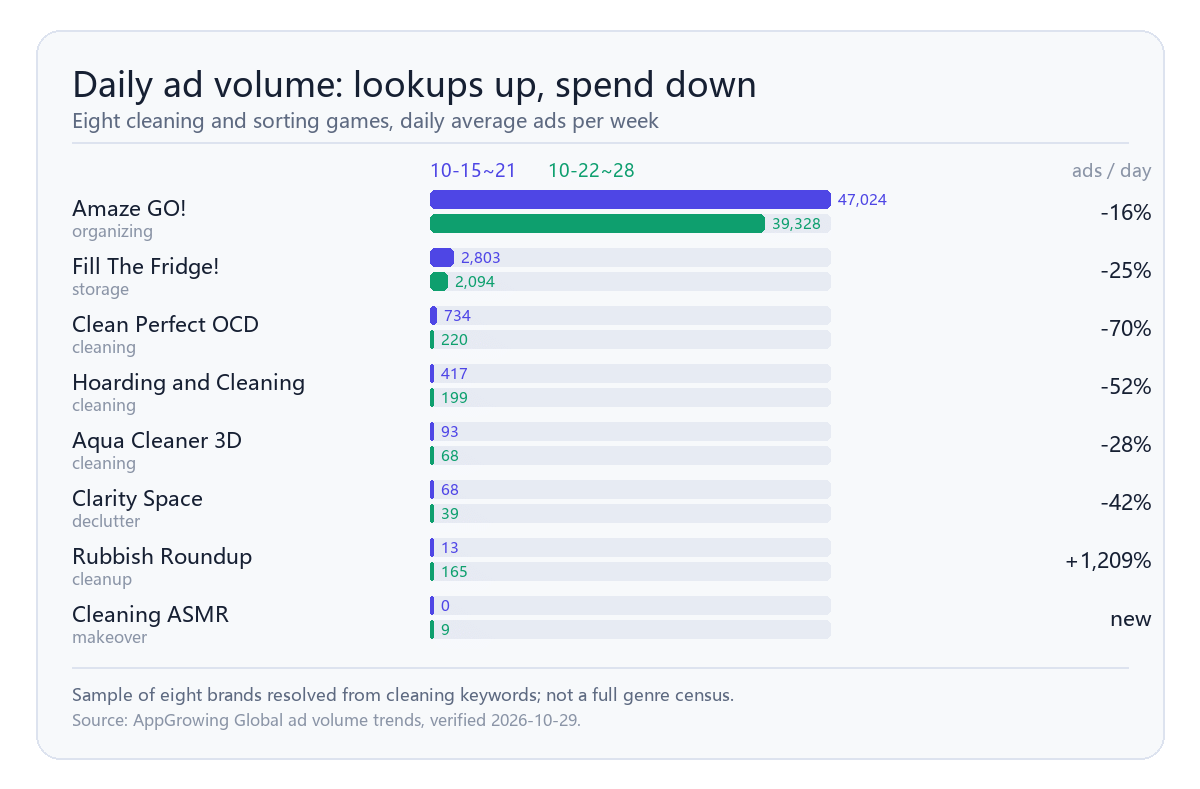
Cleaning keywords went from three entries in the ad-tool lookup list to ten in one week, with combined interest rising from 22 to 69. Across eight cleaning and sorting games tied to a brand ID, daily ad volume fell from 51,152 to 42,122 between the weeks of 2026-10-15 and 2026-10-28, an 18% drop: six advertisers cut spend, two increased. The conclusion is not that cleaning games are in demand. Attention moved into a genre whose supply is concentrated, and one title, Amaze GO!, carried 93% of the sampled volume.
Did cleaning game lookups and ad volume move together?
No, and the gap is the story. Lookups were the strongest single signal in this week's market attention data. Ad volume moved the other way. Clean Perfect OCD dropped from a daily average of 734 ads to 220, down 70%. Hoarding and Cleaning went from 417 to 199, down 52%. Clarity Space fell from 68 to 39, down 42%.
These are the products the keywords cleaner and clean actually resolve to. The searches and the spend are pointed at the same apps, and they moved in opposite directions. One reverse case stands out: Rubbish Roundup rose from 13 ads a day to 165, with new ads going from 3 to 55. That is a single product starting up, not a genre lifting off.
Which advertisers pulled back and which one scaled?
Six of eight cut. The reductions run from 16% at Amaze GO! to 70% at Clean Perfect OCD, and the largest cut belongs to the product that had been running the most deliberate mid-scale operation in the sample, not to a dormant title. On the other side, only Rubbish Roundup reached a meaningful level. Cleaning ASMR Makeover moved from zero ads a day to nine, which is still pre-scale.
Read as a group, this is not a genre being bought up. It is a genre where most advertisers are trimming while attention arrives.
Why does one title hold 93% of the genre's ad volume?
Amaze GO! ran 39,328 ads a day in the latest week against a sample total of 42,122, which is 93% of the group. The second-largest advertiser, Fill The Fridge!, ran 2,094 a day, roughly 5% of Amaze GO!. Two things follow. First, the group's direction is set by one company; the other seven cannot move the aggregate enough to change it. Second, lookup attention arriving in the genre does not spread evenly, so a keyword getting busier does not mean every product in it gets a bigger opening.
For anyone considering entry, the competitive question changes shape. You are not competing with a genre average near 5,000 ads a day. You are competing with one operator running close to 40,000, and six others who are currently cutting.
How should a UA team turn this into a monitoring task?
Three steps. First, treat the keywords as a watchlist, not as demand evidence: before adding anything, confirm each keyword resolves to a single brand ID, and set aside the ones that do not. Second, once a product is on the list, pull only daily ad count and daily new-ad count, and read direction rather than absolute size. Third, judge entry timing on concentration, not on heat: in a genre where one title holds nine tenths of the volume, a new entrant is measuring itself against that title's production capacity, not against the group mean.
Two things to avoid. Do not write a rising lookup count as rising demand; the lookups describe what marketers are checking, not what players are installing. And do not let a group total hide the single name inside it, because one of the six advertisers that cut did so by 70%.
When does this signal mislead?
When the keyword is a category word rather than a product name, lookup interest and any single advertiser's spend will not line up. cleaner resolved to six different products in this sample, which makes it useful for reading where competitors are looking and useless for judging whether any one of them is scaling. Use the cleaning cluster to decide what to monitor. This is an advertising activity signal, not a campaign performance result.
Want your genre's ad volume benchmarked?
Get a free benchmark check based on your specific app or game category.