Casual and simulation games moved in opposite advertising cycles during the same verified 31-day comparison. Casual ads and creatives both grew, while simulation ads and creatives both fell. The result supports separate monitoring workflows: expansion scanning for casual and retention-and-exit review for simulation.
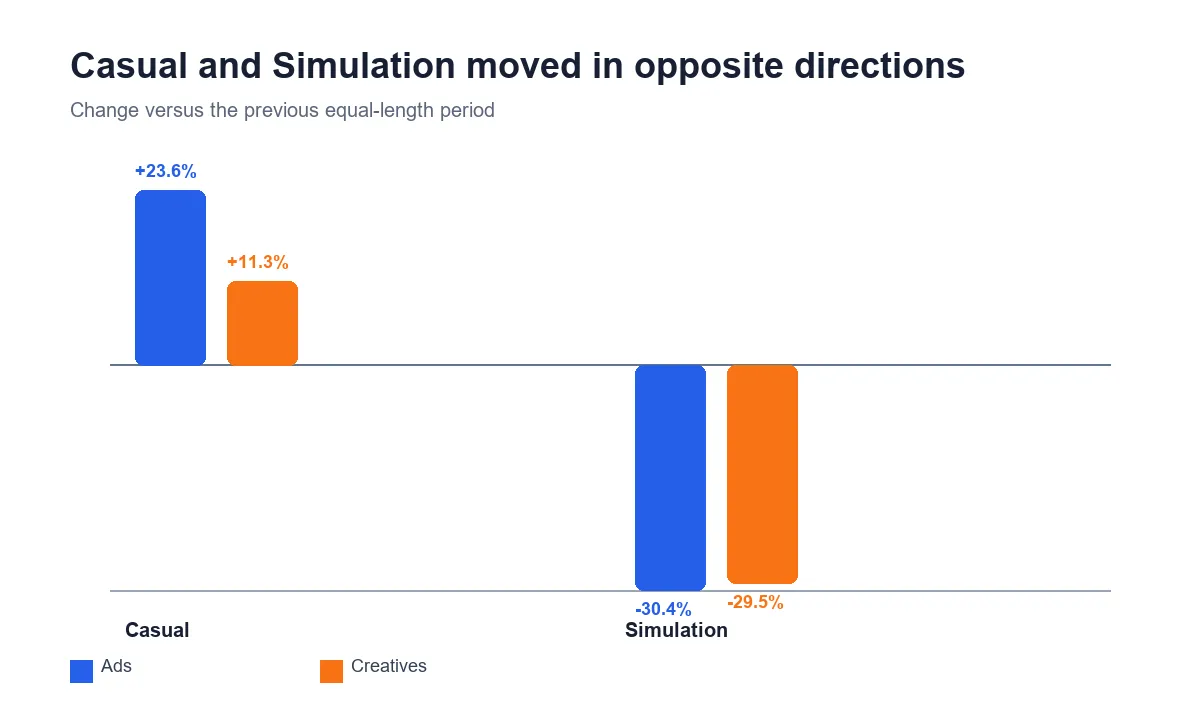
How far did the two category cycles diverge?
Casual and simulation games moved in opposite directions during the same 31-day comparison. Casual ad records increased from 2,298,487 to 2,840,097, up 23.6 percent, while creatives increased from 346,502 to 385,764, up 11.3 percent. Simulation ad records fell from 919,622 to 640,398, down 30.4 percent, while creatives fell from 269,101 to 189,663, down 29.5 percent. One category expanded on both measures while the other contracted on both.
This benchmark supports resource grouping, not a spend or performance conclusion. Casual needs expansion monitoring that can identify new templates and growing families. Simulation needs a cooling review that preserves durable proof units and records which variants disappear. Equal windows and aligned fields make the direction comparable, but they do not explain the cause.
The comparison uses the same start and end dates and the same trend fields for both categories. That makes direction and percentage change comparable. It does not make the category totals equivalent to spend, reach or market share, and it does not explain whether seasonality, releases or platform changes caused the movement.
How does each category prove gameplay?
The aggclaw material library matched 593,258 casual materials and 363,479 simulation materials in the window. The semantic comparison used the top 100 by cumulative impressions for each category. Casual samples prove one micro-action through finger taps, shelf sorting, number matching, collection and countdown rewards. Simulation samples prove a system through production chains, upgrade trees, sandbox exploration, equipment screens and boss progression.
The opening logic therefore differs. Casual aims for instant comprehension and per-tap satisfaction. Simulation establishes a world state, growth objective or earnings curve. A single first-three-second checklist would hide this difference. The review sheet should label a casual proof unit as a completed gesture and a simulation proof unit as a connected growth loop.
The material library is a second evidence layer with its own category namespace. Casual and simulation are aligned by verified category names, not by reusing webhook IDs. Counts from the two systems are therefore reported in their own contexts. This prevents an identifier mismatch from becoming a false quantitative comparison.
Need a verified benchmark for this category or competitor?
Ask for a free review using your own app, category and monitoring question.
What deserves attention in expansion and cooling phases?
During casual expansion, monitor the arrival rate of new life scenes, micro-task templates, instant-feedback devices and short voiceover prompts. Also check whether linked-ad counts expand around the same creative rather than assuming every increase comes from new concepts. Long-running casual samples show that evergreen templates can coexist with current expansion.
During simulation cooling, preserve system-proof anchors, developer or recommendation voiceover, production-and-upgrade chains and the core asset of each long-lived family. Simulation creative be99f had 1,896 active days, while 59301 had 1,877. These cumulative-exposure leaders define family memory; their impressions are not new exposure generated in the current window.
Expansion scanning should measure breadth at the level of proof units. For casual, useful fields include gesture, object, completion feedback, reward and CTA. Cooling review for simulation should capture the world state, production or upgrade chain, long-term objective and payoff. The two schemas reflect different comprehension burdens.
How should teams build a cross-category review matrix?
Use ad change as the horizontal axis and creative change as the vertical axis. A category in the dual-growth quadrant enters expansion scanning. A category in the dual-decline quadrant enters retention and exit review. Add a proof-unit field to the matrix. Record the single gesture for casual and the system chain for simulation.
Then assign different actions. For casual, sample new scene breadth and identify which micro-task families gain reuse. For simulation, preserve durable narrative and upgrade proof while tracking which peripheral edits disappear. This prevents template breadth and system depth from being treated as the same type of creative output.
Re-run the matrix on an equal schedule and retain the previous labels. A move from dual growth to mixed direction calls for a concentration review. Continued dual decline calls for a survivor-and-exit review. Only after content families are compared should teams decide where more manual creative research is justified. Store the sample rule, direct fields and semantic notes together so future comparisons use the same unit of analysis.
