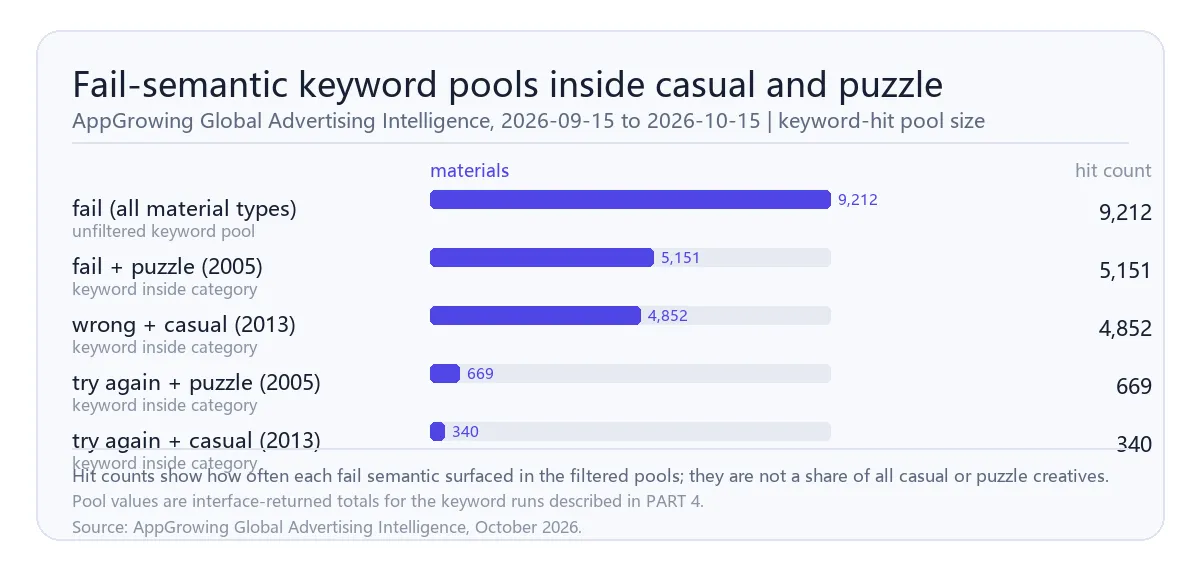
To use a fail opening safely, show the wrong input, show the game's own reaction to it, and show the same mechanic working before the download ask. In an AppGrowing Global sample of casual and puzzle creatives from 2026-09-15 to 2026-10-15, the largest fail-opening row reaches 100,653,474 cumulative impressions across 1,236 active days, while its returned visual description is empty, which is exactly why the three-question check matters more than the exposure number.
Why does a fail opening hold attention?
Because it turns watching into a bet the viewer can win. One sampled creative narrates its own repeated failure in plain language, stating that it failed again for the third time and adding a self-deprecating jab. The failure is visible, so the correction urge is what keeps the viewer in the ad; whether the failure is authentic has no bearing on that pull.
Where is the line between a fail hook and a misleading demo?
The line is three checkable questions: does the asset show the input that was wrong, does it show the game's own reaction, and does it show the same mechanic working at the end? When all three are present, failure is just a narrative device. When any one is missing while a download CTA is present, the creative should be treated as high misleading-demo risk. The test is deliberately about what the ad shows rather than about how hard the game is, because difficulty claims are cheap to assert and expensive to demonstrate.
Which fail patterns carry the highest risk?
Three patterns stand out in the sample. First, asserted statistics: one row claims that most players fail at the first step while the demonstrated puzzle is visibly simple, so the claimed failure rate and the shown difficulty contradict each other. Second, deliberate incompetence that contradicts the shown rules: the grid and the countdown are clearly readable, yet the operator repeats mistakes a real player would not make, which is the classic artificial-stuck pattern. Third, a fail loop with no resolution at all: the transcript stops at a promise to try the sister's method and no success beat is returned, so a retry promise is never cashed. Each pattern fails the same underlying test in a different way: the viewer never sees the game respond to a competent attempt.
What does a defensible fail opening look like?
Three uses hold up. The first runs fail, then correction, then a completed level inside the same mechanic and the same interface. The second shows a visible error marker tied to an actual game response rather than a superimposed stamp. The third puts the failure immediately next to gameplay of the same object being punished. In all three the failed mechanic and the closing mechanic are identical, which is what makes the promise verifiable, and in all three the correction happens on screen rather than in the voiceover.
What should a team check before launching a fail opener?
Run the three questions first: wrong input, game reaction, same mechanic working. Then check return completeness, because a missing field is not evidence of absence: in this sample the advertised slogan is empty on all ten rows and the transcript is truncated on four of them, so CTA wording cannot be verified from the data alone and has to be confirmed in the asset itself. Then separate the two things the opening is doing at once, which are holding attention through frustration and making a claim about difficulty, and confirm the second one is actually demonstrated.
How should a fail opener be rewritten when it crosses the line?
Two changes are enough in most cases: add a two to four second correct-operation beat before the download ask, and keep the failed mechanic identical to the closing mechanic so the viewer can map one onto the other. Where the opening relies on an asserted failure statistic, drop the statistic and let the shown difficulty carry the claim instead. Where the failure loop never resolves, cut the loop rather than lengthening it, because an unresolved retry promise is the part that reads as a broken demo.
Not sure whether your fail-opening creative still proves the gameplay it promises?
Get a free benchmark check based on your specific app or game category.
A fail opening is a promise about difficulty. The viewer accepts it because the correction looks reachable, so the only question a reviewer needs to answer is whether the ad eventually shows that correction happening inside the same game the download leads to, and whether the ad is honest about how hard the level actually is.
