DramaBox and ReelShort are not two versions of one playbook. Over the 30 days to October 21, 2026, 84.1% of DramaBox creatives ran longer than 61 seconds — full-episode uploads — while ReelShort built a ladder from 15–60 second cutdowns up to compilations. Their pools moved in opposite directions too: DramaBox held roughly flat (down 3.3% once the final monitoring day is excluded), while ReelShort's active pool fell 24.1% even as new-material flow rose 4.8%. One brand is recycling a stable library; the other is rotating faster.
Are the two creative pools expanding or shrinking?
DramaBox averaged 35,990 active creatives in the first seven days and 32,898 in the last seven — an 8.6% drop that mostly reflects end-of-window monitoring lag; excluding the final day it is −3.3%, effectively flat. New materials went from 2,056 to 1,935 per day, or −0.7% excluding the last day.
ReelShort's contraction is real: 32,952 to 23,885 daily active (−24.1% excluding the last day), while daily new materials rose from 3,831 to 3,639 (+4.8% on the same basis). A smaller pool with faster intake means shorter creative half-life.
Why is this a product difference rather than a style difference?
The duration structure settles it: of DramaBox's 83,787 creatives with a recorded length, 70,453 run past 61 seconds — 84.1%. ReelShort holds at least 4,826 creatives across the three buckets under 60 seconds.
That is not a preference for long or short. It is one production line that uploads episodes and another that slices them: a 15-second hook, a one-to-five-minute cut, a 20-to-35-minute compilation.
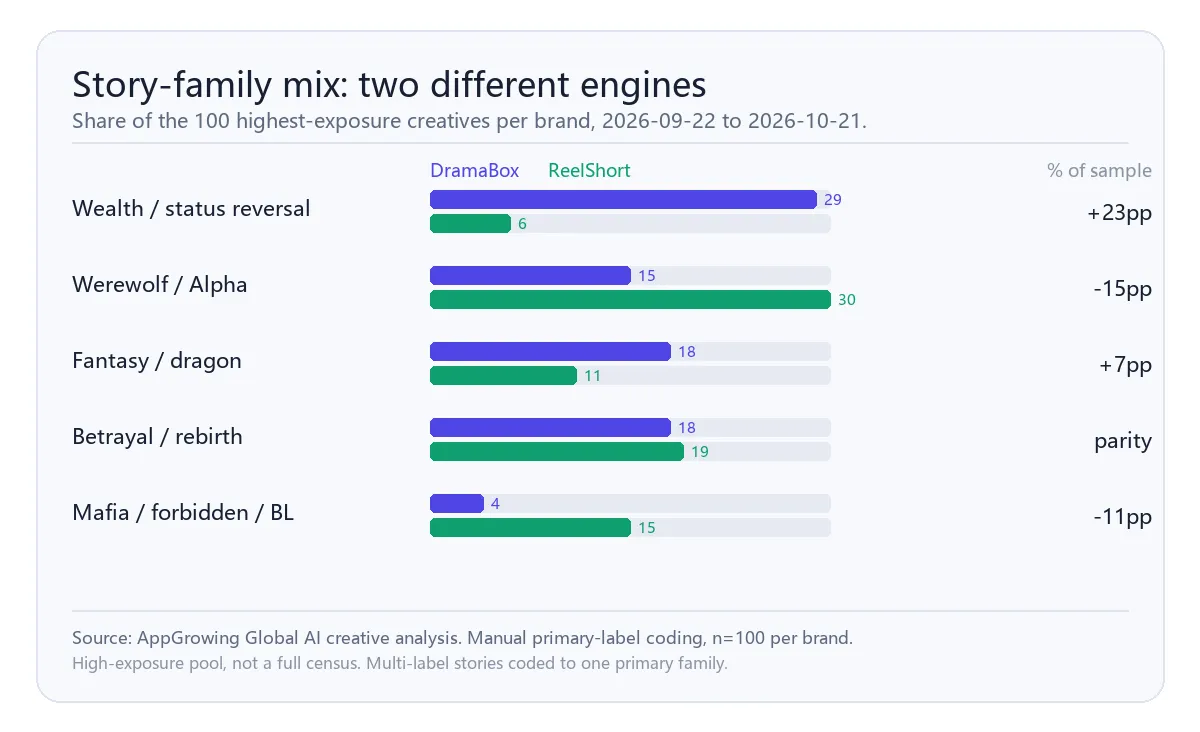
Where do the story families diverge?
Classifying the 100 highest-exposure creatives per brand by primary story family: wealth and status reversal is 29% of DramaBox against 6% of ReelShort; werewolf and Alpha runs 30% for ReelShort against 15%; mafia, forbidden and BL is 15% against 4%. Betrayal and rebirth melodrama sits at parity, 18% versus 19%.
Put simply, DramaBox sells status reversal and ReelShort sells relational taboo — two different emotional engines inside the same category.
Do the openings differ, and where does copy take over?
"Previously on" openings are not a differentiator: both sit between 27% and 29%. The gap is in ad copy — 42% of DramaBox creatives carry a plot synopsis of 40 words or more, against 34% for ReelShort.
That tracks the duration structure. A full-episode upload needs long copy to hold a reader; a cutdown advances on picture alone, so the copy can stay short.
How does each brand handle localisation and paywalls?
DramaBox localises by dubbing per campaign: seven to eight dub language tags across at least 14 titles. ReelShort relies mainly on subtitle overlays on masters that are mostly dialogue-free or English, with only three to four titles explicitly dubbed.
Neither brand uses numeric paywall prompts. "Unlock episode 12" or "first five episodes free" appear zero times in 100 creatives each; the ask is either an implicit "Watch full episodes" or a time-boxed "LIMITED-TIME FREE".
How should a UA team use this comparison?
Three rules. First, if a competitor's active pool falls more than 20% in 30 days while new-material flow still rises, creative half-life is shortening — move monitoring from monthly to weekly. Second, if more than 80% of their creatives run past 61 seconds, your 15-second cutdown is a different funnel layer, not a substitute; do not compare them as the same asset. Third, read category share rather than single hits: a 29% versus 6% split is a positioning difference, and it survives the next viral title.
What not to do: do not read the material counts as "who is spending harder" — a full-episode library and a cutdown ladder are not comparable units; do not infer conversion from synopsis length; and do not treat the number of dub languages as the number of markets.
Want your short-drama creative mix benchmarked?
Get a free benchmark check based on your specific app or game category.
