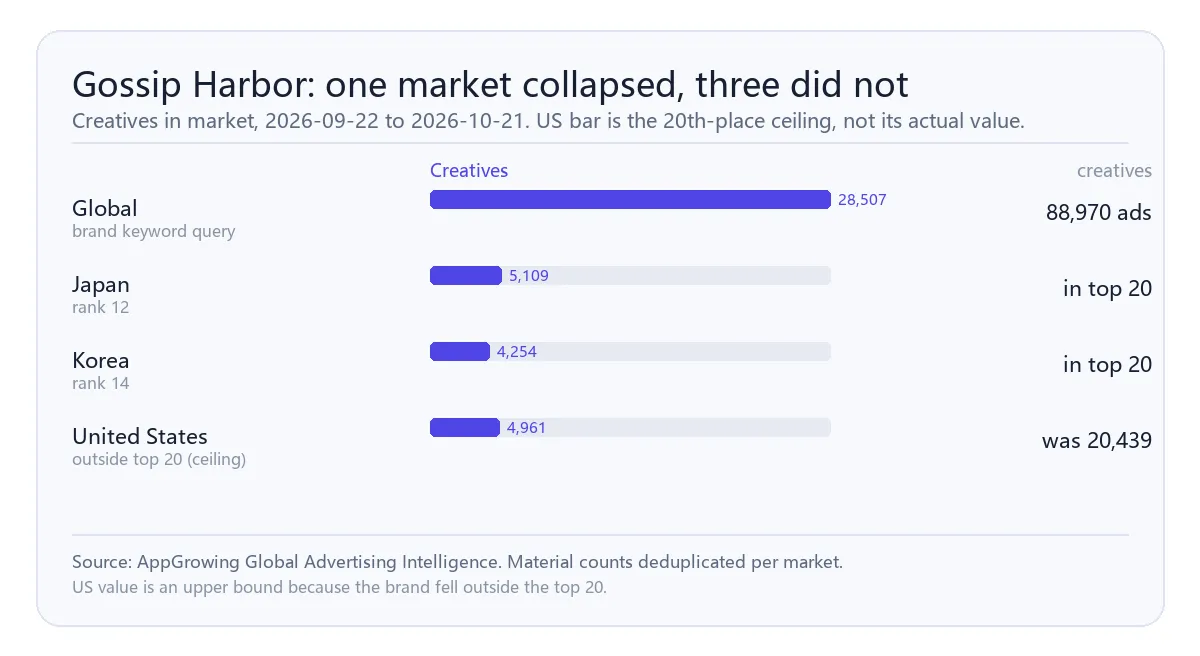
Gossip Harbor was third on the US creative ranking last month with 20,439 creatives. This month it is outside the top 20 entirely, and the 20th-place threshold was 4,961 — so its US pool fell by at least 75.7%. In the same window it still ranks 12th in Japan (5,109) and 14th in Korea (4,254), and its global footprint is 28,507 creatives and 88,970 ads. One market collapsed while the global base held.
How much does falling out of the top 20 actually mean?
The ranking only returns 20 rows, so the only defensible statement is an upper bound: US creatives are below 4,961. Against a prior 20,439 that is a decline of at least 75.7%, and possibly more.
One detail makes the drop harder to dismiss: the threshold itself fell this month, from 6,285 to 4,961. The US market cooled, and Gossip Harbor still fell below a lower bar — it shrank faster than the market.
Gossip Harbor creatives by market
Why is this easy to misread as a global retreat?
Because the global number still looks healthy: 28,507 creatives, 88,970 ads, an ads-per-creative ratio of 3.1. Read alone, that suggests a product running normally.
Split by market and the picture changes. Japan at 5,109 and Korea at 4,254 are each about a quarter of the old US figure, and the US itself is now under 4,961. The global total is being carried by markets other than the one that collapsed.
What does a 3.1 ads-per-creative ratio tell you?
That this library is replicated lightly: roughly three ad instances per creative. Compare Rotate Rings at 16.6 or Meowdoku at 12.5 in the same window. Gossip Harbor runs a broad library with low per-asset intensity.
That structure is more fragile under contraction. When budget tightens, the number of live creatives falls first, because each asset was never carrying much distribution on its own. A title running a 16x ratio has to cut almost a thousand creatives before its ad footprint moves as much.
Which three checks separate "retreat" from "market shift"?
First, check the direction of the threshold — did 20th place rise or fall? Second, pull the same product's numbers per market to see whether the drop is one market or all of them. Third, reconcile against a global figure so a single-market ranking drop is not read as a shutdown.
The first check is the one teams skip, and it is the one that separates a market-wide cooldown from a title-specific pullback.
What does this imply for monitoring cadence?
Single-market rankings work as a weekly alert; global totals work as a monthly review. Neither replaces the other. A case like Gossip Harbor — global intact, one market gone — only shows up when both layers sit side by side.
There is a practical consequence for anyone briefing a team. "Gossip Harbor is pulling back" is wrong; "Gossip Harbor is pulling back in the US" is defensible. The second sentence points at a market-level decision you can respond to — a US creative gap, a competitor moving in — while the first invites a conclusion the data cannot carry.
What not to do: do not turn "outside the top 20" into "stopped advertising"; do not treat the global creative count as the sum of markets; and do not infer a global position from one market's rank.
Want a market-level alert for your category?
Get a free benchmark check based on your specific app or game category.
