Doomsday crossover ads work best when IP spectacle leads into visible troop, base, resource, or cooperative-play proof before the CTA.
Why is IP spectacle alone not enough for an SLG ad?
The easiest mistake in an IP crossover is treating the character reveal as the complete proposition. A familiar hero, cute companion, or oversized monster can stop the scroll, but it does not explain what the viewer will do next. For a 4X or SLG ad, the decisive question is whether the creative turns that attention into visible evidence of bases, resources, troop groups, formation choices, progression, or cooperative combat. Without that bridge, the viewer remembers the collaboration but may not understand the product.
What did the 12 sampled creatives actually show?
The review covered 12 videos: five higher-cumulative-impression spectacle creatives and seven explicit The Seven Deadly Sins crossover creatives. The first group placed dragons, giants, or monster waves in the opening and then moved into base construction and troop conflict. The crossover group more often opened in taverns, food scenes, gift-code frames, or character pairings before introducing an apocalyptic threat. The highest cumulative-impression record showed 13,863,971 impressions, but that lifetime field does not measure performance during the selected month.
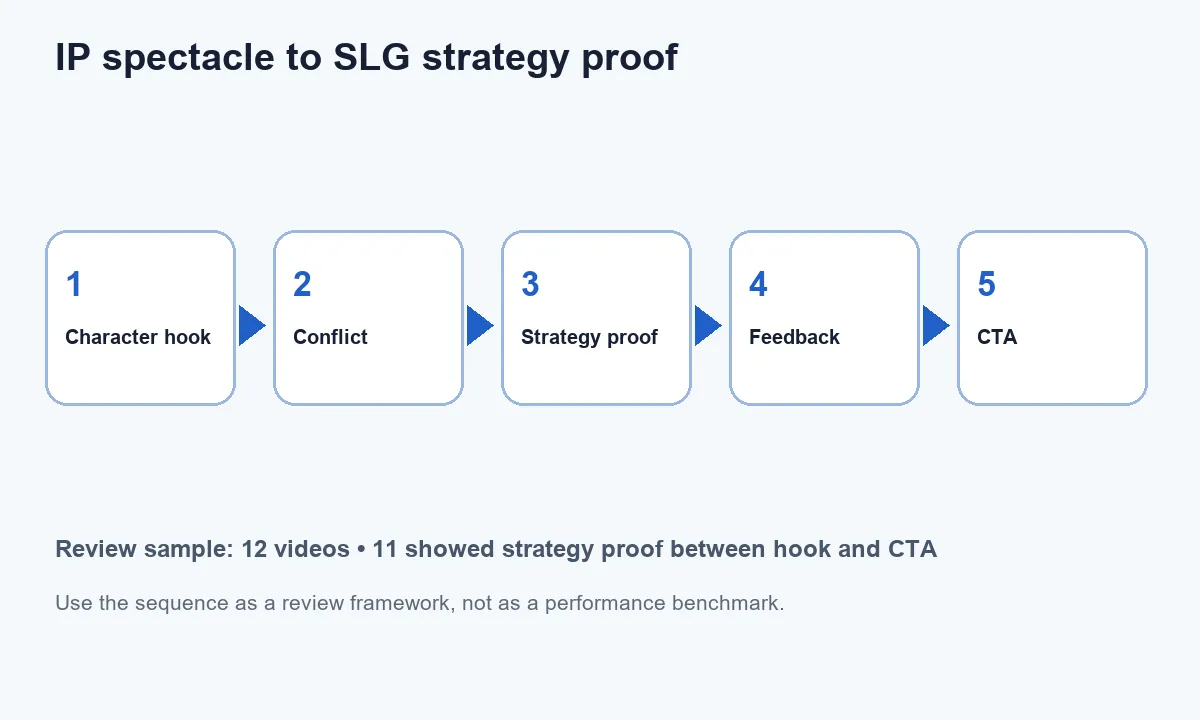
How does the five-step bridge keep strategy legible?
The reusable sequence is character hook, external conflict, strategy proof, result feedback, and CTA. The character earns attention. Conflict places that character inside a problem that requires action. Strategy proof shows how the player responds through troops, buildings, resources, team play, or progression. Feedback makes the action visible through damage, rewards, or upgrades. The CTA then joins the collaboration reward to the download action. Eleven of the 12 reviewed videos placed some form of strategy proof between the opening and the close.
When should an IP scene be classified as decoration?
Treat the IP layer as decorative when the character appearance leads directly to a gift code or download card without observable game-system evidence. A second test is causal continuity: can the conflict introduced by the IP scene be solved by the system shown next? If the hero only poses while the body of the ad switches to unrelated footage, the creative should not enter the strategy-reference library. If the hero's threat leads into a base, formation, resource, or team decision, the bridge is doing useful product work.
How should UA teams build the crossover review sheet?
Use one row per material ID and capture the character hook, conflict object, first strategy-proof frame, result feedback, CTA, cumulative impressions, active days, and linked-ad count. Keep the primary label structural, such as spectacle-to-base, character-to-team-play, or gift-code-to-progression. Character names, settings, and art styles can remain secondary tags. This makes it possible to distinguish a new bridge from an old bridge with new art, while keeping cumulative fields separate from efficiency claims.
What should creative teams test next?
Hold the same character and CTA constant, then vary when the strategy proof appears. Version A can reveal troops or a base within five seconds. Version B can complete the character conflict first. Version C can retain only the IP spectacle as a control. The useful question is not which edit has the largest lifetime impression total. It is which edit forms the clearest causal chain from character, to danger, to player action, to consequence. That version deserves the next production iteration.
Which evidence should never be confused with performance?
Cumulative impressions, active days, and linked-ad counts can help a team order its review queue, but they cannot answer whether the crossover improved installs, payer conversion, or retention. A gift code, prominent character reveal, or high reuse count also does not prove that fans converted. Keep direct fields, semantic observations, and unavailable performance metrics in separate columns. In the article and the brief, use descriptive numbers only to explain the sample and prioritize inspection.
How should the taxonomy stay current?
A crossover taxonomy is a living monitoring tool, not a one-time conclusion. When new materials arrive each week, first try to place them inside an existing bridge family. Create a new family only when at least two structural elements change: the character promise, the conflict mechanism, or the strategy-proof device. A different character, setting, language, or gift code should remain an execution variant when the underlying bridge is unchanged. That rule keeps the watchlist focused on creative structure instead of raw volume.
Not sure whether your SLG crossover creative connects IP characters to visible strategy systems?
Get a free benchmark check based on your specific app or game category.
How should the bridge become a production handoff?
Deliver a shot-level template rather than a note that says “show more gameplay.” State when the character enters, when the conflict escalates, which frame supplies the first strategy evidence, how the result responds, and whether the CTA continues the same promise. The production team can then vary one junction at a time. That makes the next review capable of separating character packaging from the quality of the gameplay bridge.
