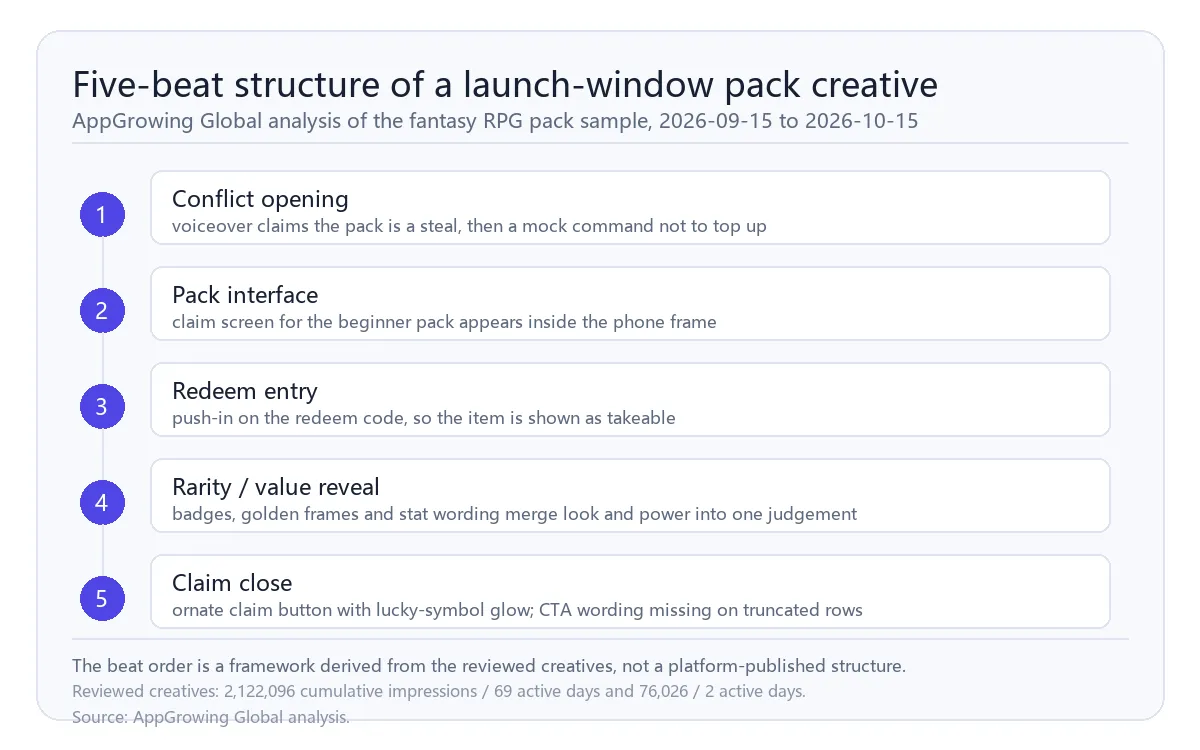
To brief a launch-window pack creative, fix five beats in order: a conflict opening, the pack interface, a redeem entry, a rarity or value reveal, and a claim button close. In an AppGrowing Global sample of fantasy RPG pack creatives from 2026-09-15 to 2026-10-15, one reviewed creative holds 2,122,096 cumulative impressions across 69 active days and 7 linked ad creatives, while a variant of the same script sits at 76,026 impressions after 2 active days, which is why the beats matter more than any single number.
Why does a launch-window pack open with conflict?
Because a bundle is not a story on its own. One sampled creative puts a CG character in a book-strewn study and has the voiceover claim the starter pack is an absolute steal, then pivots into a mock command not to touch the top-up button. The conflict turns whether the pack is worth it into a question the viewer has to settle immediately, and it does that before any item is shown.
How is the pack presented on screen?
The mid-section usually shows the pack interface directly, for example a claim screen for a beginner pack, then pushes in on a redeem-code close-up, and finally lands on a claim button framed with ornate borders and a glow around a lucky symbol. Splitting the reveal from the claim means the viewer sees that the item exists and that taking it is a concrete action, rather than one blurred promise. The sequence also gives the editor two natural cut points, which is why it survives localisation with the voiceover swapped and the interface left untouched.
What changes when the item is cosmetic rather than functional?
The sample merges the two into a single decision point instead of treating them as separate arguments. An outfit is described as boosting stats, and rarity is signalled with badges and golden frames, so the viewer makes one judgement rather than one about looks and another about power. In launch windows the same logic is often tied to pre-registration, where an exclusive outfit is gated behind the reservation action and the time pressure does the persuading. The emotional arc is consistent across the reviewed rows: curiosity or mock frustration at the hook, a collectible and rarity thrill in the middle, then urgency with a low entry anchor at the close.
Which format do launch-window pack creatives use?
Vertical video dominates wing and equipment reveals in this sample, at 5 of the 10 reviewed rows, while horizontal video carries the scripted narrative packs. Image creatives appear as long-running pack banners with extended active days, which suggests they support continuous visibility rather than the opening narrative of a launch. For a launch window that means two parallel tracks rather than one: a vertical reveal track for feed placements and a narrative track for packs that need explanation.
What should teams monitor during the launch window itself?
Because impressions and active days are lifetime values, a launch-window review has to look at tenure rather than exposure alone. One reviewed row has been running 69 days while a script variant sits at 2 active days, and both are the same idea, which is how a launch push looks when it is layered on top of an existing asset rather than replacing it. Reading the two as a single performance story would mix a fresh push with an established banner, so keep them on separate rows and compare each against its own earlier state.
What should teams check before briefing a pack creative?
First, check attribution: creatives returned from a category-level search do not carry a product or developer field, so they cannot be assigned to a named game in reporting, and only one row in this sample was confirmed through an app-identifier lock. Second, check caliber: cumulative impressions and active days are lifetime values, so a two-day asset and a sixty-nine-day asset should not sit in the same launch-window comparison. Third, check completeness: some closing descriptions are truncated, so CTA wording cannot be verified from the data alone.
Not sure how to structure a starter-pack creative for your launch window?
Get a free benchmark check based on your specific app or game category.
A pack creative is judged on whether the claim feels reachable within the window it is running in. Fixing the five beats gives the studio a structure it can localise, re-shoot and measure by beat rather than by whole commercial, and it keeps the fresh launch push separable from the banner that was already running before it.
