Of 3.47 million mobile game video creatives with a duration tag in the 30 days to October 21, 2026, 2.98 million — 85.9% — carry no detected speech at all. Silent is not a variant of game video creative; it is the default form. It is also markedly shorter: 55.7% of silent creatives run under 30 seconds against 38.0% of voiced ones, and the ≤15-second band is 2.38 times more common. The long tail reverses: creatives above 60 seconds make up 12.5% of the voiced set and only 6.6% of the silent one, because long-form storytelling still needs a narrator.
How large is the silent share really?
2,981,010 against 489,052 is a ratio of 6.1 to 1. If your team treats a voiceover as the default and silent as the variant, the default is backwards.
One caveat on the definition: "silent" here means ASR detected no speech, not that the creative has no audio. Roughly one in ten sampled "silent" records did contain lines, so the true share may sit slightly below 85.9%.
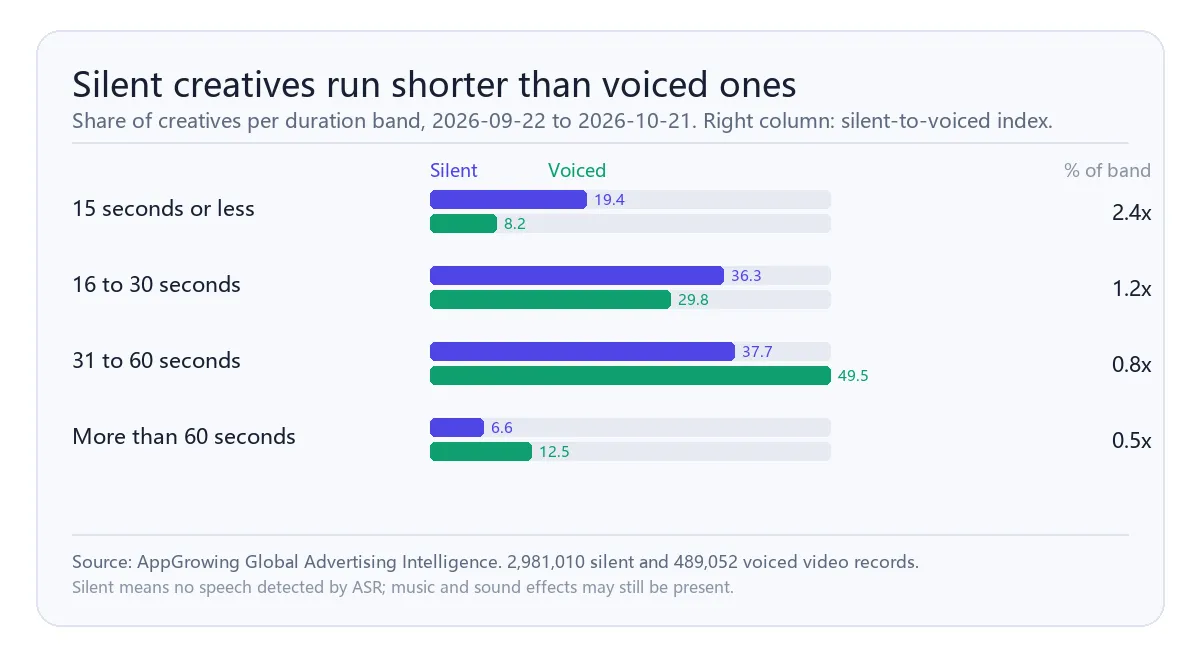
Where do the duration distributions diverge?
Four bands tell the story: ≤15s 19.4% versus 8.2%; 16–30s 36.3% versus 29.8%; 31–60s 37.7% versus 49.5%; above 60s 6.6% versus 12.5%.
The silent distribution is flatter, with its mass between 16 and 60 seconds; the voiced distribution stacks into 31–60. The difference is not length for its own sake but why the creative is long: a narrated long ad tells a story, a silent long ad demonstrates a system.
What carries the message with no narrator?
In the small readable sample, 50% of creatives had a music track only and 40% returned an empty audio field. Visually, three carriers do the work: in-game UI state, on-screen text cards, and immediate failure or reward feedback.
UI is the one teams under-use. A narrator can explain a rule; UI can only show it, which forces the key state into frame. That constraint is why silent creatives tend to look more like a live demo than an ad.
What happens at the end?
Of four creatives with a readable ending, three explicitly carried no download or try button. That is an observed gap, not a conversion finding — but it is consistent with the silent logic: do the watching well, hand the next step to the ad frame.
If your goal is in-feed conversion, that gap is the differentiator. If your goal is installs, the final frame still needs an explicit action.
Note the asymmetry with the duration data. Silent creatives are shorter on average, yet the band that grew most against voiced is ≤15 seconds, where a complete loop has to fit in one gesture and one result. That is the band where an ending is most likely to be dropped entirely, and where a single clear action is worth more than another three seconds of gameplay.
What spec should a silent demo follow?
Three bands. Under 15 seconds: one hook, one mechanic, built for volume. Sixteen to thirty seconds: the default spec, one complete failure–action–result loop. Thirty-one to sixty seconds: explain a system or a comparison, and let UI and text cards carry the information.
What not to do: do not argue that silent creatives live longer — the two longevity indicators in this pull point in opposite directions, so the claim does not hold; and do not equate silent with muted, because music and sound effects remain a primary information layer.
Want a duration benchmark for your genre?
Get a free benchmark check based on your specific app or game category.
