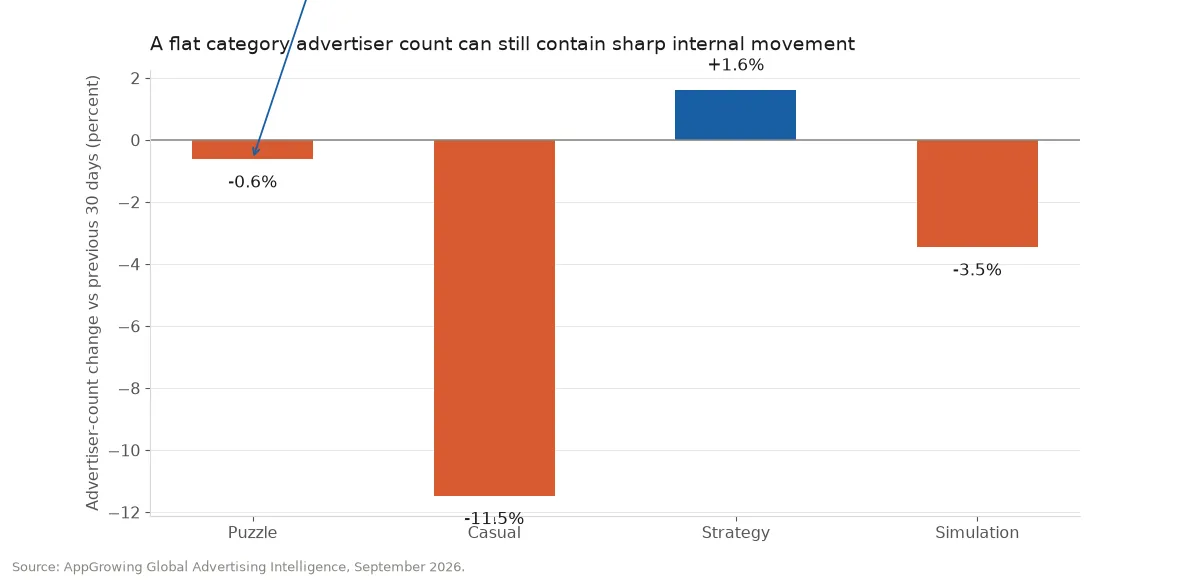
Build the watchlist from two equal-length windows, not one snapshot. In the 30 days to 2026-09-29 the Puzzle category advertiser count moved only -0.6 percent, from 7,606 to 7,559, while Block Blast! inside it raised creative records 42.8 percent to 55,786. A flat category total can hide sharp internal movement, so track per-entity deltas.
Why can a flat category count still hide sharp movement?
Across the four game categories queried, advertiser-count change ran: Puzzle -0.6 percent, Casual -11.5 percent, Strategy +1.6 percent and Simulation -3.5 percent. Puzzle is effectively flat. Reading that single line invites the conclusion that nothing moved in the category.
Look inside Puzzle and the picture changes. Block Blast! raised creative records from 39,054 to 55,786 in the same window, up 42.8 percent. Gossip Harbor rose from 37,602 to 42,889, up 14.1 percent. The category total held still while its leaders moved sharply.
A second figure points the same way. Total game brand entries fell from 48,132 to 46,138 (-4.1%), yet 26 entities entered the top 100 creative ranking and 26 dropped out, with 74 present in both windows. Turnover at the top is far larger than the change in the total. Together these two facts mean the watchlist has to be built per entity and over two windows.
Which fields should a creative watchlist carry?
Field design exists to make different people record the same thing at different times. Every field below is either returned directly by this query or recomputable from two returned values.
| Field | Definition | What it decides |
|---|---|---|
| Entity name and developer | Resolved brand entity, including developer name | Prevents same-name entities being merged |
| Creative records (current / previous) | Creative record count under one filter set; windows must be equal length | Whether the creative side expanded or contracted |
| Ad records (current / previous) | Ad record count under the same filter set | Direction of the delivery side |
| Change percentage | (current − previous) ÷ previous × 100% | Change magnitude, recomputable from source values |
| Quadrant | Creative direction × ad direction | Which review action applies |
| Linked-ad distribution | Shape of linked-ad counts across an entity's assets | Concentrated release versus low-intensity insertion |
| Material-type mix | Share of records by video, image and other types | Which asset format to review |
| Voiceover coverage | Assets with voiceover or subtitles ÷ assets in that dimension | How much of the pool semantic review can cover |
Two cautions. Creative records and ad records are record counts under a filter set, not ad-plan counts, unique asset counts or market size. And voiceover coverage reflects the share of assets where the interface returned a semantic field. It cannot distinguish a genuinely silent asset from a failed transcription.
Which entities earn a monthly check?
Do not put every entity that appeared into the list. Screening in this order cuts review cost sharply.
| Priority | Condition | Example this window | Review action |
|---|---|---|---|
| First | Creatives and ads both rise strongly, or either side moves more than 100 percent in one window | Aliens vs Zombies (+121.2% / +176.8%), Screwdom (+154.7% / -14.0%) | Decompose top assets and feed the next script round |
| Second | Creatives rise while ads fall, with creative volume already near the top of the category | Block Blast! (+42.8% / +24.8%), MONOPOLY GO! (+63.8% / -22.6%) | Check retained assets and per-creative ad support |
| Third | New entrants to the top 100 creative ranking | Leading names among the 26 entrants | Open a record and confirm developer plus entity ID |
| Watch | Category advertiser count falling two windows running | Casual (-11.5%) | Check whether any single entity is expanding against the trend |
Run the check monthly and re-pull every time. Creative records and ad records shift with entity resolution, window length and filters, so reusing last month's absolute values introduces error.
What should the review deliverable contain?
A usable review does not need to be long. Fix four parts: an entity-level change table for both windows, the quadrant assignment, the list of entities that need deep decomposition (keep it under five), and a concrete task per entity.
Write the tasks as actions. Take that entity's creative and ad records for the window and confirm the filters match. List the five assets with the highest linked-ad counts and log their opening, gameplay proof and closing CTA. Count the material-type mix and the voiceover coverage. Written this way, the review feeds straight into the next production round instead of stopping at a conclusion.
Keep one discipline in place: every number that enters the list must trace back to a raw query record with entity, period, filter conditions and sort order. Miss any of those and the entry is a lead, not a finding.
Not sure which competitors in your category deserve a monthly creative check?
Get a free benchmark check based on your specific app or game category.
