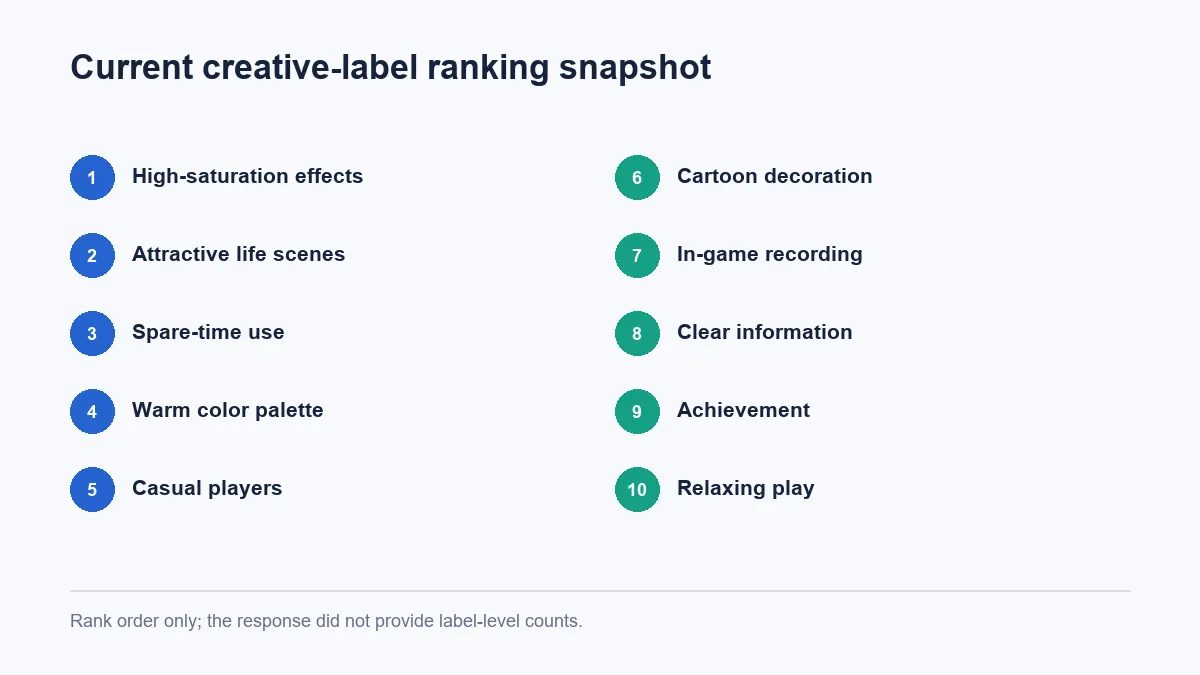
Creative labels become useful only when they change what the team tests. A ranked list of visual or messaging attributes is not a brief, and it is not proof that the top label performs best. The practical method is to translate each label into an observable creative variable, pair it with a control, and define the evidence needed to keep or reject the variant. The AppGrowing Global snapshot checked on August 28, 2026 ranked labels such as high-saturation effects, attractive life scenes, spare-time use, warm palettes, casual players, in-game recording, clear information, achievement, and relaxing play. The response supplied rank order, not label-level performance.
What does the label ranking actually tell the team?
The ranking is a discovery snapshot from the verification date. It shows which label names appeared first in the returned list under the selected purpose and material dimension. Because the tool does not accept a date window for this ranking and did not return a count for each label, it cannot support statements such as fastest-growing theme or most-used idea in the last 30 days. Its value is narrower and still practical: it gives creative strategists a vocabulary for segmenting material searches and a starting list of hypotheses to inspect against actual ads.
How should one label become a testable variable?
Rewrite the label as something an editor can change and a reviewer can observe. High-saturation effects can become color intensity in the first five seconds. In-game recording can become the percentage of opening time occupied by authentic interface or gameplay. Clear information can become one promise, one mechanic, and one action on screen. Relaxing play can become pacing, sound, failure pressure, and reward rhythm. Each variable needs a control, one deliberate change, a target placement, and a first-party success metric. The external label supplies the hypothesis; internal experiment data decides whether it works.
- Label
- Observable execution
- Control
- Single change
- First-party metric
What did three material searches add to the ranking?
Separate material queries for July 30 through August 28 matched 9,660 records for in-game recording, 87,441 for relaxing play, and 282,657 for high-saturation effects. The first returned in-game-recording examples included Garden Match, Buildit - Chill Brick Game, Royal Match, and Paper.io 2. High-saturation examples included Fashion Girl: Dress Up Game, Zombie Sniper War 3, Garden Match, and One Line: Mini Drawing Games. These counts may overlap because one material can carry multiple labels. They show that the labels lead to inspectable records, not that one label is more effective than another.
How should teams validate a label at material level?
Inspect at least several unique material IDs for each selected label. Confirm that the visual or message actually matches the label, note whether the same asset carries multiple attributes, and resolve every campaign association. Then code the opening, mechanic proof, emotional promise, format, aspect ratio, media, and end card. A label that repeatedly maps to the same observable execution can become a useful test dimension. A label that is inconsistent, too broad, or attached to unresolved records should remain a search aid only. Do not let an automated tag replace watching the creative.
What should the final test matrix contain?
Build rows from creative variables and columns from controlled executions. A practical matrix includes the source label, observed examples, control asset, one changed element, unchanged elements, target market, placement, production owner, launch date, and first-party evaluation metric. Add an evidence-status field with observed, inferred, internally validated, or rejected. Limit each round to a small number of independent changes so the result remains interpretable. When two labels naturally co-occur, such as high saturation and achievement, test the combination only after each variable has a readable baseline.
Not sure how to turn game creative labels into a test matrix?
Get a free benchmark check based on your specific app or game category.
What is the practical takeaway?
Selling-point labels are best treated as a structured hypothesis generator. The current ranking supplies vocabulary, and the label-specific searches supply inspectable material pools. Neither supplies performance proof. Translate each selected label into one observable execution, verify it across unique materials, and connect the resulting test to first-party metrics. Archive the query date, sample IDs, rejected matches, and test owner so the team can repeat the exercise without changing definitions midway. Review the label vocabulary periodically because automated taxonomies and visible creative populations can shift. That process turns a taxonomy into a production instrument while keeping the evidence boundary visible.
