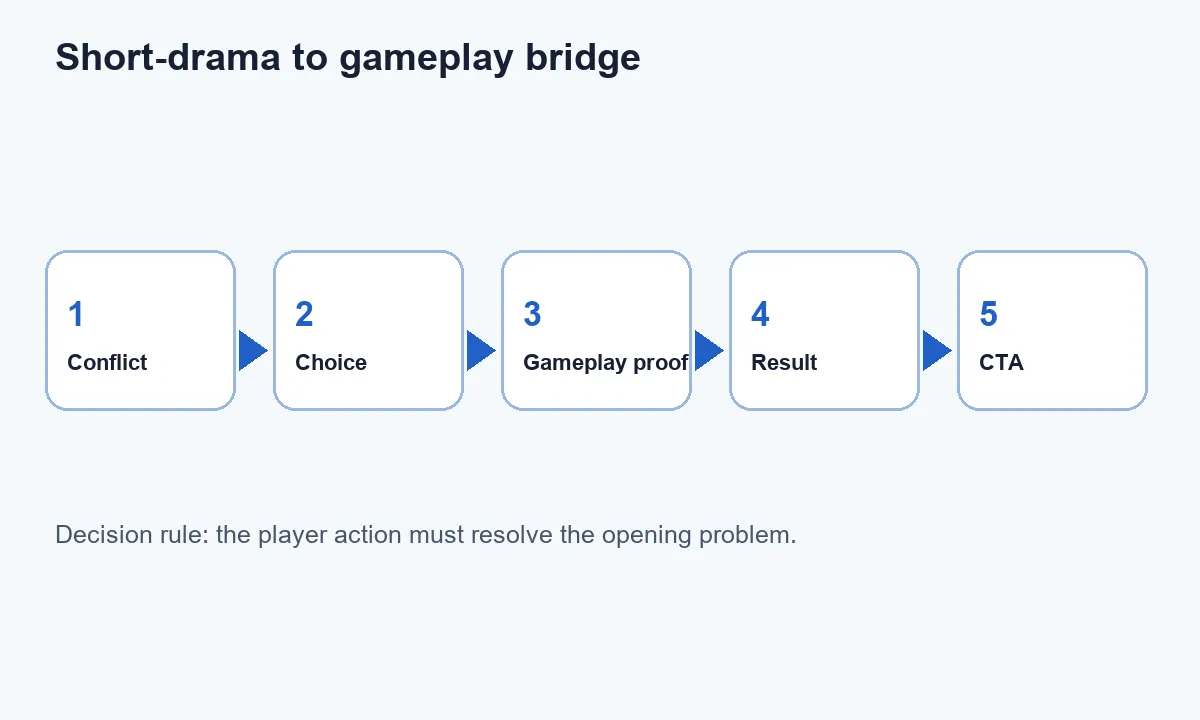
Mobile game ads can borrow short-drama conflict, relationships, and suspense, but the story must lead to observable play rather than hide it. A review of eight high-cumulative-impression DramaBox samples and eight Gossip Harbor samples, checked on September 17, 2026, supports a practical five-part bridge: conflict, choice, gameplay proof, result, and CTA.
What job does a drama hook do differently from a game hook?
A drama hook creates an information gap: the viewer wants to know what happens next. A game hook must also answer a second question—what will the player do? The DramaBox sample used marriage claims, identity reversals, rescue situations, and summoning scenes to create suspense. Gossip Harbor connected mother-child danger, damaged rooms, and winter hardship to cleaning, repair, and merge tasks. The transferable lesson is not to copy a plot. It is to convert the character’s problem into a player-sized decision.
Why can gameplay proof not wait until the last second?
If the first half is pure drama and a board suddenly appears at the end, the creative contains two unrelated promises. In the reviewed Gossip Harbor set, one material introduced a tool interface and game grid at roughly nine seconds, then proved the result through a before-and-after room restoration. Another did not show the level grid until about 28 to 31 seconds, creating a much heavier transition burden. After the conflict escalates, show input, rule, and immediate feedback early enough for the viewer to connect cause and effect.
How should the five-step narrative-to-play bridge work?
First, establish one relationship and one visible conflict. Second, translate that conflict into an action the player can choose. Third, show an interface, gesture, rule, or state change that proves interactivity. Fourth, make the reward or failure causally connected to that action. Fifth, continue the same task in the CTA. “Help this family restore the room” preserves the narrative thread better than a generic download command because the viewer already understands the goal.
Which signals show that story is hiding the game?
Send a creative to review if gameplay appears very late, the character goal has no relationship to the player action, editing gives the outcome without visible input, or the CTA switches to a different product promise. The diagnostic rule is simple: after seeing the gameplay proof, a reviewer should be able to say in one sentence, “I do this, and that helps resolve the opening problem.” If the sentence cannot be completed, the bridge needs to be rewritten.
How can a creative team turn the sample into a test matrix?
Hold the mechanic and result feedback constant, then vary the conflict type, relationship intensity, or suspense duration. A first round might test identity reversal, family rescue, and resource crisis. A second round can test gameplay proof at five, ten, or fifteen seconds. Change one variable per cell and record whether the story promise is fulfilled by the play sequence. Performance metrics still belong in the campaign system; the creative review sheet measures structural continuity so the team knows what the test actually changed.
How should the script mark the handoff from story to play?
Add a dedicated “control handoff” cell to the storyboard and name the exact moment when the viewer moves from watching conflict to understanding an action. That cell should contain an input cue, a visible state change, and a goal connected to the opening problem. Directors may vary the camera, actor, and pacing, but those three pieces of proof should remain. If the handoff works only because a voice-over explains it, the mechanic has not yet entered the narrative chain.
Not sure how to connect short-drama hooks with puzzle or merge gameplay?
Get a free benchmark check based on your specific app or game category.
What is the final decision rule?
Short drama does not improve a game ad by making it longer. It gives the player goal an emotional reason. Conflict earns attention, choice turns attention into action, gameplay proof establishes credibility, the result delivers the emotional payoff, and the CTA continues the unfinished task. When all five steps are continuous, story and play reinforce each other. When one step jumps, treat it as a structural problem rather than a stylistic editing choice.
