A genre that looks far simpler than 4X strategy is now drawing serious attention from the industry's biggest publishers. According to Sensor Tower, merge-2 has become the second-highest-grossing casual category, behind only match-3.
On the global stage, Chinese publishers are making real headway. Microfun's Gossip Harbor and Century Games's Tasty Travels have set the pace, and established names such as Cedar Games Studio and Yota Games have since launched merge-2 titles of their own.

Put these games side by side and a pattern emerges. Each layers narrative, simulation or restoration content on top of the core merge mechanic. So when product structures look increasingly alike, where does differentiation come from? The answer lies not only in the product itself, but also in user acquisition (UA) and marketing strategy.
1. Similar Gameplay, Different UA Strategies
Similar themes and packaging don't mean similar UA. To see where the strategies diverge, we used the MCP from AppGrowing to compare the ad delivery and creative approaches of three titles over the past three months:
- Gossip Harbor (Microfun Limited)
- Tasty Travels (Century Games)
- Mystery Town (Cedar Games Studio)
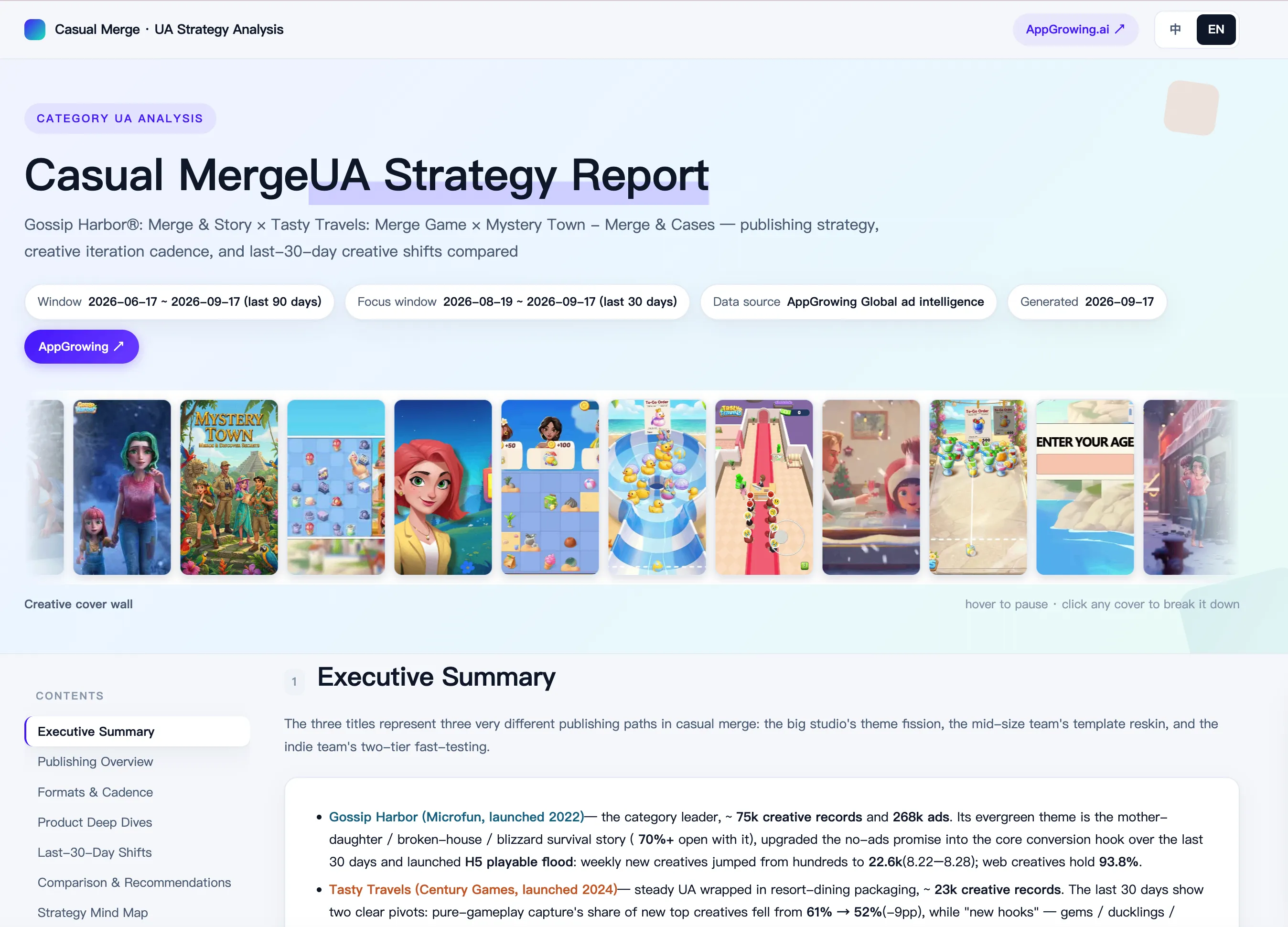
Source: AppGrowing
The full report is linked at the end of this article.
Gossip Harbor: Story as the Lead Selling Point
Microfun has made "story-driven merge" its signature. Across Gossip Harbor's ad creatives, one concept appears again and again: rescuing a freezing mother and daughter. It features in more than 70% of its English-language video ads.
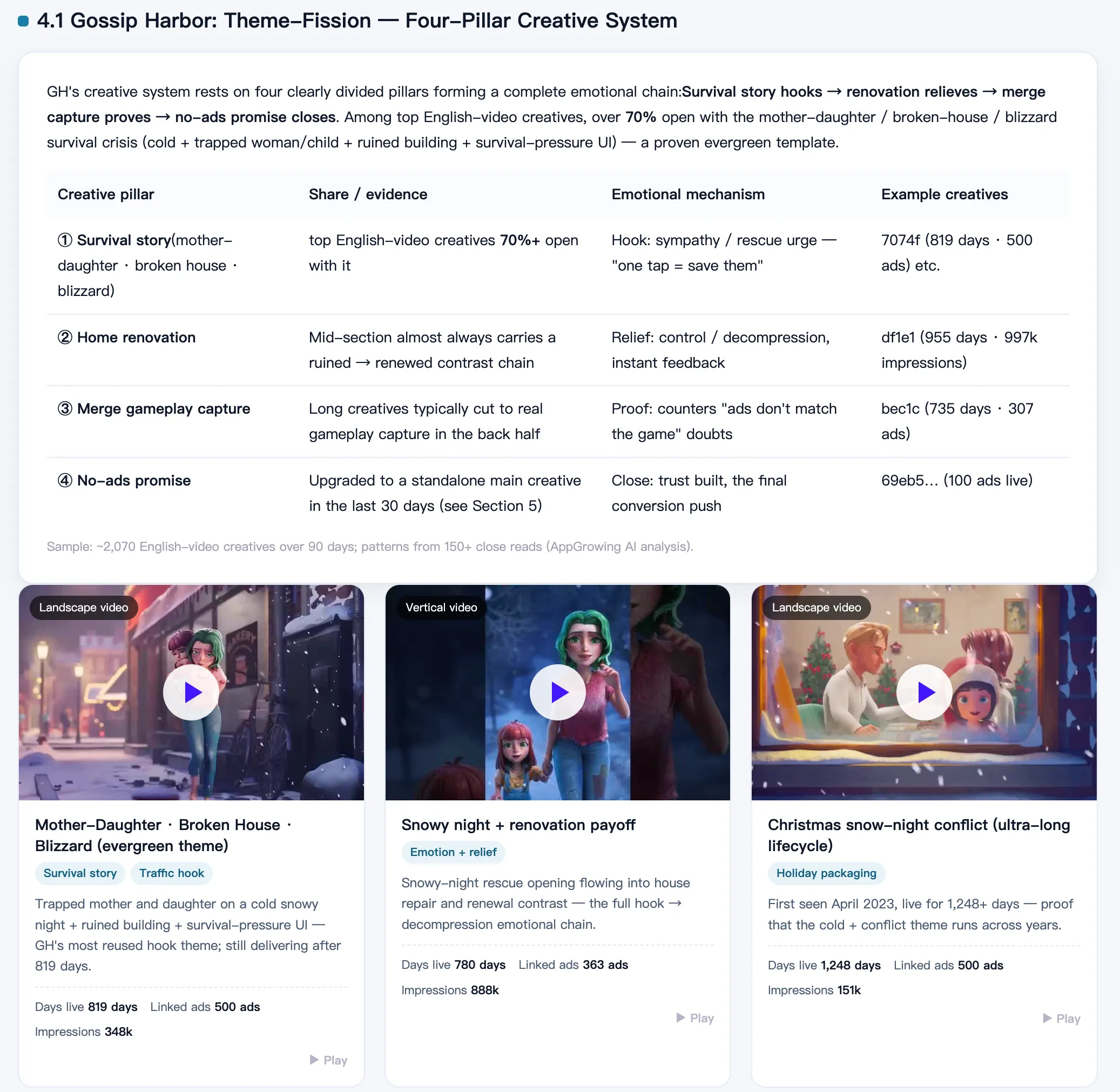
Source: AppGrowing
This isn't simply a storyline bolted onto a merge game. The narrative is the hook. The viewer's first thought isn't "how does this game play?" but "what on earth happened to this mother and daughter?" That lets the creative reach players well beyond the usual merge audience.

Source: AppGrowing
The rise of short-form drama in recent years has given Gossip Harbor further ways to package its stories. For example, some call-to-action (CTA) end screens mimic the look of a short-drama app, hinting that the viewer should "watch what happens next".
Hook with story, then convert with gameplay: this is now Gossip Harbor's proven UA formula.

Source: AppGrowing
Tasty Travels: Mini-Games as the Way In
Century Games's Tasty Travels takes a different route. It shares the same "merge-2 plus meta content" structure, but its creatives don't simply copy Gossip Harbor's story-led approach. Instead, they open with mini-games, such as fruit merging and tabletop pinball, as the first visual stimulus.
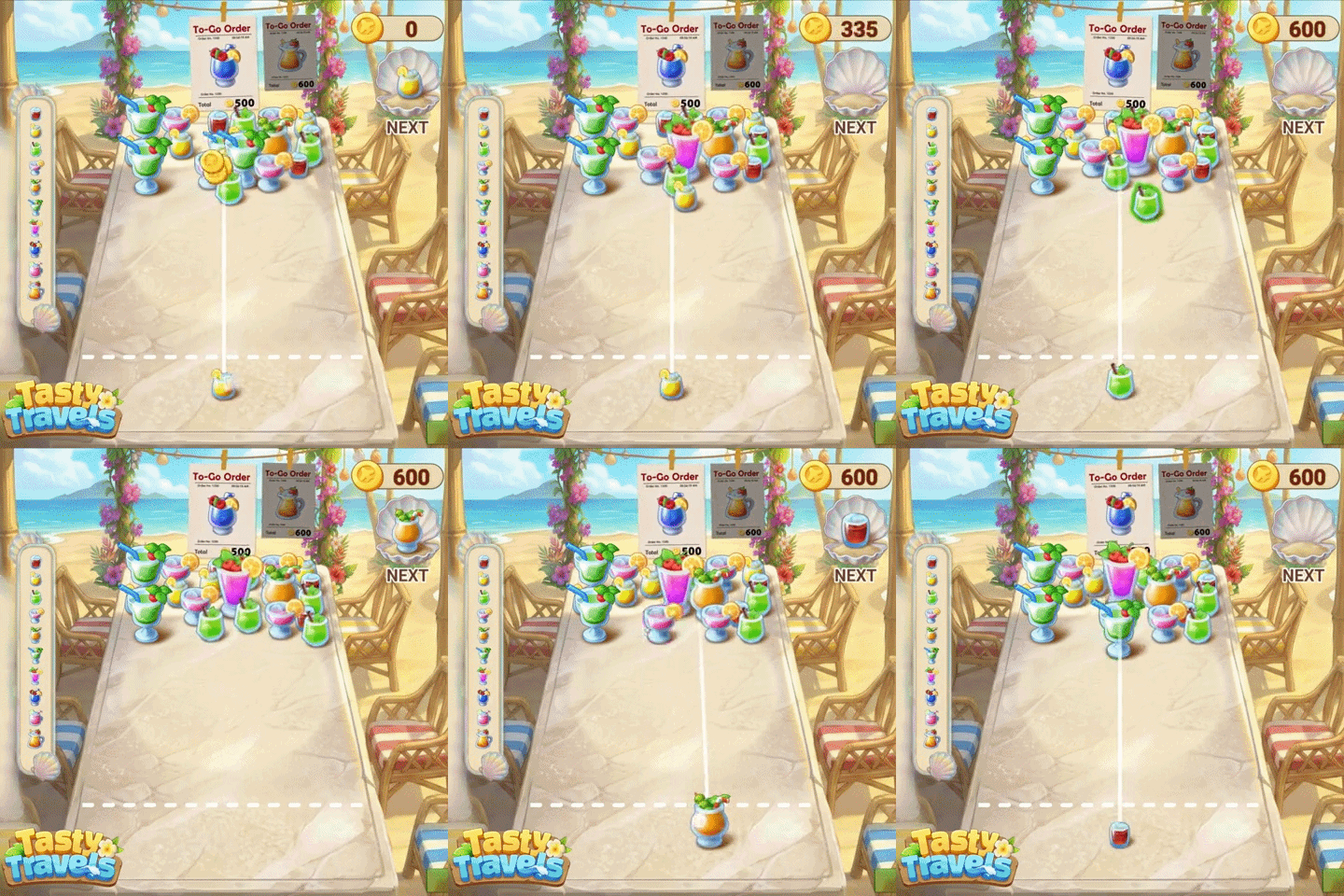
Source: AppGrowing
This builds on the studio's earlier creative experience with titles like Whiteout Survival. Mini-game packaging creates a stronger first-three-seconds hook, which then leads into the core gameplay.
Mystery Town: Packaging Gameplay with Clear Goals
Cedar Games Studio's Mystery Town keeps the spotlight on the merge mechanic itself, with an emphasis on instant, satisfying feedback. It then adds visual contrast through ruined buildings or run-down town scenes, uses restoration tasks to set a clear goal, and finally guides the viewer into merging.

Source: AppGrowing
This goal-driven approach draws on the publisher's experience in casual and hyper-casual games. Hyper-casual titles thrive on instant feedback and a sense of stress relief. Compared with a complex plot, restoring a derelict building is a simpler, more intuitive visual task. Give the viewer one clear objective, then lead them into merge-2 gameplay.
2. The Real UA Battle: Finding the Right Players
Viewed together, the three strategies target different types of player:
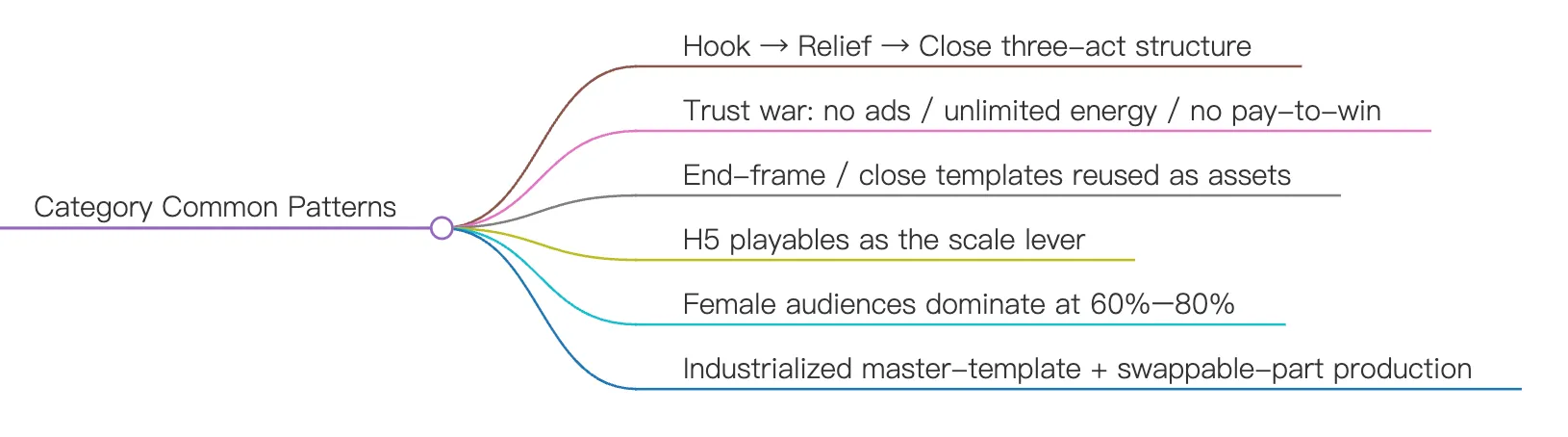
A selection of creative strategy mind maps for three products summarized in AppGrowing's MCP report
Gossip Harbor builds a binge-worthy, web-novel-style experience from character relationships and emotional conflict. It is most likely to attract web novel and short-drama fans.
Tasty Travels uses mini-games and highly responsive controls to create instant excitement and a strong "this looks fun" first impression. This sits closest to the tastes of casual players.
Mystery Town keeps stressing restoration, makeovers and before-and-after transformations, giving viewers a simple, visual goal. This kind of strong visual stimulus is common in hyper-casual ads, so it naturally appeals to hyper-casual players.
Although these look like three separate creative tactics, they do the same thing: they use different content to find the people most likely to be drawn to the game. It is a textbook case of "creative as targeting" in the merge-2 category.
As ad platforms increasingly rely on content understanding to find potential users, age, gender and location are only baseline signals. What a user engages with is becoming a key signal. This matters even more in a category where core mechanics are highly similar and themes are fairly concentrated. Publishers are competing not only on product differentiation, but on differentiated attention.
The key question in UA, then, is which content will put your game in front of the people most likely to love it? As products converge, the publisher that finds its audience most accurately gains a fresh competitive edge.
3. After the First Winning Hook: Keep Finding Incremental Growth
Finding an effective entry point to your audience isn't the end of the job. The harder question follows: where do you go next?
Once a creative works, simply duplicating it only meets short-term demand for assets. To sustain growth, teams must keep building on their strengths and uncovering new content angles and interest groups. There are two ways to do this:
Look inward: go deeper and wider on creatives that have already proven effective.
Look outward: monitor what competitors are running and testing, and find new angles from there.
Over the past 30 days, all three leading titles have been testing new audience entry points. Tasty Travels is a good example. Alongside fruit merging and tabletop pinball, it has begun to lean into its "food and travel" theme. Some ads show restaurant management from a first-person view for stronger immersion, while others wrap the conveyor-belt mechanic in a Japanese sushi restaurant to widen the mini-game settings.

Source: AppGrowing
This suggests Tasty Travels is now reaching out to players who enjoy storytelling and simulation, in order to scale monetisation further. According to Sensor Tower, its global revenue reached a record $46 million in August, clearly the result of new live-ops events and UA iteration working together.

Expanding outwards from one effective entry point means constantly searching for the next group of players who might be drawn in. In merge-2, some publishers create emotion with story, others thrill with mini-games, and others set goals through restoration tasks. In an increasingly crowded category, the publisher that finds the right content fastest, and puts it in front of the right players, is the one most likely to find room to grow.
Access the full report, 'Casual Merge UA Strategy Report,'here.
