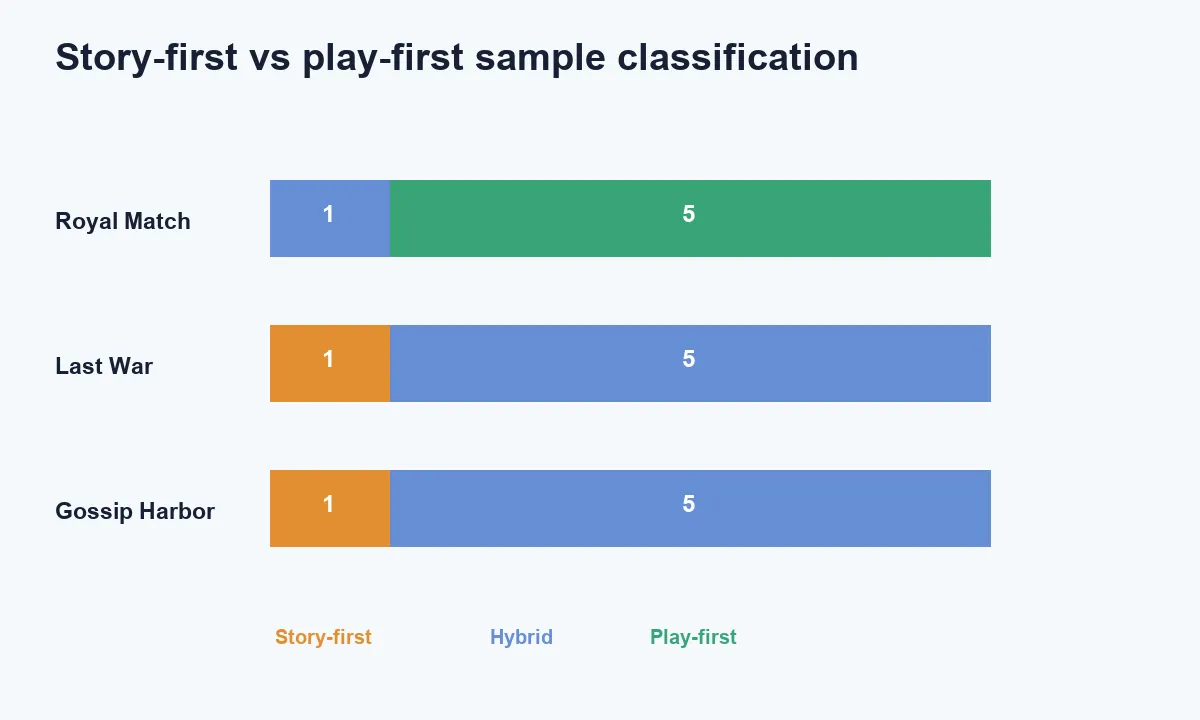
There is no universal winner between story-first and gameplay-first advertising; the right opening depends on what the product must prove first. In 18 extractable samples checked on September 17, 2026, Royal Match had five play-first and one hybrid creative. Last War and Gossip Harbor each had one story-first and five hybrid creatives.
How are story-first, play-first, and hybrid defined?
The classification uses the first content-bearing segment. A material is story-first when a relationship or conflict arrives before an actionable rule. It is play-first when the board, input, and feedback establish the promise immediately. It is hybrid when situation and task appear together or alternate within the first few beats. This is a structural classification, not a performance score. A play-first sample is not automatically better than a story-first sample.
What differed across the three entity samples?
Royal Match leaned strongly toward play-first structure: five of six reviewed materials presented the obstacle, board, or decision before adding emotional context. Last War and Gossip Harbor leaned toward hybrid structure, with five of six samples in each group combining survival, family, or resource pressure with a lane, combat, cleaning, or merge task. The difference reflects what each product needs to explain; it is not evidence that one genre has a superior format.
When should a team test a play-first opening?
Start with play when the central pleasure is understandable within a few seconds and the action produces visible feedback. Show input, rule, and result early rather than delaying comprehension with several narrative beats. The Royal Match sample suggests that a board task and immediate consequence can carry the primary promise, while a character crisis supplies emotional motivation. This route is especially useful when the team needs to prove that the advertised interaction exists.
When should a team test story-first or hybrid?
If the product value depends on long-term progression, character relationships, or scene restoration, operation alone may lack meaning. Use story to explain why the task matters, then move rapidly into a hybrid sequence. Last War needs to connect a proxy mini-game with a larger survival and battle system. Gossip Harbor needs cleaning and merging to serve a character problem. Hybrid does not mean adding more unrelated material; it means keeping emotional cause and playable effect in the same chain.
How can the A/B test avoid becoming ambiguous?
Change only the opening order while keeping the gameplay clip, outcome feedback, and CTA constant. Version A begins with the actionable task. Version B begins with character conflict. A hybrid version juxtaposes both within the first three beats. If all three versions also change the character, mechanic, and reward, the test cannot reveal why outcomes differed. A structural test must keep the later proof sequence comparable.
How should teams read the distribution of 18 samples?
The split describes how the selected high-cumulative-impression, extractable materials organized their openings. It does not estimate the share of every live creative in a genre. Ranking by cumulative exposure favors historically visible assets, while the semantic-coverage rule excludes records that cannot be interpreted. Treat the five-to-one and one-to-five patterns as evidence for test order, not as a budget-allocation formula or a universal creative benchmark.
Which common proof should all three versions preserve?
Whether story or play comes first, every version should retain the same core interaction, outcome feedback, and destination promise. The test then compares comprehension order instead of three different product stories. During review, record the second at which the rule, first feedback, and CTA appear. This reveals whether one version improved the handoff or merely postponed the proof that viewers needed.
Not sure whether your next mobile game ad should lead with story or play?
Get a free benchmark check based on your specific app or game category.
What is the final selection framework?
When play is legible at a glance, begin with a play-first test. When motivation is harder to explain than the rule, test story-first. When the product depends on both an emotional goal and visible interaction, test a disciplined hybrid. The sample classification proposes an order hypothesis; campaign outcome data must decide which version to retain. Do not turn the distribution of 18 reviewed materials into a universal industry best practice.
