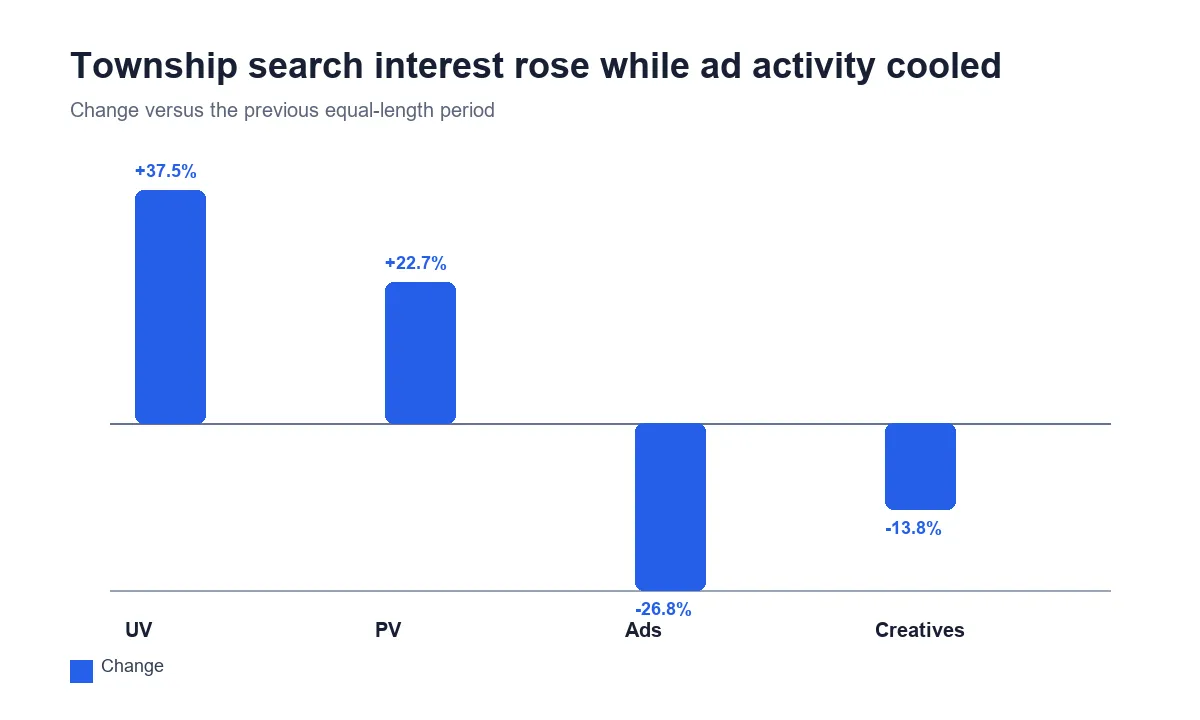
Township lookup interest rose while observed official-package advertising activity fell. The verified pattern raises competitor-review priority, but it does not prove campaign expansion or player-demand growth. Teams should inspect the long-running resource, farm-to-city, fail-to-retry and No Ads families that remained visible during the cooldown.
Why does rising attention not mean ad expansion?
Township became more visible in industry lookup behavior while its observed ad activity cooled. From August 6 to 12, 2026, AppGrowing search UV increased from 16 to 22, up 37.5 percent, and PV increased from 22 to 27, up 22.7 percent. Over the 31-day advertising window, official-package game ad records fell from 16,548 to 12,110, down 26.8 percent, while creative records fell from 3,134 to 2,700, down 13.8 percent. The useful conclusion is higher review priority, not expansion.
Search activity measures what marketers are looking up. Advertising records measure observed activity under a separate query. They are not stages of one funnel and should not be forced into a causal story. When lookup interest rises as activity falls, UA teams should treat the mismatch as a reason to inspect the remaining creative system. The question becomes which ideas are surviving the cooldown and why competitors still want to study them.
For a useful weekly review, keep the lookup and advertising series in separate columns. Preserve the exact period, entity and field name beside every value. A directional mismatch should trigger content inspection, not a blended score. This keeps the signal actionable without inventing a causal relationship between marketer research and observed delivery.
Which Township creatives still carry long-term memory?
The official Township entity directly matched 2,962 materials in the aggclaw window. Sixty-two of the top 100 cumulative-impression materials had usable visual or spoken semantics, and the voiceover pool contained 942 materials. Creative cc05c recorded 751,171,754 cumulative impressions, 346 active days and 100 linked ads. Videos 81bb7 and 91d22 each remained active for 557 days and linked to 114 and 113 ads.
The sample shows a layered expression rather than one isolated mechanic. Farm resources, truck queues, egg piles and corn stacks create an immediate abundance cue. Roads, bridges, buildings, store counters and expansion screens appear later as the payoff. Failure remains low-cost. A failed level or overloaded bridge moves quickly into a Pick or retry prompt, converting frustration into another action rather than ending the story.
Durability must also be read carefully. Active days, linked ads and cumulative impressions are direct historical fields, not current-period outcomes. Use them to locate assets that carry category memory. Then inspect the semantic sample for recurring openings, proof steps and endings instead of treating the largest lifetime number as a current winner.
Need a verified benchmark for this category or competitor?
Ask for a free review using your own app, category and monitoring question.
Why should the No Ads script be tracked as a family?
The current retrieval identified 242 materials in the All About Skill dialogue family. The recurring script asks whether the player can watch an ad to double eggs, hire a helper or speed up a task. A firm refusal introduces the no-ads positioning, a gameplay segment demonstrates the loop, and Township play now closes the execution. Multiple creative IDs share this skeleton while changing the farm job, character or obstacle.
Track the family through three fields. Keep the positioning claim as the family anchor. Record the farm or city problem as the scene variant. Record the gameplay capture as the proof unit. This prevents every new actor, crop or obstacle from being counted as a new concept. It also reveals whether the surviving message is the no-ads promise, the resource fantasy, or the farm-to-city progression.
A family record can use five columns: positioning claim, opening problem, gameplay proof, payoff and CTA. Township variants often change the crop, helper, bridge or shop while retaining the same promise and progression. This format shows meaningful novelty and prevents cosmetic recuts from inflating the creative-concept count.
What should UA teams monitor next?
Use a three-layer watchlist. Layer one records industry-search UV and PV to see whether competitor attention persists. Layer two records ad and creative activity to distinguish continued cooling from renewed expansion. Layer three records creative families, especially the No Ads dialogue, resource-abundance openings, farm-to-city payoff and fail-to-retry structure.
Apply one decision rule. If lookup interest keeps rising while activity keeps falling, review long-running survivors first. If ads and creatives rebound together, expand monitoring to new variants. If ads rebound while creatives remain lower, test whether a small number of families are carrying more delivery. This is an advertising-activity signal, not a campaign-performance result.
The next comparison should use another equal-length search window and another equal-length advertising window. Keep the official package and entity fixed. A watchlist update is warranted when direction changes or a family gains materially wider reuse; no effectiveness claim should be added unless outcome data is independently available.
