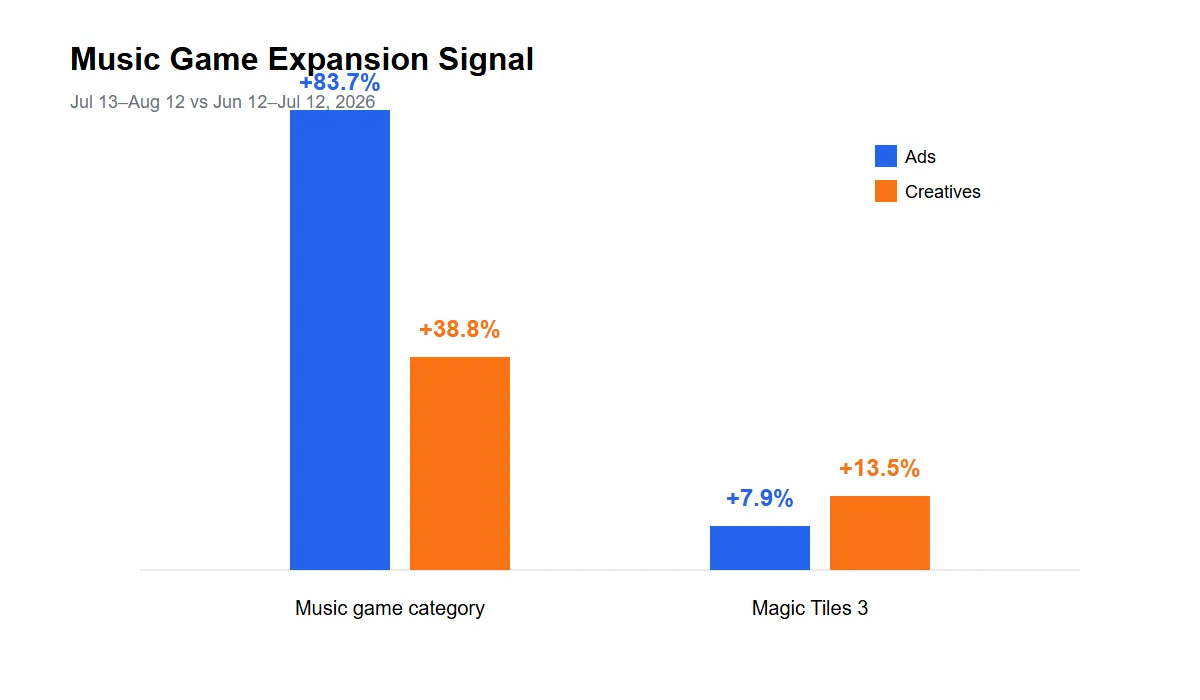
The music game category is expanding faster in ad activity than in creative output. From July 13 to August 12, 2026, ad records rose 83.7 percent while creative records rose 38.8 percent. Magic Tiles 3 showed a more moderate increase in both measures. UA teams should monitor which song-and-gameplay proof families are receiving broader use before translating the category surge into higher creative quotas.
What does the expansion signal actually mean?
Music game ad records increased from 323,278 to 593,995, while creative records increased from 61,089 to 84,780. Ad growth exceeded creative growth by 44.9 percentage points. This supports a monitoring conclusion about faster advertising expansion and greater reuse pressure. It does not establish budget growth, return, or player demand.
Magic Tiles 3 ads increased from 29,850 to 32,213, a 7.9 percent rise. Its creative count increased from 1,431 to 1,624, or 13.5 percent. The entity did not reproduce the category's steep acceleration, but it supplied a directionally consistent title-level check.
Use a two-stage rule. If the category grows much faster than a named competitor, expand the competitor set before drawing a title-level conclusion. If the named game also grows, move to material structure and identify what is being repeated.
Which proof structures does Magic Tiles 3 repeat?
The official-entity aggclaw retrieval matched 763 materials and reviewed up to 185 records, including the top 100 by cumulative impressions. The readable sample repeatedly uses four proof layers.
The first is song recognition. Voice-over and image executions refer to a favorite song, popular tracks, free songs, exclusive albums, and playlists. The second is rhythm proof. The ads show tile tapping, PERFECT judgments, combo streaks, and rising scores. The third is human demonstration. Top-down tablet shots and visible fingers make the interaction understandable before the viewer processes any explanation. The fourth is social challenge. Sibling challenges, hardest-level promises, and direct questions invite the viewer to outperform the player.
These layers usually form a short loop. The opening uses a song, a dare, or visible hand movement. The body stays on continuous gameplay and judgment feedback. The close moves to the app icon, a PLAY button, a song-library value statement, or another challenge. Failure appears briefly as the novice stage; reward and growth supply the ending.
Which four material families need separate monitoring?
Song-library materials should track music category, seasonal theme, and access or value language. Skill-satisfaction materials should track PERFECT feedback, combos, scores, and Noob-to-PRO growth. Human-demonstration materials should track hand movement, filming angle, device, and lifestyle styling. Social-challenge materials should track the relationship, difficulty promise, and question directed at the viewer.
If the track changes but the gameplay proof remains identical, keep the executions in one script family. If both the mechanic and feedback system change, mark a new concept. If only the hand, room, or performer changes, classify the record as a visual variant. This prevents song replacement from being counted as a completely new creative idea.
Semantic coverage should also affect priority. Many high-exposure videos in the top 100 had no readable voice-over or visual description, so exposure rank alone cannot support a hook conclusion. Use materials with populated speech or scene fields for structure research, then place semantically empty but long-running materials in a manual viewing queue. This keeps the watchlist evidence-based without discarding potentially important executions.
How should the next creative test be prioritized?
Start with high-cumulative-impression materials that have populated semantic fields, then add active days and linked-ad counts. Build one test lane for each family. Change only the song or theme in the library lane. Change only judgment and difficulty in the gameplay lane. Change only hands and setting in the demonstration lane. Change only the relationship and voice-over in the challenge lane.
Not sure which music game song, gameplay, or challenge family deserves the next test?
Get a free benchmark check based on your specific app or game category.
The music game surge warrants more frequent monitoring, but it does not require every team to increase output by the category growth rate. The actionable strategy is to preserve comparable proof structures while testing controlled variations in songs, challenges, and human presentation.
