Casual puzzle teams often assume that rising ad activity means a competitor is producing more creatives. In this four-game comparison, Meowdoku is the only title that expanded both measures at high speed, with ads up 177.5% and creatives up 111.9%. Candy Crush, Gossip Harbor, and Royal Match all increased ad activity while their creative pools contracted, so each requires a retained-creative review rather than the same new-concept analysis.
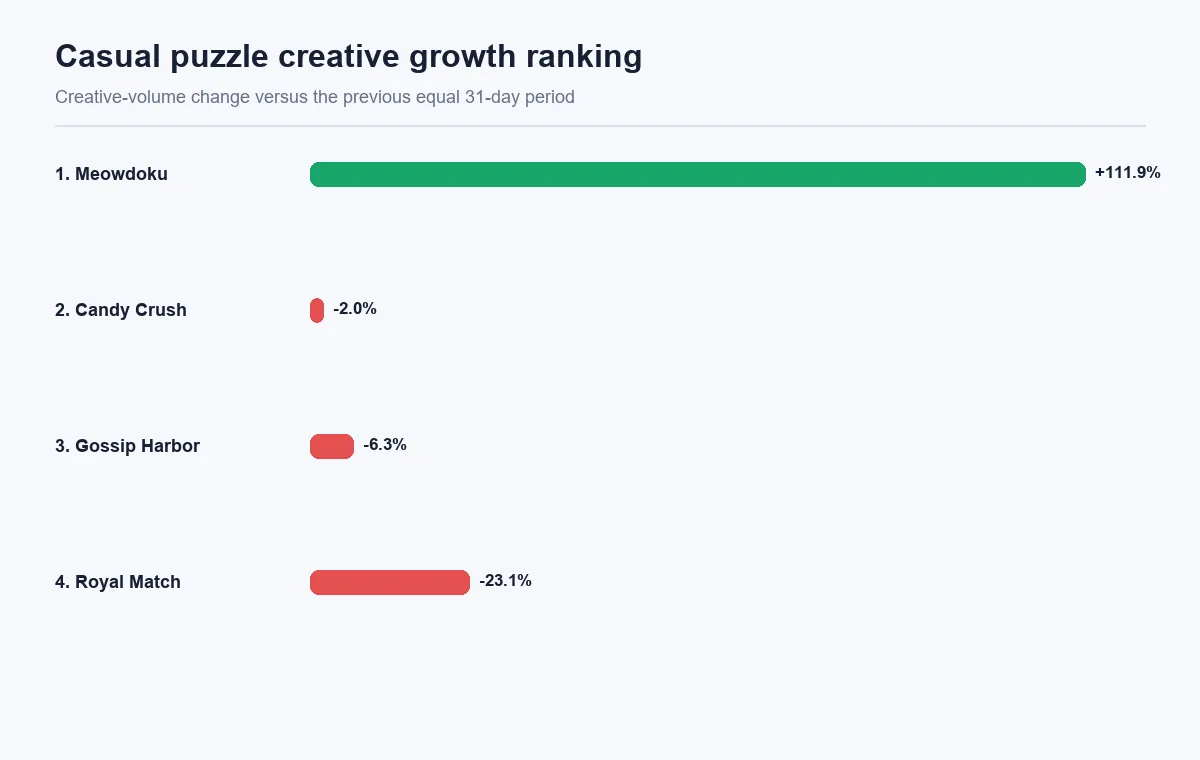
| Rank | Game | Ad change | Creative change | Current creative density |
|---|---|---|---|---|
| 1 | Meowdoku | +177.5% | +111.9% | 2,722 |
| 2 | Candy Crush | +19.0% | -2.0% | 945 |
| 3 | Gossip Harbor | +29.9% | -6.3% | 1,611 |
| 4 | Royal Match | +9.8% | -23.1% | 1,821 |
Why should Meowdoku's new creatives be reviewed first?
Meowdoku ads increased from 12,294 to 34,110, while creatives increased from 4,383 to 9,286. The title also reached 2,722 creatives per 10,000 active ads, the highest density in this four-game set. That combination supports a clear review task. Separate newly introduced concepts from repeated execution variants, then compare how each concept explains the rule, frames the character, presents the first decision, and continues into the CTA.
The production implication is not to copy the largest visible group immediately. A fast-growing pool can contain many close variants of one message. Sample across concept families first. If five assets change only colour, character position, or caption wording, they belong to one family. If the viewer is asked to understand a different rule or solve a different opening task, that is a more meaningful test branch.
Which games need retained-creative analysis?
Gossip Harbor ads rose from 26,336 to 34,206, an increase of 29.9%, while creatives fell from 5,881 to 5,509, a decline of 6.3%. The first question is therefore not which new asset appeared last. It is which narrative openings, merge transitions, and end-card promises remained active while the pool narrowed.
Royal Match presents an even stronger concentration signal. Ads rose 9.8%, but creatives fell 23.1% from 3,437 to 2,644. Its current creative density remains higher than Gossip Harbor and Candy Crush, yet the direction of change indicates consolidation. Review the structures that survived the contraction and identify whether the same crisis, puzzle resolution, or correction CTA appears across multiple retained assets.
Candy Crush has the largest current ad count in the sample at 42,060. Ads increased 19.0% while creatives slipped 2.0% to 3,974. Its density of 945 creatives per 10,000 ads is the lowest of the group. This is a delivery-concentration question, not evidence that fewer concepts are universally better. The team should check whether a smaller set of boards, failure states, or progression messages accounts for more visible activity.
How should a UA team compare these four patterns?
Use a simple decision rule. When ads and creatives rise together, as they did for Meowdoku, inspect new concepts and broader coverage. When ads rise while creatives fall, as they did for the other three titles, inspect retained messages and concentration. Do not give all four competitors the same brief. Meowdoku should generate a concept-family map, while Candy Crush, Gossip Harbor, and Royal Match should generate a retained-structure sheet.
The sheet should record the opening task, visible gameplay proof, emotional frame, CTA role, first-seen date, and whether the concept appears in more than one asset. Those fields allow a creative team to move from a volume signal to a specific review. They also prevent the ranking from becoming a list of screenshots without a production decision.
What can this ranking prove?
The ranking proves that the four exact-title queries moved differently across two equal 31-day periods. It does not prove test success, lower CPI, higher conversion, stronger retention, or better creative quality. Creative count is an activity signal. Use it to decide which materials to inspect and which questions to ask, then use campaign or backend data for performance conclusions.
The most useful conclusion is operational. Meowdoku deserves a new-concept review because both ads and creatives expanded sharply. The other three titles deserve retained-creative reviews because more ad activity was supported by a smaller visible pool. That distinction is more actionable than naming one universal winner.
Keep the same competitor set and equal period length in the next review. A stable comparison will show whether Meowdoku's expansion continues and whether the other three pool reductions become a repeated pattern rather than a one-period movement.
