When a competitor's ad activity rises, UA teams often answer by requesting more creative output. The current data shows another pattern. Gossip Harbor, Royal Match, Candy Crush, and Whiteout Survival all increased active ads while their visible creative pools became smaller. Gossip Harbor has the largest growth gap at 36.2 percentage points, followed by Royal Match at 32.9 points. These titles should enter a retained-creative and concentration review before they inspire a production-volume decision.
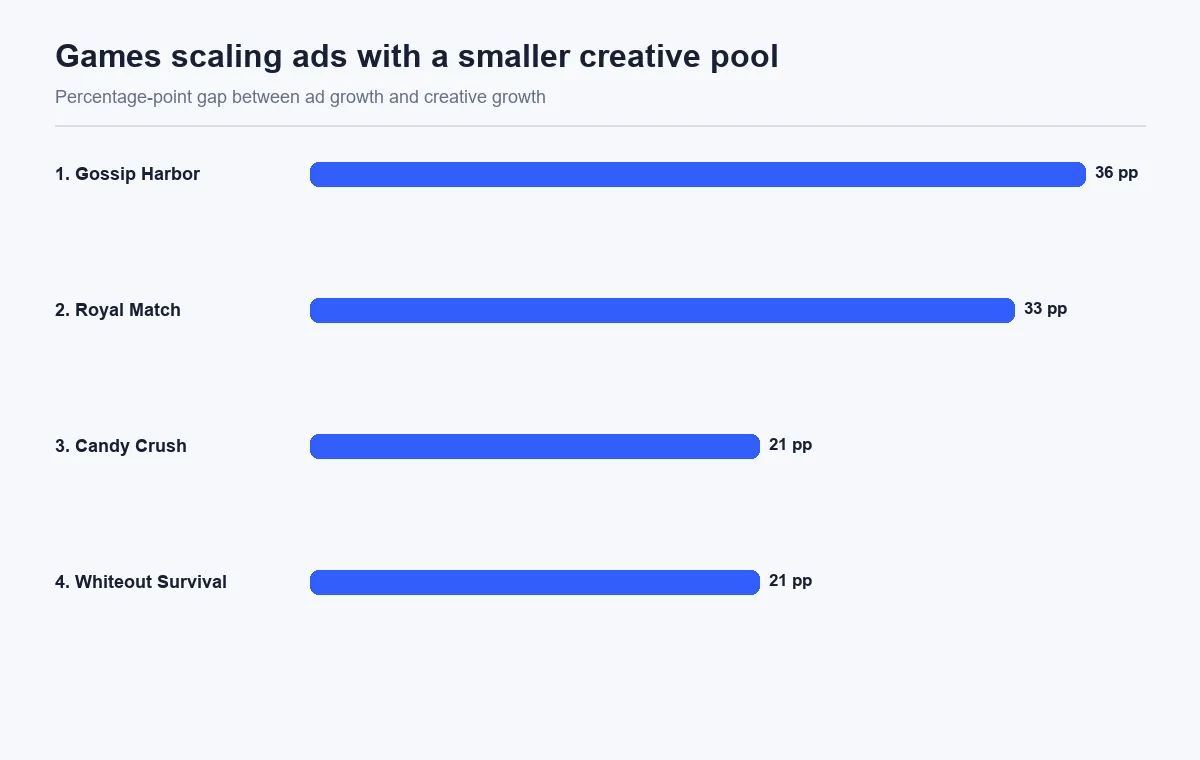
| Rank | Game | Ad change | Creative change | Growth gap |
|---|---|---|---|---|
| 1 | Gossip Harbor | +29.9% | -6.3% | 36.2 pp |
| 2 | Royal Match | +9.8% | -23.1% | 32.9 pp |
| 3 | Candy Crush | +19.0% | -2.0% | 21.0 pp |
| 4 | Whiteout Survival | +2.3% | -18.7% | 21.0 pp |
What does ads up and creatives down mean?
It means a higher level of visible ad activity is being supported by a smaller visible creative pool. That relationship can be consistent with retained creatives carrying more activity, delivery concentrating around fewer concepts, or exploratory production slowing. The activity fields do not identify which explanation is correct. They create a diagnosis task.
The distinction matters because a competitor signal should not become a production instruction too early. A team that sees fewer competitor creatives may decide to cut its own output, even though the competitor could be relying on several proven structures that were established earlier. The first response should be to inspect the current pool and its concept distribution.
Which game should be reviewed first?
Gossip Harbor has the largest gap. Ads increased from 26,336 to 34,206, or 29.9%, while creatives declined from 5,881 to 5,509, or 6.3%. Review which narrative openings, merge transitions, failure states, and end-card promises remain present across multiple assets. The goal is to identify the message families supporting the expanded activity, not to choose the newest upload.
Royal Match has the sharpest creative contraction. Ads increased from 13,219 to 14,521, while creatives fell from 3,437 to 2,644, a 23.1% decline. Its review should begin with the structures that survived the pool reduction. If the same crisis, board resolution, or correction CTA appears repeatedly, that structure is a stronger test candidate than an isolated visual treatment.
How do Candy Crush and Whiteout Survival differ?
Candy Crush ads rose 19.0% and creatives slipped 2.0%. The small creative decline paired with a larger ad increase suggests a mild concentration pattern. A review should compare board states, progression messages, and recurring failure or satisfaction loops. The team should also distinguish a concept from its many colour, level, and copy variants.
Whiteout Survival ads increased only 2.3%, while creatives declined 18.7% from 6,298 to 5,119. This is a stronger pool-reduction signal with limited ad growth. Review retained survival threats, character situations, base-building promises, and progression proof before interpreting the pattern as expansion. The two games share a 21.0-point growth gap, but the underlying movements are different.
How should teams turn divergence into a review task?
Start with a retained-concept sheet. Group current creatives by opening task, gameplay proof, emotional frame, product promise, and CTA role. Record how many distinct assets belong to each concept family and whether the family appears throughout the period. This separates a durable message from a one-off execution.
Next, compare the competitor with its previous period. If a concept remains visible while the overall pool shrinks, it belongs in the high-priority review set. If it appears once after the contraction, keep it in the watchlist. Only promote a structure into production when it is repeated enough to justify a hypothesis and when the product promise can be reproduced honestly.
What should not change in your own workflow?
Do not reduce creative production simply because a competitor's visible pool became smaller. Advertising activity does not report spend, conversion, CPI, or creative effectiveness. A smaller pool may be concentrated around proven messages, but campaign or backend data is required to verify performance.
The actionable conclusion is more limited. Ads-up and creatives-down is a signal to study retained structures before writing new variants. It changes the order of analysis, not the production target by itself.
Track the same titles and retained structures in the next equal period. A repeated divergence across two cycles is a stronger reason to adjust review and production resources than a single monthly ranking.
