AI video attention is rising, but creative production is not expanding with it. In AppGrowing’s latest comparison, weekly industry lookup UV for ai video increased from 13 to 23. Over the monthly window, related App ads rose from 230,418 to 331,656 while creatives fell from 105,116 to 94,767. The useful diagnosis is not simply that the segment is getting hotter. UA teams should check whether more delivery is concentrating around a smaller set of creative concepts.
Why are lookup interest and creative output moving in different directions?
The two signals measure different behavior. AppGrowing search UV shows what industry users are looking up inside a data tool. It does not measure consumer demand, installs, or campaign efficiency. Advertising volume measures observed activity, while creative volume measures the distinct supply of materials associated with that activity.
From June 30 to July 30, AI Video App ads increased 43.9 percent compared with the previous equal-length period. Creative volume decreased 9.8 percent. The number of creatives per 10,000 ads consequently fell from 4,562.0 to 2,857.4, a 37.4 percent contraction. That pattern supports a concentration diagnosis. It does not prove that the remaining creatives became more effective.
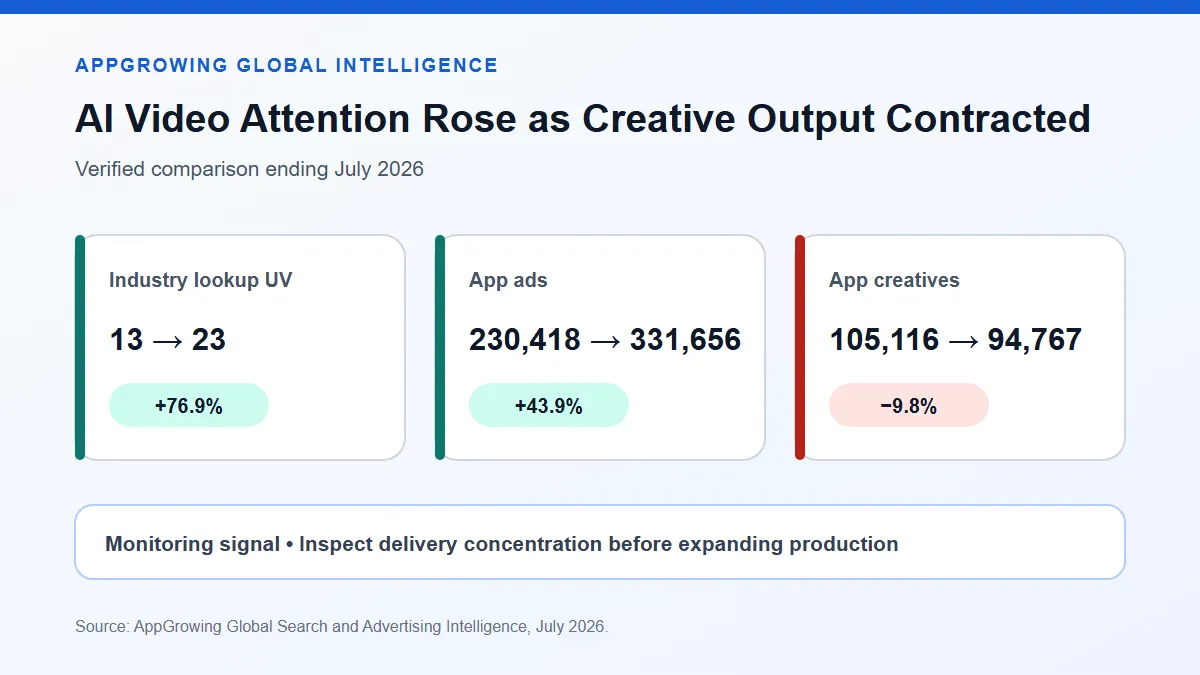
The chart makes the divergence visible without turning it into a performance claim. A growth team can use it to decide where to investigate first. Check whether older materials are being copied into more ad units, whether several variants belong to one repeated concept family, and whether the decline reflects a short production pause or a deliberate consolidation.
Which concepts are carrying the current AI Video message?
AppGrowing’s aggclaw analysis reviewed more than 500 AI Video App materials from the same monthly period. The sample included creatives associated with Dualio, LuminoVid, AIVION, and other tools. Five recurring hook families stood out.
The first is the AI twin speaking in the first person. A human stops working, gets sick, handles family duties, or goes on holiday while the synthetic presenter continues publishing. The second is the one-photo transformation. An ordinary image appears, a brief processing step follows, and the finished video becomes the proof. The third frames creator exhaustion as the conflict. The fourth asks viewers to decide whether the presenter is real. The fifth contrasts a desirable lifestyle with automated production.
These families share a practical structure. They open with a recognizable tension, demonstrate the result, and close with a short brand or download card. One verified example in the sample reached 116,676 impressions with a minimalist gradient close, while another brand-close example reached 38,130 impressions. Those counts identify materials worth reviewing. They do not establish CTR, CPI, or ROI.
How should teams diagnose concentration before making more ads?
Use a three-signal rule. If ads continue rising while creatives continue falling, inspect delivery concentration and repeated concept families. If lookup interest rises while the promise and proof remain unchanged, test a new value demonstration rather than another face, caption, or color treatment. If ads and creatives begin rising together, then test whether the segment has moved from consolidation into genuine concept expansion.
Here’s a pattern I keep seeing. Utility advertisers often describe every output as faster, easier, or more realistic, even when the visual evidence is nearly identical. A useful review sheet separates the opening promise from the proof. Record the hook family, input shown, transformation moment, product interface timing, final result, and CTA. This exposes whether a new material adds a new idea or only a cosmetic variation.
What should the next AI Video test matrix contain?
Build one row for each concept family. Use AI twin, one-photo transformation, workflow relief, reality challenge, and lifestyle contrast as the first five rows. Across the columns, vary the proof rather than the claim. One version can show avatar creation, another can show editing speed, and a third can show multiple finished outputs. Keep the closing brand treatment consistent so the test isolates the promise and proof.
The monitoring decision is straightforward. Rising lookup interest earns the segment a place on the watchlist. Rising ads confirm that advertising activity is expanding. Falling creative output tells the team to inspect concentration before requesting more volume. Together, these signals turn a broad AI trend into a concrete creative review.
