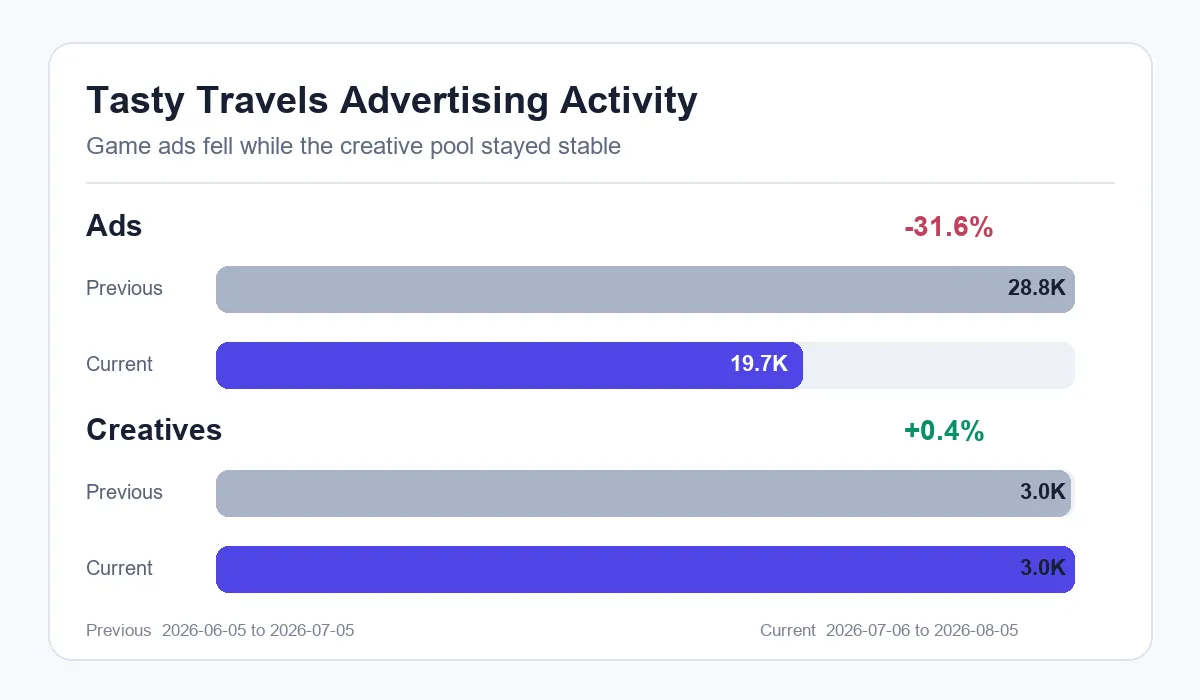
Tasty Travels advertising activity declined, but its creative production system stayed active. Matched game ads fell from 28,783 to 19,686, down 31.6 percent, while creatives moved from 3,011 to 3,023, up 0.4 percent. This is not a signal that testing stopped. UA teams should identify which lifestyle hooks, merge proof, and beach-themed end cards continue to be retained and recut.
What does lower ad activity with a stable creative pool show?
Creatives per 10,000 ads increased from 1,046.1 to 1,535.6, a 46.8 percent rise. The material pool became denser relative to observed advertising activity. That can be consistent with continued production, low-volume exploration, or fewer ad units, but the current data cannot determine the cause. The useful conclusion is to review retained concept families before reducing creative resources.
The keyword tasty travels entered AppGrowing’s current TOP50 with 12 UV and 34 PV. Its PV was the highest among the five newly selected entities in this batch. This is rising industry lookup attention, not player demand. Paired with lower ad activity, it supports a competitor review rather than a market-expansion claim.
Which hooks and gameplay proof remain in the pool?
The aggclaw query matched 2,581 creatives and analyzed the Top 100 by observed impressions. Openers included immediate top-down gameplay, giant burger or fried-chicken food trucks, real-person situations such as a 12-hour flight or poor cafe Wi-Fi, cozy cat viewpoints, and influencer-style recommendations. The line about unwinding after a long day appeared in at least five sampled creatives.
Mid-section proof concentrated on order matching, sliding cups into merges, coin feedback, and seasonal locations including a beach bar, winter cafe, and desert market. Some materials also introduced hidden-object laundry or cat-collection segments. Reviewers should decide whether those sections add a coherent layer to the merge promise or create an unrelated second-game impression.
How should teams review the end card and selling points?
A standardized close repeatedly combined the game icon, beach scene, female character, and download button. Some versions used a Breaking News-style panel. A stable end card helps reviewers compare hooks, but it can also hide whether the proof changed. Record when the end card first appears, the spoken CTA, and whether it continues the relaxation, travel, or merge task introduced earlier.
The sample also included no ads, no Wi-Fi needed, and play-anywhere language. Those are expressions for a claim-review queue, not product facts established by this article. If the current store listing and product behavior do not support the statement, do not reuse it. If the statement is verified, still check that the creative demonstrates a relevant use situation rather than attaching the claim to unrelated footage.
How should the next cooldown review be organized?
Group materials into immediate gameplay, food-truck spectacle, real-person context, cat viewpoint, and spoken recommendation. Capture run days, linked ads, gameplay reveal time, recurring voiceover, and end-card family. Prioritize concepts that continue to appear across multiple ads, and separate language, character, or seasonal recuts from genuinely new proof. This reveals what the stable pool is preserving.
Run a three-part continuity check as a second pass. The opener should establish a clear relaxation, waiting, or food task. The middle should show a readable matching or merge action. The ending should continue the same relaxation or travel promise. When one part breaks the chain, label the material as a packaging test rather than a complete product narrative. This keeps the review focused on how the creative moves from context to proof and then to action.
Here’s a pattern I keep seeing. Merge ads often surround one simple interaction with many lifestyle frames. The flight, cafe, beach, winter, and cat scenes can make the campaign look diverse even when the same order-matching loop sits underneath. A useful review asks whether each frame explains a different reason to play or only changes the decoration around the same proof.
Not sure which Tasty Travels concepts remained important as observed ad activity cooled?
Get a free benchmark check based on your specific app or game category.
The monitoring decision is straightforward. Falling ad activity calls for a cooldown review. Stable creative output tells the team that production and testing still deserve attention. Focus on the hook-to-gameplay transition, recurring voiceover, and shared end card. Those elements show what Tasty Travels continues to preserve while distribution changes.
