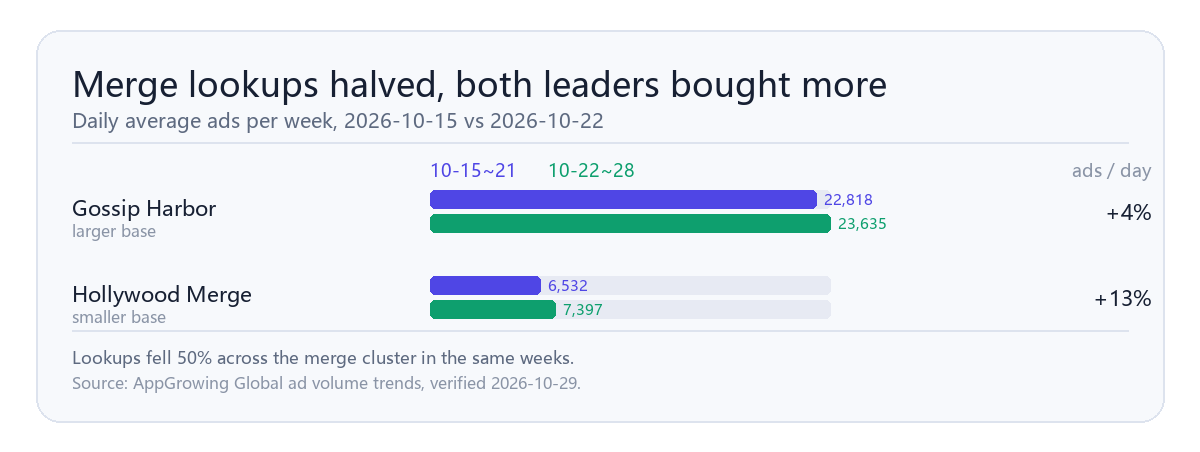
Merge keywords fell from 28 to 14 in combined lookup interest between the weeks of 2026-10-15 and 2026-10-28, a 50% drop, and merge cooking dropped off the list entirely. Both genre leaders bought more anyway. Hollywood Merge rose from 6,532 to 7,397 daily ads, up 13%, and Gossip Harbor from 22,818 to 23,635, up 4%, with its new-ad count rising from 6,636 to 8,917. Attention left the genre; the two largest advertisers did not.
Does a halved lookup count mean the genre peaked?
No. Lookup interest measures what peers are checking, it moves ahead of spend, and it can fall while spend is untouched. What fell this week was attention. Both leaders increased daily volume, and if the genre had actually peaked the first number to move would be new ads. At Gossip Harbor new ads rose 34%.
Why are the two leaders' growth rates so far apart?
Because their bases are three times apart. Gossip Harbor runs 22,818 ads a day, so 4% is a bit over nine hundred ads. Hollywood Merge runs 6,532, so 13% is a bit over eight hundred. The absolute additions are close while the percentages differ threefold, which is the reason to compare what was added rather than the rate at which it grew.
Why does the new-ad count matter more than the total?
Gossip Harbor's new ads rose from 6,636 to 8,917, taking its new-ad share from 29% to 38%. Total volume up 4% with new ads up 34% is a creative refresh, not a volume push. Hollywood Merge went the other way: new ads fell from 681 to 493 and its share slipped from 10% to 7%, which reads as holding rather than rebuilding. Both added volume. Only one rebuilt.
When should a lookup signal be set aside?
When at least two genre leaders have not changed product or spend and lookups still fall, the drop describes attention moving rather than demand changing. The test here is whether the two layers agree. Lookups fell 50%; the leaders' volume rose 4% and 13%; new ads rose 34%. One of the three moved down. In that configuration, treat the cluster number as noise and wait for the next period to see whether it persists.
Which fields should a monitoring routine keep?
Three steps. First, merge the aliases, because counting merge, merge cooking, hollywood merge and gossip harbor separately produces four unrelated signals out of one genre. Second, pull daily ad count and daily new-ad count, and compute the new-ad share. Third, only write a genre conclusion when lookups and spend point the same way; when they do not, write the divergence and name both windows.
Two cautions. Do not read merge cooking leaving the list as the sub-genre disappearing, since it only means the keyword is outside the top 50. And do not let one leader's growth rate stand in for the genre.
For a weekly report that means one line per advertiser rather than a cluster average, because the cluster average is the number that fell by half while both of its largest members grew.
What does the drop-off of merge cooking tell you?
That one keyword left the top 50, not that the sub-genre disappeared. Lookup lists are capped, so a keyword can fall out while the products behind it keep buying at the same level, which makes the exit a statement about attention share rather than about supply. The practical response is to check the underlying titles directly before writing anything about the sub-genre. In this case the two largest merge advertisers both increased volume, so the drop-off reads as the attention moving to other themes rather than as merge cooking cooling down.
How long can this divergence last?
Unknown, but it can be bounded. If new ads keep rising at both leaders while lookups keep falling, attention and buying can stay decoupled for several weeks. If new ads turn down, the leaders have started to follow. Watch the new-ad count rather than the total, because it moves first. Use this pattern to guide monitoring, not to judge campaign efficiency.
Want your genre's lookups checked against real ad volume?
Get a free benchmark check based on your specific app or game category.