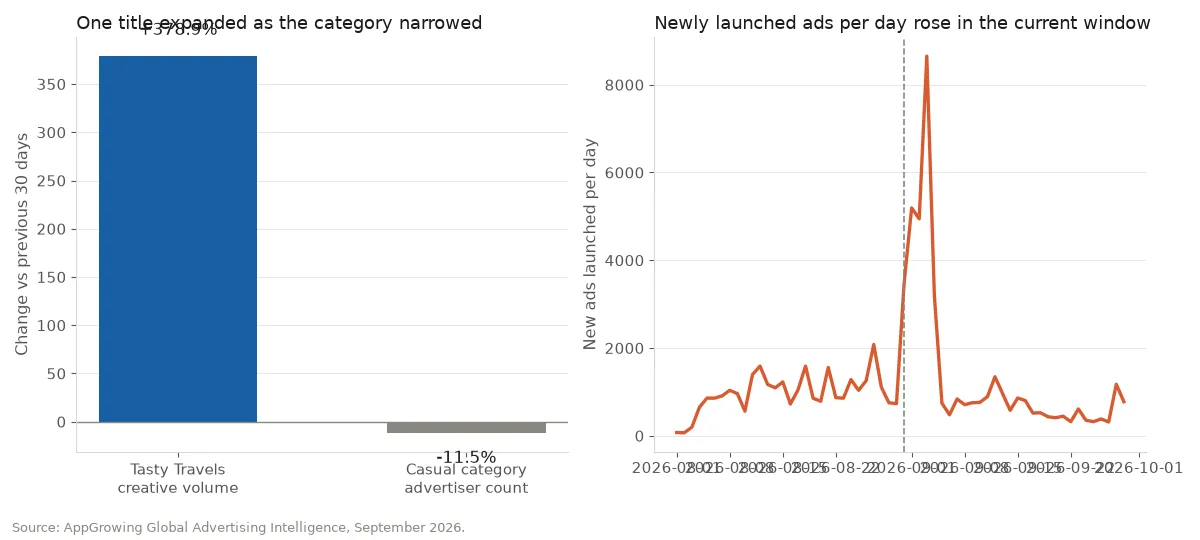
Tasty Travels: Merge Game raised creative records 378.9 percent, from 5,144 to 24,634, in the 30 days to 2026-09-29 while the number of Casual-category advertisers in the same query fell 11.5 percent, from 11,261 to 9,969. The expansion came from a modular creative system: a fixed ~45-second merge body and a fixed end card, with only the hook swapped.
Why did Tasty Travels expand while the casual category narrowed?
Under one query condition, Casual-category advertiser count fell from 11,261 to 9,969 between the two equal 30-day windows, a decline of 11.5 percent. Over the same period, Tasty Travels: Merge Game moved from 5,144 creative records to 24,634, up 378.9 percent, and climbed from rank 43 to rank 8 in the creative ordering. Its ad records rose 27.3 percent, from 45,572 to 58,025.
That combination is not a title holding on in a downturn. It is a title increasing output. The daily data sharpens the picture. Tasty Travels' average daily active ads fell 30.2 percent, from 17,740 to 12,380, while average daily new ad launches rose 43.1 percent, from 972 to 1,391. Falling active ads with rising new launches points to continuous replacement rather than simple accumulation.
A lower advertiser count in the category does not prove softer demand. It only means fewer brands were running under this query. Within the same window, at least one title was still expanding.
What makes 2,860 creatives possible in one month?
The material query for this window returned 2,860 video assets, 153 of them carrying readable English voiceover or subtitles. Decomposing the structure reveals three layers that recur.
| Layer | Content | Variable? |
|---|---|---|
| Hook (0–7s) | Cold-open gameplay, lifestyle character with one conflict line, UGC talking head, anti-ad skit, 3D spectacle (food truck, miniature city) | Variable, five observed types |
| Body (~45–50s) | Top-down merge grid loop, order fulfilment, coin increments, sparkle feedback on each match | Largely fixed — the product demonstration engine |
| End card (1–2s) | Beach backdrop, character, game logo, Download button, Breaking News style title bar | Template, almost never rebuilt |
This is a sandwich structure. The top layer is packaging that can be swapped; the middle demonstration and the bottom conversion module stay reusable. Four identifiable body templates appeared in the sample: pure gameplay plus end card, lifestyle voiceover plus gameplay, UGC streamer split-screen plus gameplay, and 3D spectacle transitioning into gameplay. All four share the same gameplay body and the same end card.
That is why volume scales: a new asset only requires rebuilding the top layer. The middle and the end card carry almost no incremental production cost. The practical bottleneck is therefore not total production capacity. It is the size of the hook library.
Which parts are actually being reused?
On the audio layer the recurring scripts are even more concentrated than the visual templates. Three families dominate the sample: free-to-play and no-ads claims, recommendation-style social proof, and contrarian openings that tell viewers not to start. The claim that the game has no ads, needs no Wi-Fi and is completely free appears in at least eight distinct high-cumulative-impression creatives.
That claim deserves its own line in a monitoring sheet, because it is a positioning sentence rather than a visual element. It places the title opposite user fatigue with ad-heavy casual games, and it shows up in both the hook and the body voiceover.
Hook-type shares and segment boundaries here are semantic derivation from returned visual descriptions, not interface fields. Script repeat counts are sample-internal and cover only the assets returned for this window.
How should a team apply this pattern?
If your category also shows a narrowing advertiser pool, check a single competitor in three steps. First, compare creative records and ad records across two equal windows to see whether they moved together or separated. Second, split that entity's high-cumulative-impression assets into hook, body and end card, and measure how much each layer varies. Third, if body and end card are largely repeated, put the budget into the hook library rather than into raw capacity.
One step is easy to skip: use daily new-ad data to separate replacement expansion from volume expansion. Rising new launches with falling active ads means continuous replacement. Both rising means the title is growing total delivery. The two call for different production schedules.
Re-pull monthly. Creative records shift with entity resolution, window length and filters, so carrying this window's absolute values forward will drift. Every figure here is an advertising-activity record from the queried sample, not spend, CPI, ROI or market size.
Not sure whether your casual title's creative output can scale without a new production line?
Get a free benchmark check based on your specific app or game category.