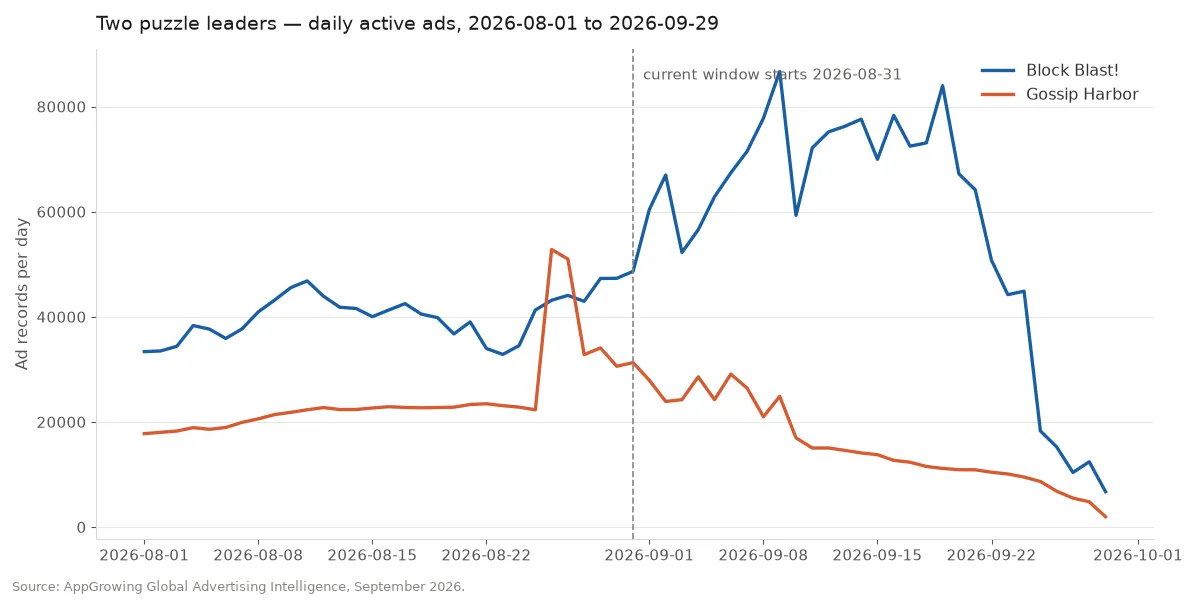
The two puzzle leaders expanded on opposite schedules in the 30 days to 2026-09-29. Block Blast! raised creative records 42.8 percent to 55,786 and ad records 24.8 percent to 418,766, while Gossip Harbor raised creatives 14.1 percent to 42,889 and cut ads 5.6 percent to 134,981. Their creative architecture is inverted: one proves the game through play, the other proves the story through play.
Why did one puzzle leader expand while the other consolidated?
In the same window, Block Blast! moved from 39,054 to 55,786 creative records (+42.8%) and from 335,462 to 418,766 ad records (+24.8%). Creatives and ads moved together, which is an expansion shape. Daily data confirms it: average daily active ads rose from 40,064 to 57,449, up 43.4 percent.
Gossip Harbor took the other route. Creative records rose from 37,602 to 42,889 (+14.1%) while ad records fell from 142,916 to 134,981 (-5.6%) and average daily active ads fell from 24,555 to 15,938 (-35.1%). It added assets while contracting delivery.
The two remain adjacent on the creative ranking, moving from third and fourth to second and third. They occupy the same tier of the category on deliberately different schedules.
What is each set of creatives actually proving?
Decompose the structures and the difference is architectural rather than a matter of degree.
| Dimension | Block Blast! | Gossip Harbor |
|---|---|---|
| Gameplay proof | Direct screen recording of grid placement, line-clear animation and a live score counter — the board is the content | The merge grid appears as a 2–5 second cut-in between narrative scenes, framed as a task a character performs |
| Opening problem | An incomplete grid with visible gaps waiting to be filled; some assets overlay clear-rate scarcity copy | An emotional crisis — broken window, freezing child, collapsed room, a tearful character face |
| Pacing engine | Elimination cascade: place, clear, score bump, new blocks, repeat | Narrative beats: crisis, merge fragment, scene transition or dialogue, another gameplay fragment, resolution |
| Visual style | Pixel and low-poly blocks, wood-grain texture, warm amber palette, high-saturation clearing flashes | 3D cartoon rendering, cold-warm contrast between snow and warm interiors, character-forward compositions |
| Closing CTA | Brand reveal: pixel title plus PLAY button plus star icon, last 3–4 seconds a static brand card | Scene-based soft close: a character smiles in a renovated room with the logo and download button overlaid |
The material query also supports a distribution reading. Block Blast! leans heavily toward pure gameplay proof with almost no narrative arc; Gossip Harbor leans the other way, with narrative driving the structure and the merge mechanic embedded as a chapter device. Both use puzzle mechanics, but one treats the board as the narrative and the other treats the mechanic as one scene inside a multi-scene emotional arc.
That distribution reading is derived from returned visual descriptions, not an interface field.
What do the two architectures mean for a team?
The architecture decides where production bottlenecks sit. The pure-gameplay route is bottlenecked on clarity and pacing of the mechanic, and it templates easily: the end card is almost never rebuilt. In this window Block Blast!'s highest-cumulative-impression asset carried 494 linked ads over 234 active days.
The narrative route is bottlenecked on script and character. Assets need scenes, relationships and emotional payoff, which lengthens the cycle, but a single asset can run for a long time. Gossip Harbor's highest-cumulative-impression asset showed 587 active days with 13 linked ads.
Those two figures are not an efficiency comparison. Linked-ad counts and cumulative impressions are returned record values, and they do not establish spend, ROI or creative quality. They show two different reuse patterns: a few assets carrying heavy delivery, versus a long-running asset with light delivery attached.
How should a team choose between the two?
Start from your own production capability. If the team is small but strong on gameplay expression, the pure-gameplay route raises output at a lower unit cost. If the team holds stable writers and character assets, the narrative route is harder for competitors to copy quickly, but it needs a longer lead time.
Separate the monitoring metrics. For the gameplay route, track material-type mix and the stability of the end-card template. For the narrative route, track how often characters and scenes recur, and the time split between story beats and gameplay segments. Mixing both into one table makes the two sets interfere.
That two leaders in one category chose opposite directions is itself useful. Across these two samples, no single creative architecture dominates. Compare how well an architecture fits your team rather than copying a competitor's current move.
Not sure which puzzle competitor's creative structure is worth copying?
Get a free benchmark check based on your specific app or game category.
