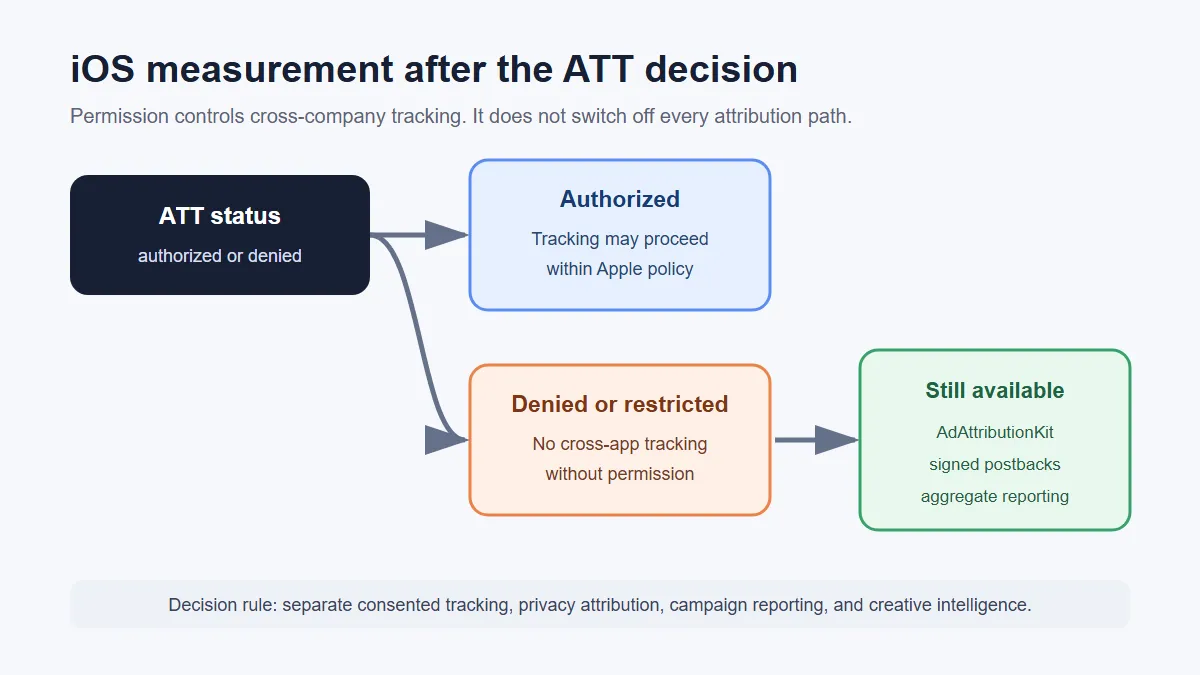
An ATT denial does not switch off every form of iOS advertising measurement. It prevents tracking that requires permission to connect user or device data across other companies’ apps and websites, while privacy-preserving attribution, aggregated platform reporting, and creative monitoring can still operate. The practical fix is to separate user-level tracking, attribution postbacks, platform reporting, and competitive creative intelligence instead of calling all four activities tracking.
What does ATT actually control?
Apple says an app must use AppTrackingTransparency when it collects end-user data and shares that data with other companies for tracking across apps and websites. The implementation has three basic parts. The developer provides a purpose string, requests authorization, and reads the resulting authorization status.
The framework exposes four states. They are not determined, restricted, denied, and authorized. These states describe permission for the tracking behavior covered by Apple’s rule. They do not describe whether analytics is installed, whether a campaign produced an install, or whether an advertiser can examine public creative activity. ATT is a permission boundary, not a universal measurement switch.
Which measurement paths remain after a denial?
Apple’s 2025 privacy guidance states that calling AdAttributionKit APIs does not require displaying the ATT prompt. AdAttributionKit can attribute app installs and re-engagements to campaigns through signed postback signals generated by the device. An advertised app can also specify an endpoint to receive a copy of those postbacks.
Aggregated or modeled platform reporting may provide another layer. Creative intelligence provides a different one by monitoring observable ad activity, creative volume, script structures, visual styles, and competitor changes. These sources should not be blended. A postback addresses campaign attribution. A platform report summarizes account outcomes. Creative intelligence explains what competitors are producing and testing.
What information does privacy attribution not restore?
AdAttributionKit should not be described as a replacement user profile when ATT permission is absent. A privacy-preserving postback does not recreate a person-level journey that can be joined freely across companies. It provides an attribution signal under platform-defined rules, with platform-defined fields, timing, and privacy protections.
This distinction matters when a vendor promises complete visibility after ATT denial. Ask whether the output is a signed postback, an aggregated platform estimate, an advertiser-owned event, or a user-level identity link. Only the final category raises the specific cross-company tracking question that ATT is designed to govern.
How should UA teams rebuild the measurement stack?
Use four layers. First, record ATT authorization status and limit consented tracking to permitted purposes. Second, receive and validate privacy attribution postbacks such as AdAttributionKit signals. Third, document whether platform metrics are observed, modeled, or combined, along with their event definitions and conversion windows. Fourth, use creative monitoring to interpret competitor activity without relabeling creative counts as installs, revenue, or incremental lift.
The decision rule is direct. If a question requires identifying a person across companies, check ATT permission and policy scope first. If it requires campaign-level install or re-engagement attribution, inspect the privacy postback path. If it asks which hooks or scripts competitors are testing, use creative intelligence. Matching the question to the correct layer is more reliable than forcing one metric to fill every measurement gap.
How can teams avoid misreading an ATT data gap?
When reporting changes, check authorization state, platform support, postback configuration, event definitions, and conversion windows before blaming budget or creative. An ATT denial shows that a class of tracking was not authorized. It does not by itself prove campaign failure, user loss, or creative fatigue.
Label each output as observed data, modeled data, privacy postback data, or framework judgment. That simple discipline keeps teams from comparing unlike signals and makes the final decision auditable. The useful conclusion is not that measurement disappeared. It is that iOS measurement became a layered system with different permissions, granularity, and questions for each layer.
Apply the same labels during vendor review. Ask whether a result comes from a device-signed postback, platform modeling, an advertiser-owned event, or an identity link. Record its granularity, delivery delay, conversion window, and known missing conditions. A product that provides aggregate signals should not be described as reconstructing a complete user path. Precise data-type language is more useful than an undefined promise of full-funnel visibility.
