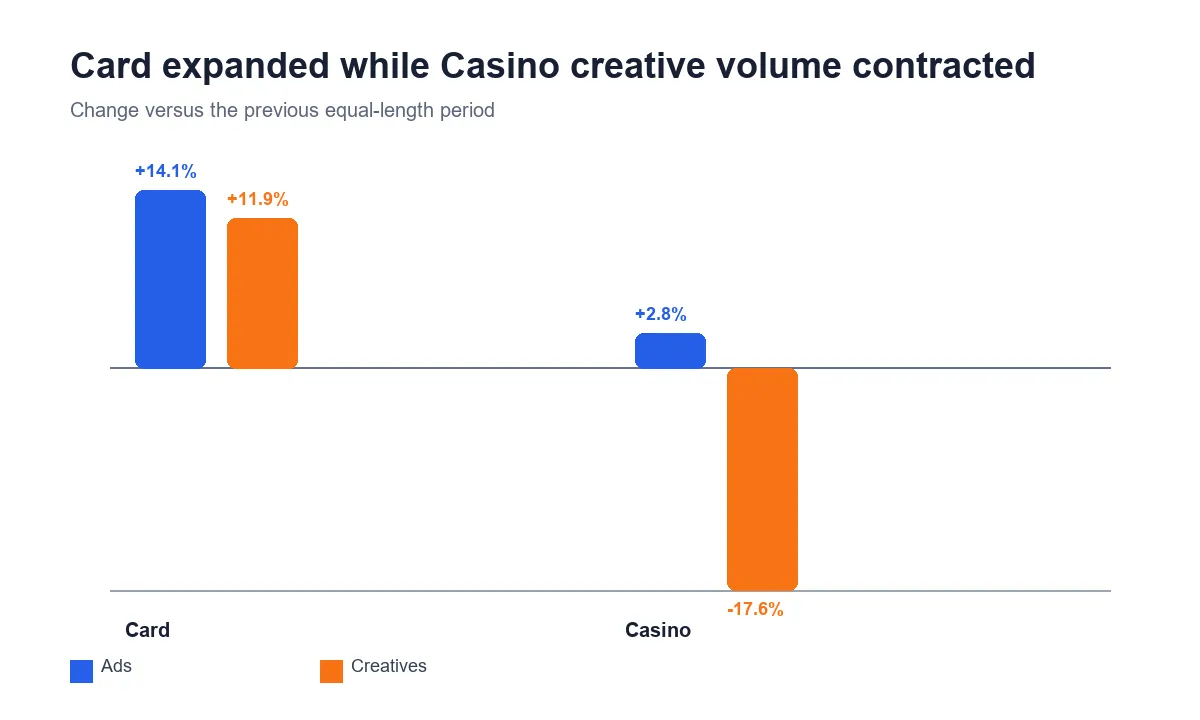
Card and casino games did not show the same type of advertising growth. Card ads and creatives increased together, while casino ads rose slightly as creative volume contracted. Card therefore needs family-expansion monitoring; casino needs tighter reuse, reward-language and risk-review monitoring.
Why are these not the same type of growth?
Card and casino games require different monitoring plans because their ad and creative measures separated. Card ad records increased from 5,578,103 to 6,364,850, up 14.1 percent, and creatives increased from 859,684 to 961,783, up 11.9 percent. Casino ad records rose only 2.8 percent, from 404,680 to 416,055, while creatives fell from 61,759 to 50,904, down 17.6 percent. Card shows synchronized expansion; casino shows stable activity with contraction.
The correct action is therefore different. Card monitoring should look for new families, long-tail accumulation and broader reuse. Casino monitoring should look for short-cycle template rotation, concentration and risky reward language. The trend fields describe activity direction, not spend, market share or effectiveness.
The trend comparison should be read as two separate category diagnoses. Card sits in the dual-growth quadrant, so reviewers should scan for added family breadth and wider reuse. Casino sits in a mixed quadrant, so reviewers should ask whether a smaller set of assets is carrying stable advertising activity.
How does each category attract attention and prove play?
The aggclaw library matched 134,488 card materials and 185,393 casino materials. Each comparison used the top 100 cumulative-impression assets plus 50 voiceover samples. Card openings often use beaches, farms, cute animals, nostalgic solitaire tables and Free Solitaire text. Proof comes from a clean card board, finger taps and an understandable rule.
Casino openings use ALL IN text, chip stacks, roulette spins, jackpot figures and dramatic face-offs. Proof centers on the bet and winning moment rather than a calm rule explanation. The card voiceover subset contained 16,549 materials and the casino subset 14,390. In the sample, card calls to action were softer, while casino executions used urgent install prompts, CALL cards and reward-led conversion.
The aggclaw material library uses its own category IDs, separate from the webhook taxonomy. The analysis aligns the verified category names only and keeps system totals independent. Top cumulative-impression and voiceover samples support content-pattern review, but their sample proportions are not population shares and should not be published as prevalence.
Need a verified benchmark for this category or competitor?
Ask for a free review using your own app, category and monitoring question.
Why must risk review be part of monitoring?
The card sample included unattributed senior-use percentages, neurologist recommendations and memory or sleep claims. These need source and policy review before reuse. The casino sample included instant-withdrawal language, free spins, large prize amounts, violent ALL IN scenes and cartoon animals inside gambling contexts. These are risk-review signals, not automatic violation findings.
Add a claim-evidence field for card creatives and a reward-regulation field for casino creatives. Record whether age or responsible-gambling labels are visible where relevant. Also separate simulated or virtual casino wording from real-money claims. A creative team should never convert high cumulative exposure into an assumption that the expression is safe or effective.
Monitoring cards should distinguish attention device, gameplay proof, reward language, CTA and policy-review status. Card examples often prove an understandable solitaire rule before a soft challenge. Casino examples compress the sequence into stake, spin or reveal and reward. One template cannot describe both without losing important risk context.
What cadence should each category use?
Review card families monthly for new variants, long active windows and linked-ad accumulation. The sample contains multiple assets active for more than 1,200 days and families repeated across several IDs. Review casino weekly for new-material velocity, template turnover, cash-out wording, jackpot framing and labeling gaps.
Both workflows need semantic noise control because category filters can contain cross-tagged material. The final sheet should record structure, reward expression, CTA, reuse family and risk status separately. That keeps an expansion playbook from being copied into a contracting category and gives compliance reviewers a concrete queue.
Set different review cadences and escalation rules. Monthly card review can focus on family growth and long-lived reuse. Weekly casino review can flag new cash-out, jackpot, free-spin and urgency wording for human review. Exposure history never removes the need to verify claims, labels and the applicable market policy. Preserve the original material ID, voiceover text and visual description beside every flag. That audit trail lets creative, UA and compliance teams review the same evidence without turning a sample observation into a category-wide claim.
