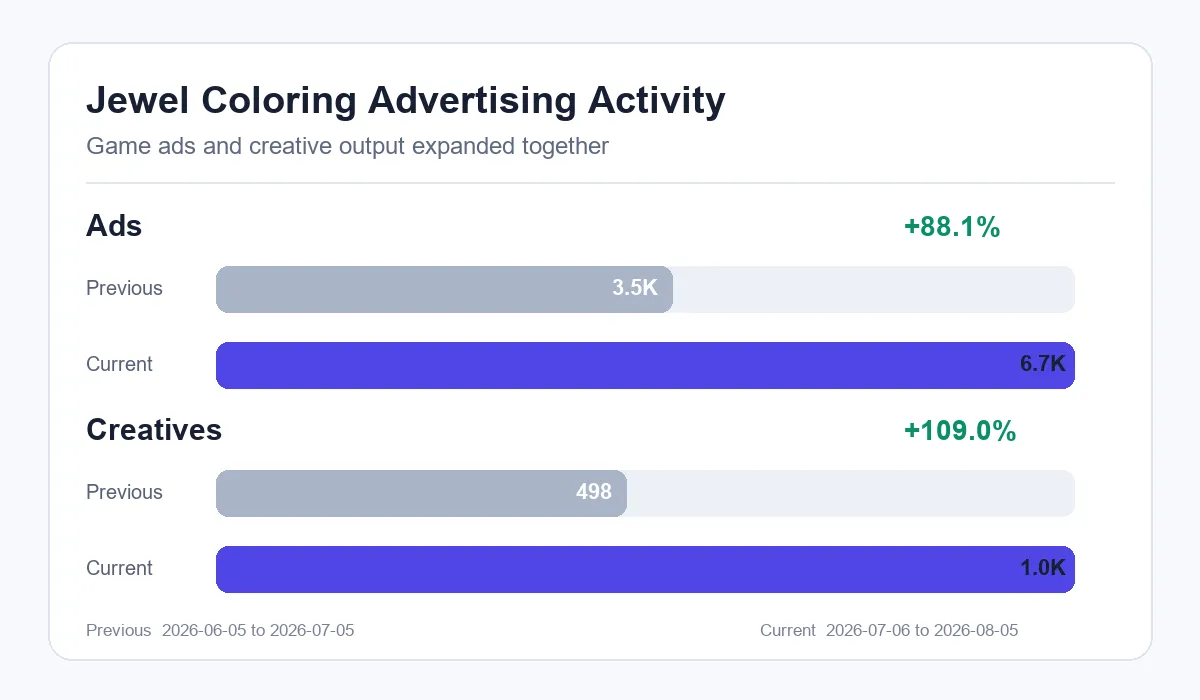
Jewel Coloring expanded both observed advertising activity and creative supply. Matched game ads increased from 3,541 to 6,662, up 88.1 percent, while creatives rose from 498 to 1,041, up 109.0 percent. This is an expansion signal rather than a concentration signal. UA teams should raise monitoring frequency and separate batch gameplay templates from genuinely new hooks, proof sequences, and audience situations.
Which numbers show that Jewel Coloring is expanding?
Creatives per 10,000 ads increased from 1,406.4 to 1,562.6, up 11.1 percent. Ads and creatives moved in the same direction, and creative output grew faster. The current pattern is consistent with a broader testing range, not only broader distribution of a fixed pool. It still does not show which individual material produced better CPI, conversion, or revenue.
The keyword jewel coloring entered AppGrowing’s current TOP50 with 11 UV and 15 PV. This is industry lookup interest, not evidence of player demand. When it appears alongside rising ads and creatives, it supports a higher competitor-review priority. The advertising and material data supply the expansion evidence.
Which hooks make up the current expansion mix?
The aggclaw query matched 648 creatives and analyzed about the Top 100 by observed impressions. Openers fell into five working families. They were direct gameplay, SUPER WIN reward feedback, real-life waiting situations such as checkout or laundry, jewelry and bead-object previews, and static screenshots combining an App icon with the game grid.
Mid-section proof showed color-by-number filling, gem or pattern restoration, progress stars, pixel animals, and level feedback. A lifestyle opener becomes useful only when it moves quickly into a visible action. If a person waiting in a supermarket or near a washing machine never leads to a clear coloring task, the scene creates attention without proving the product promise.
How can teams separate batch templates from new tests?
Five static images shared the same 133 run days and 75 linked ads, identifying one batch-template family. The sample also contained several fresh materials with seven run days and one linked ad. Those rows are useful for detecting small-scale refresh tests. If a new file changes only the pixel animal or background, keep it inside the existing gameplay family. If it changes the opening task, proof, or usage situation, mark it as a new concept.
Some sampled creatives used 100% offline, 2,000-plus levels, ranking, and senior brain-training language. Treat those statements as items for claim review, not verified product facts. Check the current store listing, actual product behavior, market, and landing page before adapting them into another brief. The monitoring task is to record the expression and its creative role.
What should the next expansion watchlist contain?
Create five lanes for direct gameplay, reward feedback, lifestyle context, object aesthetics, and static screenshot ads. Record new materials, linked ads, run days, proof timing, and CTA for each lane every week. Maintain a separate new-test column for seven-day assets and watch whether they graduate into wider distribution. In an expansion phase, concept coverage matters more than the file total alone.
After a fresh test enters the sheet, check whether it gains linked ads, remains active for longer, or produces a second batch using the same structure. If none of those changes appear, keep it as an exploration record. If one appears, promote it to the priority-review lane and compare its proof with the established gameplay family. This is a monitoring rule, not a performance threshold, and it keeps small tests from being mistaken for scaled concepts.
Here’s a pattern I keep seeing. Casual puzzle expansion often combines one stable mechanic with many visual surfaces. A fox, a whale, a bead dress, and a supermarket scene can all lead to the same tap-and-fill loop. The useful question is whether the surface changes the audience problem or simply decorates the same proof. That distinction should drive the next test matrix.
Not sure which Jewel Coloring hooks represent new concepts and which are batch variants?
Get a free benchmark check based on your specific app or game category.
The decision rule is practical. When ads and creatives rise together, treat the competitor as expanding. When the new-test column produces new proof or a new usage situation, promote that concept in the watchlist. When it only changes art subjects, keep it within the existing family. This turns rapid output growth into a review sequence the team can act on.
