To make a reward ending do the proving, attach the closing number to the same player action the ad opened with, and keep that number incrementing for at least one beat before you cut to it. In an AppGrowing Global sample of 10 creatives with explicit closing-stage quantitative cues from 2026-09-15 to 2026-10-15, the highest row holds 29,036,558 cumulative impressions across 1,520 active days and 100 linked ad creatives, and its opening combo and score rush is reintroduced inside the closing combat footage.
Why does the closing number carry the proof?
Because a number can be remembered and compared, while an adjective cannot. The closing tags in this sample lean on combo counters, score digits, damage figures and health bars, which translate becoming stronger into a readout the viewer can hold on to. A close that only asserts strength gives the viewer nothing to check the claim against.
What should the number be attached to?
The same player action that carries the rest of the ad. The sampled rows keep the counter or multiplier incrementing for at least one beat, then cut or push in so the numeral occupies the visual centre. When the number is separated from the action that produced it, it stops reading as evidence and starts reading as an overlay. The practical test is simple: if you can mute the ad and still understand where the number came from, the close is doing its job; if the number only makes sense with the voiceover explaining it, the visual beat is still missing.
How should the closing echo the opening?
By reintroducing the opening metric in magnified form. In the highest row, the opening runs a combo and score rush, and the close puts the same combo and score language inside the combat footage with a larger damage figure and a higher level. That echo is what makes the asset read as one continuous process rather than two stitched segments, and it gives the closing beat something specific to escalate. Where the opening and the close use different metrics, the viewer has to build a new frame at the end, which is exactly the moment attention is lowest.
What if no CTA copy is available?
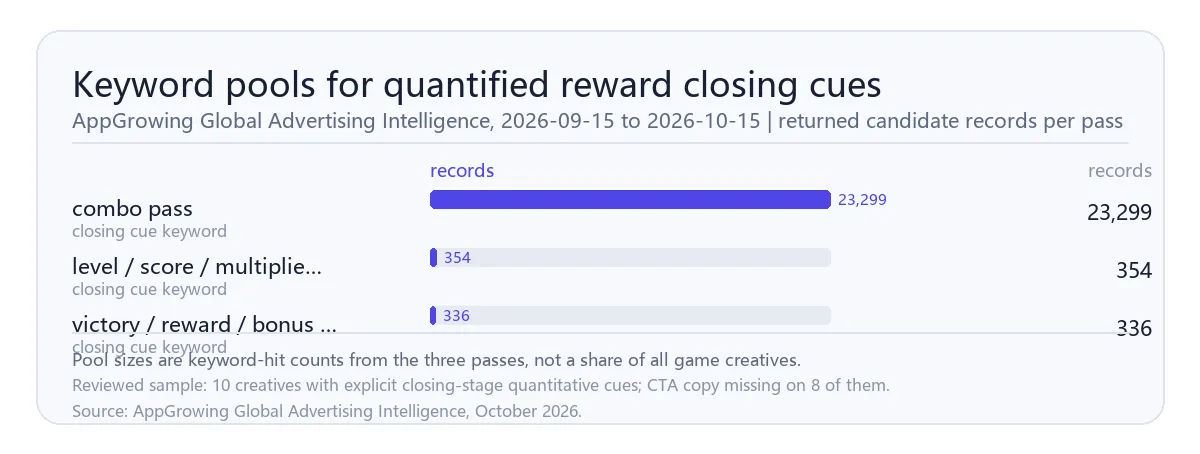
Let the unfinished progress state carry the pull. Some rows close on an incomplete level or an unmet target, which turns the gap itself into the prompt. This matters practically because CTA copy is missing for 8 of the 10 rows in this sample, so closing wording has to be confirmed in the asset rather than assumed from the data.
How should the close be tested?
Change one element at a time and keep the rest of the close fixed: first the length of the incrementing beat, then whether the number is centred in frame, then whether the opening metric is the one being escalated. Reading the result on the ad platform's own measurement window matters here, because the cumulative impressions quoted throughout this sample are lifetime values and cannot be used as a before-and-after comparison for a new test. It also helps to hold the closing beat duration constant across variants, so any difference in outcome can be attributed to what the number shows rather than to how long the viewer had to read it.
What should teams brief for the close?
- Keep the counter or multiplier incrementing for at least one beat before the cut.
- Cut into or push in on the number so the numeral sits at the centre of the frame.
- Reintroduce the opening metric in a larger form, such as a higher multiplier or a bigger bonus.
- Give the number an object to sit on, such as a trophy, a reward card or a button panel.
- Place the prompt line last, or let an unfinished progress state stand in for it.
Not sure whether your game ad's closing number is doing any proving?
Get a free benchmark check based on your specific app or game category.
A reward ending is a small accounting problem: the ad has to show where the number came from, and the viewer has to have watched it grow. Do that and the close feels earned rather than announced, and the same five steps apply whether the number is a combo count, a multiplier, a level or a coin total.
