A promise-to-play audit does not decide whether an ad is good; it checks whether the opening promise is continuously supported by the play shown afterward. The current review examined eight high-cumulative-impression Last War records and eight Golf Orbit records through five steps: promise, input, rule, feedback, and continuity into the core system and CTA.
Why must the audit begin with extractable material evidence?
A title, cumulative-impression value, or active-day count cannot reveal what an ad shows. Reviewers can compare the opening, body, and close only when visual description or transcript evidence is available. Several current records contained metrics but no structured visual or spoken content, so they were marked not auditable. Missing evidence is neither a pass nor a fail; it is a retrieval status that should send the material back for inspection.
What does the five-step audit check?
Step one writes down the opening promise. Step two identifies the input method depicted or implied. Step three describes the observable rule. Step four checks whether failure or reward follows from the action. Step five asks whether the core-system cue and CTA continue the same task. Each field must come from the material itself. Product knowledge may help formulate a follow-up question, but it cannot fill a missing frame or transcript.
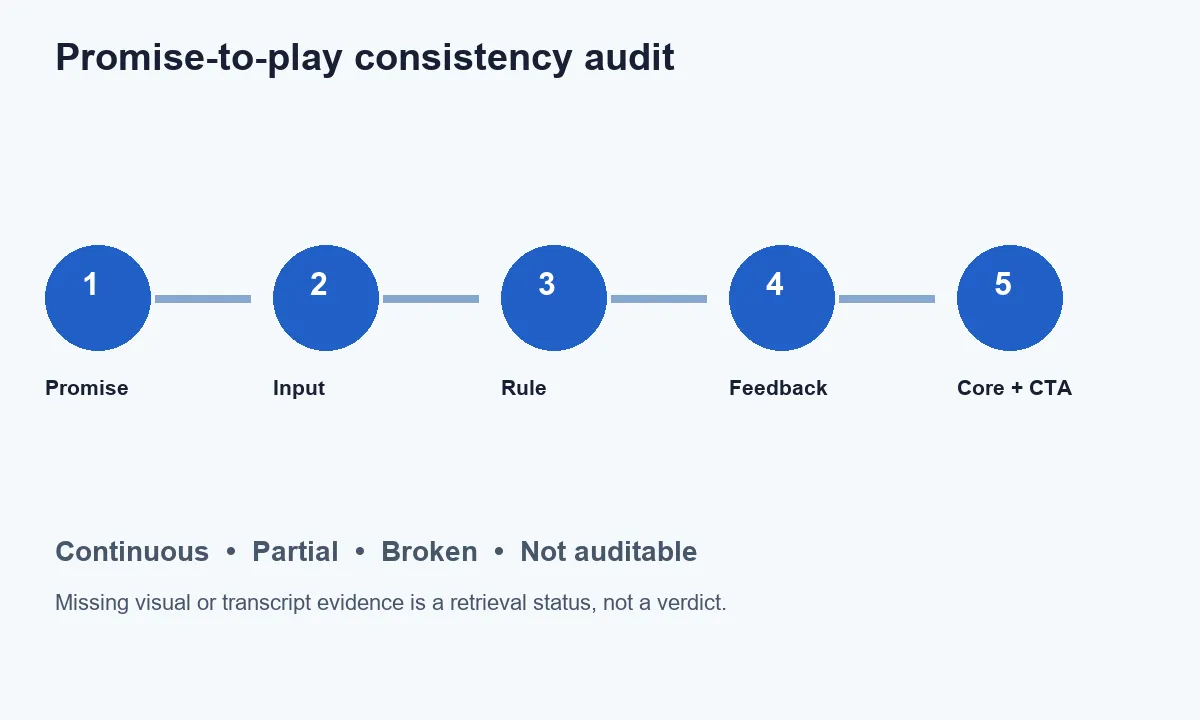
Which bridge problem appeared in the Last War sample?
One Last War material used a meta-hook contrasting “real gameplay” with fake-ad conventions. It then showed a number-growth lane sequence before closing on multiplayer shooting and capture-the-flag imagery. The opening and middle shared a playable thread, but the middle and close shifted systems, so the review marked it partially consistent. Other records offered only narration or static art; they could support a theme observation but not a rule-continuity judgment.
How did Golf Orbit show partial and thematic consistency?
One Golf Orbit sample opened with a golf swing and then sent the ball into a neon rail, combining golf and orbit-track movement. That is a partial match between the opening action and the depicted core. Another sample kept the swing, input cue, and celebration around one golf-shot task and was consistent at the theme level. Neither classification says which material performed better. It only describes how many conceptual jumps a viewer must make.
When should a material be blocked from imitation?
Pause imitation when the opening promise, core rule, and closing system represent three different tasks, then ask the product team to supply the missing bridge. Do not label a material deceptive or highly consistent when its visual evidence is missing. A practical rule is to require direct visual or transcript support for at least three consecutive audit steps before assigning a continuity judgment. Otherwise, mark the item for re-review.
How should evidence quality enter the audit score?
Add one of four evidence labels to every step: direct visual, direct transcript, semantic inference, or missing. A continuity judgment should rely primarily on direct visual and transcript evidence. Semantic inference can support a bounded description, while missing evidence contributes no score. Keeping evidence quality separate from the continuity status prevents a poorly documented material from being treated as highly consistent merely because the reviewer did not observe a contradiction.
How is consistency review different from compliance review?
Consistency review describes whether the promise and depicted play form a coherent chain. It does not decide whether an ad is unlawful, misleading, or contrary to platform policy. A compliance conclusion needs additional evidence about the target market, applicable rules, landing destination, and actual product experience. Teams can use continuity status to prioritize a deeper review, but they should not rewrite “partially consistent” as a policy violation.
Not sure whether a mini-game ad keeps its promise through the playable experience?
Get a free benchmark check based on your specific app or game category.
How should the audit enter the creative brief?
Keep the five evidence fields and a link to the reviewed material, then assign one of four statuses: continuous, partially continuous, broken, or not auditable. The creative team should extract variables only from segments whose continuity can be explained. This preserves useful opening tension, feedback rhythm, or visual exaggeration without copying a promise that the first playable experience cannot support.
