Build a Royal Match creative-variant taxonomy around the promise of the ad, not its surface look. The same king, board, or color palette can serve very different creative jobs. In 12 high-cumulative-impression video samples checked on September 17, 2026, the useful monitoring unit combined the opening device, gameplay proof, and CTA continuity, then assigned each material to one mutually exclusive family.
Why does a normal swipe file fail as a monitoring system?
Teams often save “king in danger,” “match-3 board,” and “creator voice-over” as parallel folders. One ad then appears in several places, and the weekly review cannot tell whether a structure is expanding or whether the team simply collected more executions. A stronger system starts with the ad’s primary promise. Characters, settings, and emotions remain secondary tags. The main family is exclusive; the descriptive tags can be multiple. That distinction separates a genuinely new structure from a familiar structure wearing new art.
Which six families appeared in the current sample?
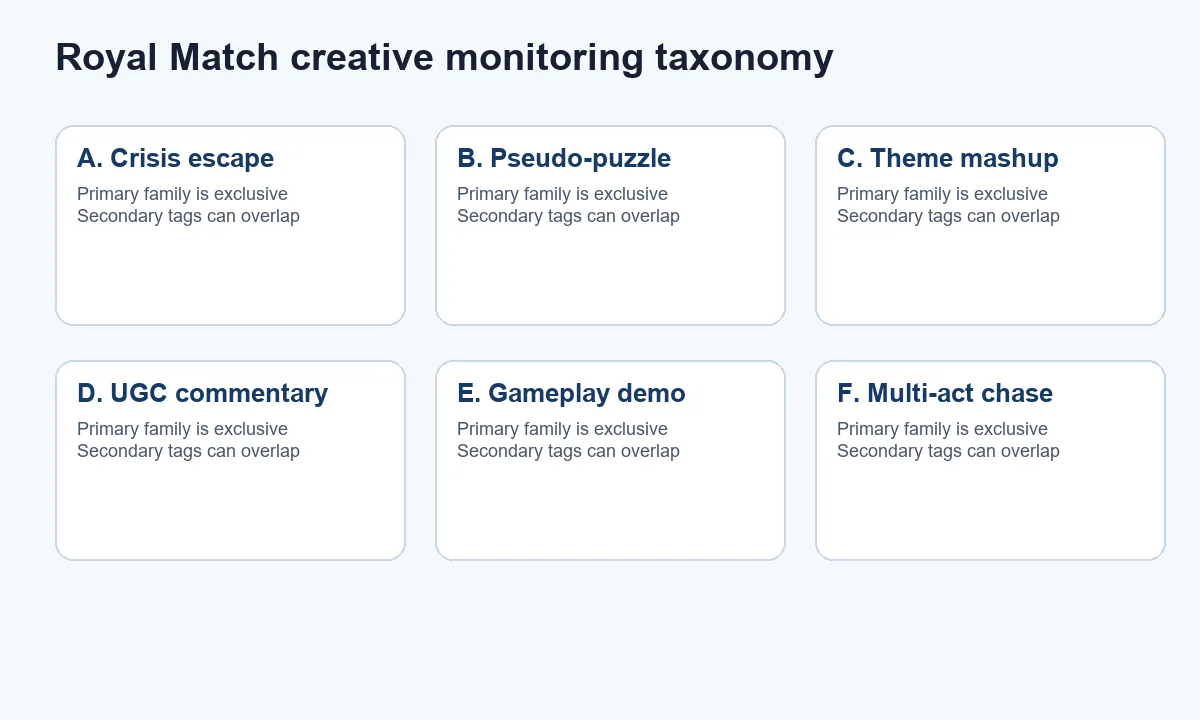
The 12 reviewed videos were organized into six families: crisis-escape openings, pipe or water-flow pseudo-puzzles, industrial or fantasy theme swaps, UGC-style commentary, extended standard-gameplay demonstrations, and multi-act character chases. The highest cumulative-impression record showed 110,791,464 impressions, 1,786 active days, and 100 linked ads. Those fields make it a high-priority review item, but they do not prove current-period efficiency, conversion, or profit.
What fields belong in the competitor-monitoring sheet?
Use one row per material ID. Record cumulative impressions, active days, linked-ad count, opening device, first visible rule, failure or reward feedback, character task, closing CTA, and primary family. Add a “source of variation” field that identifies whether the execution changes the character, setting, rule, narrative, or CTA. This makes production movement visible at the correct layer. A higher material count alone cannot tell the team whether a competitor tested a new idea or merely rendered more versions.
When is a material a variant rather than a new family?
If the opening promise, core interaction, and outcome feedback remain the same while the character or art changes, keep the material in the existing family. If the ad changes the problem the viewer is asked to solve, or introduces a different playable rule in the opening, create a new family. A practical rule is to require structural change in at least two of the three core fields before promoting an execution to a new family. Otherwise, classify it as a production variant and preserve the original family ID.
How should UA teams turn the taxonomy into a weekly action?
First count newly observed materials by family. Next, check whether the high-cumulative-impression or high-linked-ad records introduce a new execution variable. Do not call the highest record a winner; place it in a priority-review queue. The creative team can then select one stable family and change one variable at a time—for example, the crisis character or the timing of gameplay proof—while holding the other structural elements constant. The taxonomy becomes a test planner rather than a retrospective filing system.
How should cumulative fields affect review priority?
Cumulative impressions, active days, and linked-ad counts can order a review queue, but they should not be treated as direct performance scores. A long-running material can signal that a structure has been repeatedly reused. A high linked-ad count can signal that an asset has been extended across many executions. Reviewers still need to return to the frames and determine whether the reusable unit is the opening, the play sequence, or the closing card. Only then can a descriptive metric become a controlled test hypothesis.
Not sure which Royal Match creative families deserve weekly monitoring?
Get a free benchmark check based on your specific app or game category.
What should the final deliverable look like?
The deliverable is not a gallery. It is a living family ledger in which one row equals one material ID, each observable variable has its own column, and the classification reason remains auditable. When the main family is exclusive, secondary tags are reusable, and cumulative metrics are not presented as performance, Royal Match monitoring changes from “we watched many ads” to “we can see which structure changed and what to test next.”
