A creative that remains visible for months deserves attention, but it does not deserve an automatic winner label. Long duration can reflect retained media use, repeated relaunches, broad syndication, incomplete archival boundaries, or a genuinely durable concept. The practical approach is to use duration as a discovery signal and then verify the material, app entity, message, and placement context. In the AppGrowing Global query checked on August 28, 2026, a 30-day active window plus a minimum duration of 30 days returned 1,403,722 matched material records. That large result set is a review pool, not a leaderboard of profitable ads.
Why is long duration useful but insufficient?
Duration answers a narrow question: how long the platform has observed a material record between its first and last dates. It does not reveal daily spend, conversion quality, creative-level revenue, or whether delivery was continuous. Lifetime exposure bands are also cumulative, so they cannot be read as exposure added during the selected 30-day window. This distinction protects the review from a common shortcut. A retained material may contain a stable hook or production-efficient template, but the team still needs performance data from its own accounts before calling the idea scalable, efficient, or profitable.
How should analysts build a retained-creative set?
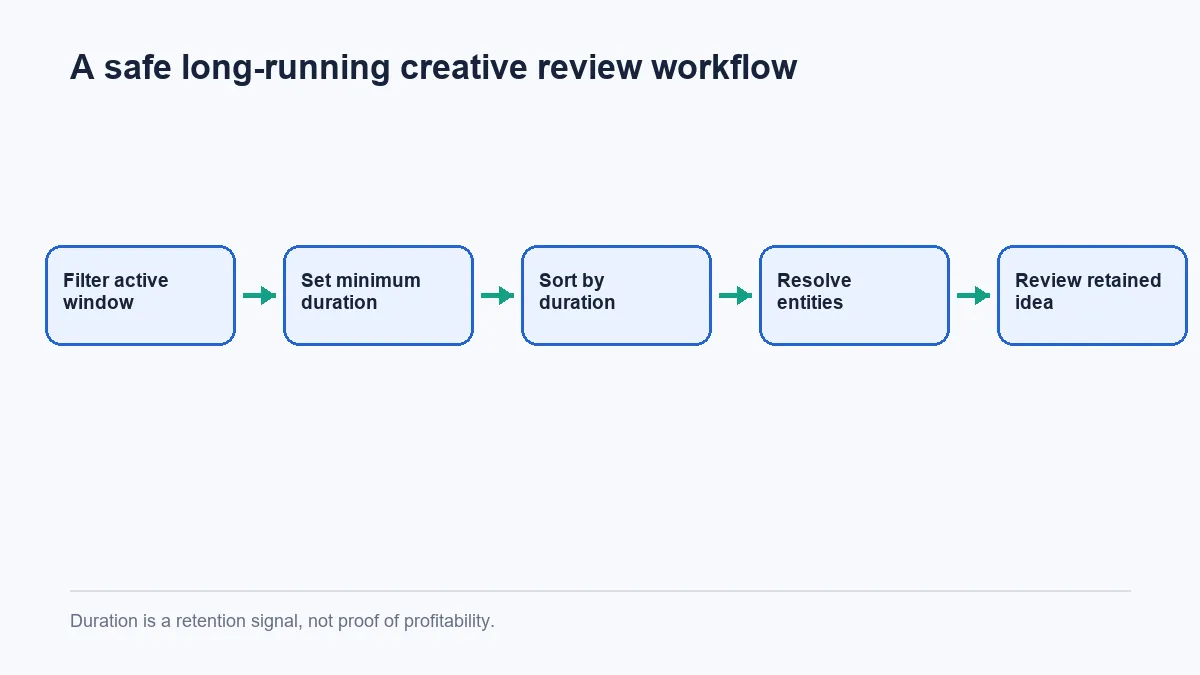
Use an active date window, set a minimum duration, and sort by duration descending. Save the raw response before reviewing the first page. Then deduplicate by material ID and resolve every linked campaign. A clean retained set should exclude obvious entity conflicts, records whose linked campaigns span unrelated products, and assets whose dates appear implausible until manually checked. Keep separate columns for duration, first date, last date, linked-ad count, similar-material count, media, format, and cumulative exposure band. The point is not to shrink the sample aggressively; it is to make every retained row explainable.
- Discover with duration
- Verify dates and entity
- Cluster the creative idea
- Check first-party performance separately
What did the current long-running sample show?
The query returned 1,403,722 matched records and 100 records on the inspected page. Two Ork Monster Hero Game records showed durations of 6,707 and 6,705 days, while a Truck Simulator 3D: City Truck record showed 6,130 days. One other high-duration record was linked to several unrelated campaigns and websites, which is exactly why entity resolution is mandatory. These observations prove that the filter can surface extremely old, still-observed records. They do not prove uninterrupted delivery, commercial success, or that every returned campaign association is correct.
Which creative questions matter after filtering?
Review the retained idea, not merely the old file. Identify the first three seconds, the core mechanic or fantasy, the visual proof, the emotional promise, and the end-card transition. Next, check whether the same idea appears in newer aspect ratios, languages, characters, or UI treatments. A long-running record with several recent variants may indicate a durable concept family; a single untouched asset may instead be archival residue. The difference cannot be inferred from duration alone. Analysts should tag each case as active family, isolated survivor, relaunch candidate, or unresolved record and attach the evidence used for that tag.
How should long-running ideas enter a refresh brief?
Preserve the proven-to-exist structure and vary the execution. A refresh brief can keep the same problem setup while changing the protagonist, visual route, pacing, reward reveal, or end card. Require one sentence explaining what remains constant and one explaining what the variant is testing. If internal performance data later confirms efficiency, the idea can move from retained signal to validated control. If first-party results are weak or unavailable, keep it as an external creative reference only. This rule prevents ad-intelligence observations from silently becoming performance claims inside the production process.
Not sure which long-running game creatives deserve a closer review?
Get a free benchmark check based on your specific app or game category.
What is the practical takeaway?
The safest definition of a long-running creative is a material record observed across a long date span under a stated query, not a winning ad. Use duration to narrow attention, then verify entities, continuity, variants, and internal performance separately. The current snapshot shows why this discipline matters: it surfaces both useful retained concepts and records with associations that require caution. Recheck the queue on a fixed cadence so changes in dates and associations remain visible. A good output is a prioritized review queue with confidence labels, not a list of supposed winners.
