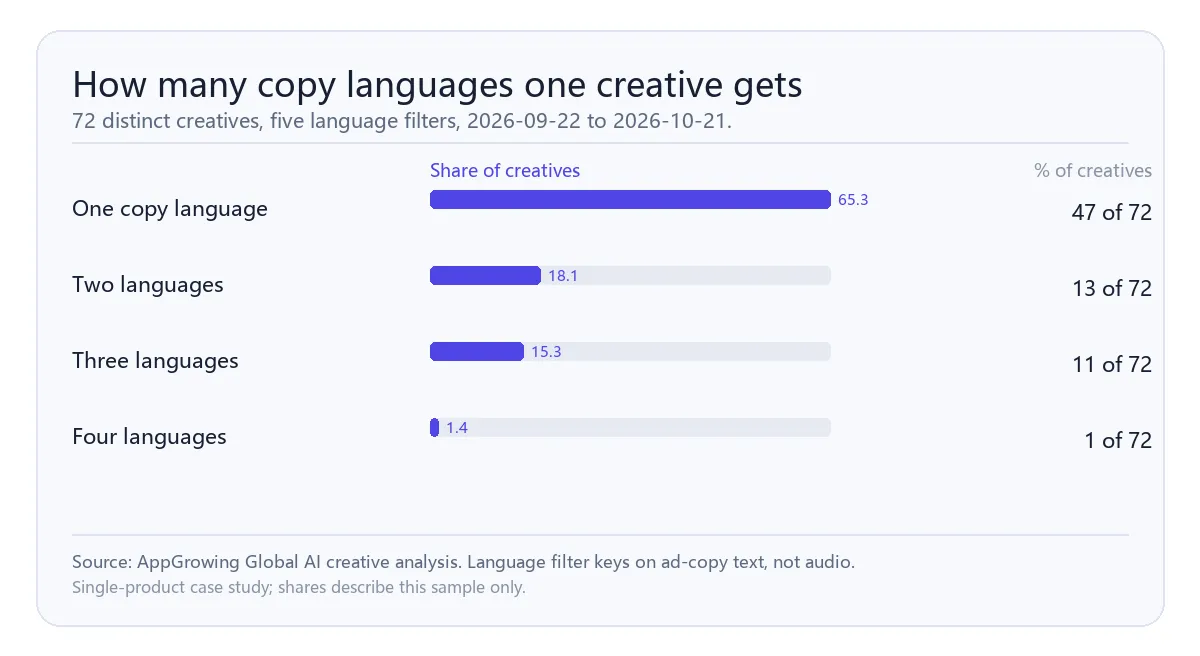
Pull the same game's creatives under five language filters and 72 distinct assets come back. Forty-seven of them — 65.3% — appear under a single ad-copy language, and only 12 appear under three or more. Of 51 creatives with readable video, 45 carry no speech track at all; the two that do are in English and were served under Japanese and Korean ad copy. So the non-English markets in this sample were not watching a dub. What actually changed was the copy angle, plus the occasional market-specific art set.
How many language versions does one creative really get?
65.3% get one, 18.1% get two, 15.3% get three, and a single creative covers four. Multi-language treatment is an exception applied to priority assets, not a default.
The definition matters more than the distribution. The platform's language filter keys on ad-copy text, not on video audio, so the same asset surfaces under Japanese, English and German filters with entirely different copy. Counting language versions therefore overstates how much of the creative was actually localised.
Is it dubbing, subtitles, or neither?
Neither. 88.2% of the sample has no speech track, and the two voiced assets are English originals placed under Japanese and Korean copy. No local-language dub was detected anywhere in the set.
That pushes localisation down to the third layer: on-screen text and copy. And even on-screen text often stays put — in 9 of the 12 creatives where the burned-in language could be identified, it differed from the ad-copy language.
What actually changes, then?
The selling angle. The same footage runs a season teaser in Japanese, a Mega Mewtwo event in English, a 2016 nostalgia line in German and back to the season in Portuguese. One 814-day-old banner was served with English, German, Korean, Portuguese and Indonesian copy.
True market-specific art sets are rare: a Korean hanbok and festival set, a German evolution and neon set. Those are exceptions to "one asset, many markets", not the rule.
Does the format mix shift by market too?
Yes, and in opposite directions. 16:9 is 38.0% of the US set against 24.3% in Japan; 9:16 is 27.3% in the US against 40.0% in Japan. Japan leans vertical, the US keeps more horizontal inventory.
This layer is more copyable than language, because it reflects placement habits rather than vocabulary.
It is also the layer most often missed in a competitive review. A team that pulls one market, sees 40% vertical and concludes "our format mix is fine" has not looked at the market where 40% of the inventory is vertical by default. Format is a decision made per placement, so it belongs in the launch plan rather than in the creative brief.
In what order should a multi-market launch localise?
Three layers, ordered by cost against coverage. First, copy: swap language and selling angle, which is the cheapest layer and reaches every market. Second, format: adjust the 16:9 to 9:16 mix per market, because it decides which inventory you can buy. Third, footage: build a market-specific art set only where a cultural marker is strong enough to carry it — a festival, a garment, a local reference — and accept that only a handful of assets will earn that spend.
What not to do: do not treat the number of language versions as a localisation score, because the filter counts copy; do not assume an English asset will be dubbed for other markets; and do not generalise one product's pattern to the whole category.
Planning a multi-market launch?
Get a free benchmark check based on your specific app or game category.
