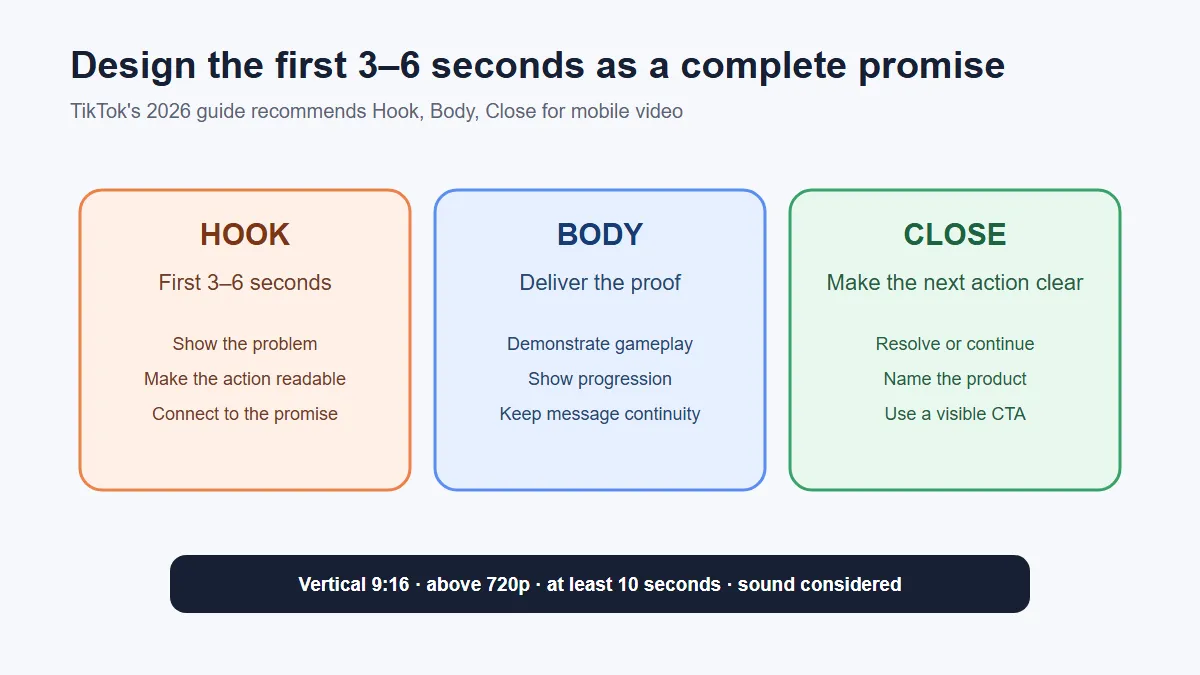
The first 3 to 6 seconds matter because a mobile video needs to establish an understandable reason to keep watching. They are not a universal biological deadline. An effective hook makes the problem, visible action, and product-consistent promise legible early, then lets the body provide proof and the close provide a next step. TikTok’s 2026 creative guide describes this sequence as Hook, Body, and Close.
What must the first 3 to 6 seconds accomplish?
A useful hook completes at least three jobs. It tells the viewer what is happening, makes the important action readable on a phone screen, and connects the opening to the product promise that follows. A game ad might show a failed choice, an urgent objective, or a visible rule. An app ad might show a precise frustration, a before-and-after state, or an immediate result.
The hook does not need to explain every feature. It needs to create a clear information gap that the product can close. A viewer should be able to describe the task before the body begins, even if the outcome remains unresolved.
Why is visual shock alone insufficient?
A loud sound, exaggerated face, or rapid edit can create a moment of attention. If the body cannot prove the opening promise, however, the hook becomes disconnected bait. Semantic continuity matters. The opening presents a problem, the body demonstrates how gameplay or a feature addresses it, and the close continues the same task with a relevant call to action.
Use a direct diagnostic. Remove the logo and ask whether a reviewer can explain the relationship between the opening task and the product. If the body needs a completely different story to introduce the app, the hook has not established the promise clearly enough.
What other video rules does TikTok specify?
TikTok’s 2026 Creative Starter Pack recommends video ads that are at least 10 seconds long, vertical, and above 720p resolution. It recommends a 9:16 format for TikTok-first creative and describes the platform as sound-on, where audio hooks can be as useful as visual hooks. The close should state a clear action through text, voiceover, or graphics.
The guide also cites earlier TikTok research stating that 90 percent of ad-recall impact and 80 percent of awareness impact are captured within 6 seconds. Those figures come from TikTok’s 2020 Value of View analysis. They are platform research context, not a guaranteed result for every game, app, market, or network.
How can a hook become a testable variable?
Avoid comparing five videos in which every element changes. Hold the body and close stable while changing one opening hypothesis. Test the opening task, protagonist, first-frame text, action speed, or audio entrance separately. This design helps the team learn whether the useful difference came from crisis, rule explanation, result preview, or sound.
The review sheet should record hook start and end time, first frame, problem type, first action, product clue, audio cue, transition into the body, and CTA continuity. Creative-intelligence tools such as AppGrowing can help teams collect competitor examples and label these structures. Account experiments are still required to measure campaign outcomes.
How should a UA team choose which hook to retain?
First remove openings that misrepresent the product or cannot transition into a truthful body. Then compare variants against the same business event instead of judging them only by video views. A hook that attracts viewing but fails to support downstream action may have a promise-to-proof break.
If both viewing and the selected downstream event improve, expand the concept family. Keep the underlying task and promise while varying character, setting, pacing, or resolution. Copying only the loudest surface element loses the mechanism that made the hook understandable.
What should the final creative brief contain?
Write the first 3 to 6 seconds as a miniature contract. Name the problem, visible action, product clue, unresolved question, and transition into proof. Define what the body must demonstrate and how the close completes or extends that promise. Add format, resolution, audio, duration, and CTA requirements as production constraints.
This turns the hook from a vague request for something more attention-grabbing into a reviewable hypothesis. The team can then compare competitor patterns, produce controlled variants, and decide with campaign data which promise deserves further scale.
