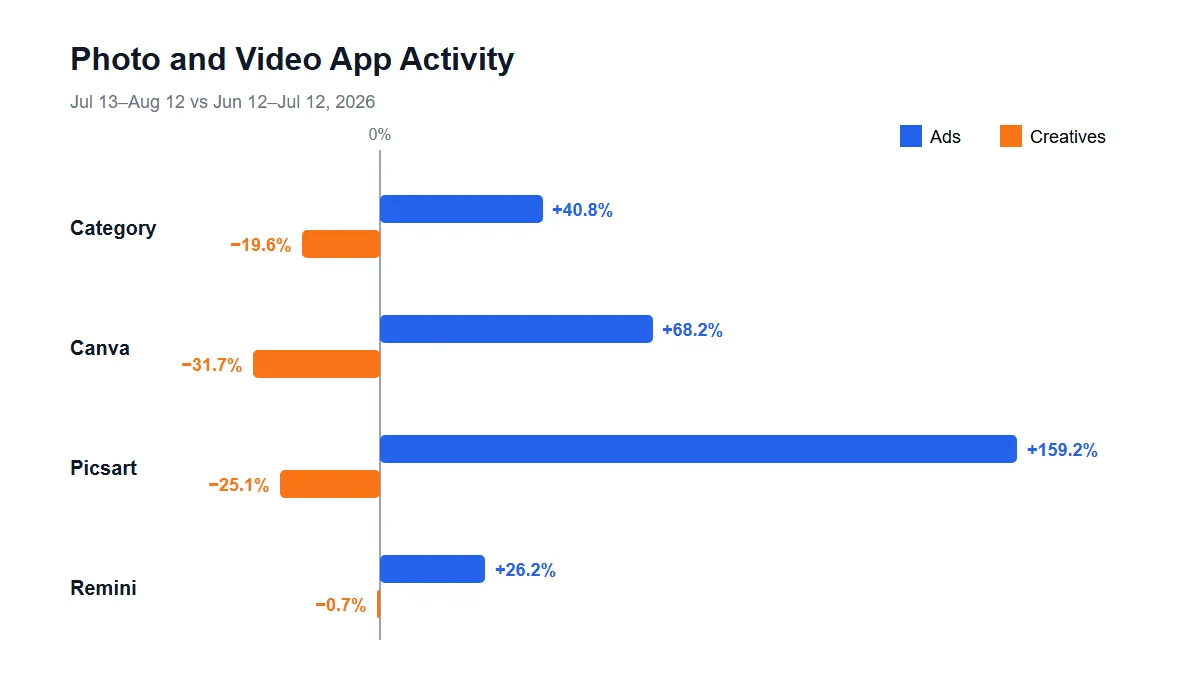
Photo and video app ads expanded without a matching increase in creative output. From July 13 to August 12, 2026, category ad records rose 40.8 percent while creative records fell 19.6 percent. Canva, Picsart, and Remini showed the same broad divergence. UA teams should first identify the proof templates receiving broader use, then decide whether they need more concepts or stronger variants.
Why did ad growth not produce more creatives?
The category pattern is not driven by one isolated app. Canva ad records increased from 18,218 to 30,641 while creatives fell from 7,950 to 5,426. Picsart ads rose from 5,961 to 15,451 while creatives declined from 1,340 to 1,004. Remini ads increased from 13,068 to 16,491 while its creative pool moved slightly from 3,001 to 2,979.
This relationship supports a monitoring conclusion about creative concentration. It does not prove that any app achieved better campaign performance. It shows that more observed advertising activity is being carried by a smaller or nearly unchanged creative pool.
If ads rise while creatives fall, inspect materials with long active histories, high linked-ad counts, and repeated script families first. Only move new concept production to the top of the queue when those retained structures cannot explain the expansion.
How do Canva, Picsart, and Remini prove product value?
The official-entity aggclaw sample shows three different proof units. Canva matched 3,615 materials in the retrieval window. Its high-exposure sample emphasizes finished templates, editing interfaces, and work scenarios. One material with 4,238,345 cumulative impressions demonstrates how a social media manager creates TikToks for clients in Canva. Another long-running execution opens with a cat, then moves into template search and finished output.
Picsart matched 941 materials. Its semantic sample more often turns a discrete AI tool into a UGC event. Observed structures include travel and fashion imagery, childhood-memory recreation, hairstyle and avatar generation, and creator-earning narratives. The product is framed as a creative playground where one feature can produce many social variants.
Remini matched 2,189 materials. Its strongest readable proof is the transformation itself. A material with 26,106,092 cumulative impressions shows an old photograph becoming clear through a before-and-after sequence, an enhancement button, and a family-album setting. Other repeated families use age prediction, portrait enhancement, viral tutorials, and nostalgic restoration.
The three competitors therefore need different review sheets. For Canva, check whether the workflow reaches a usable output. For Picsart, check whether one tool can generate multiple UGC variants. For Remini, check whether the visual difference remains obvious with sound off.
Which materials belong on the next watchlist?
Use three groups. Outcome-proof materials show the input, operation, and finished asset and are especially relevant to Canva. Tool-event materials combine one AI feature, a human reaction, and a social use case and fit Picsart. Visual-transformation materials depend on a readable before-and-after contrast and emotional memory value and fit Remini.
Apply a simple rule. If ad activity grows faster than creative output and the leading materials also show long active histories or many linked ads, place those structures in the reuse watchlist. If ads and creatives rise together, create a new-concept watchlist. If creatives shrink without a change in the proof unit, inspect template recuts, cast changes, and language variants before labeling every record a new idea.
How should UA teams run the next review?
Group materials by proof unit rather than surface style. Select ten high-cumulative-impression materials with populated semantic fields for each app. Record the input, operation, result, narrator role, CTA, active days, and linked-ad count. Merge repeated executions into template families, then compare which families were retained, introduced, or removed between review cycles.
Not sure which Canva, Picsart, or Remini proof templates belong on your creative watchlist?
Get a free benchmark check based on your specific app or game category.
The current evidence supports a clear operating decision. Photo and video app teams should not raise creative quotas mechanically because ad activity increased. They should first determine whether competitors are carrying more delivery with fewer proof templates. That shifts the creative meeting from quantity anxiety to the quality and repeatability of product proof.
