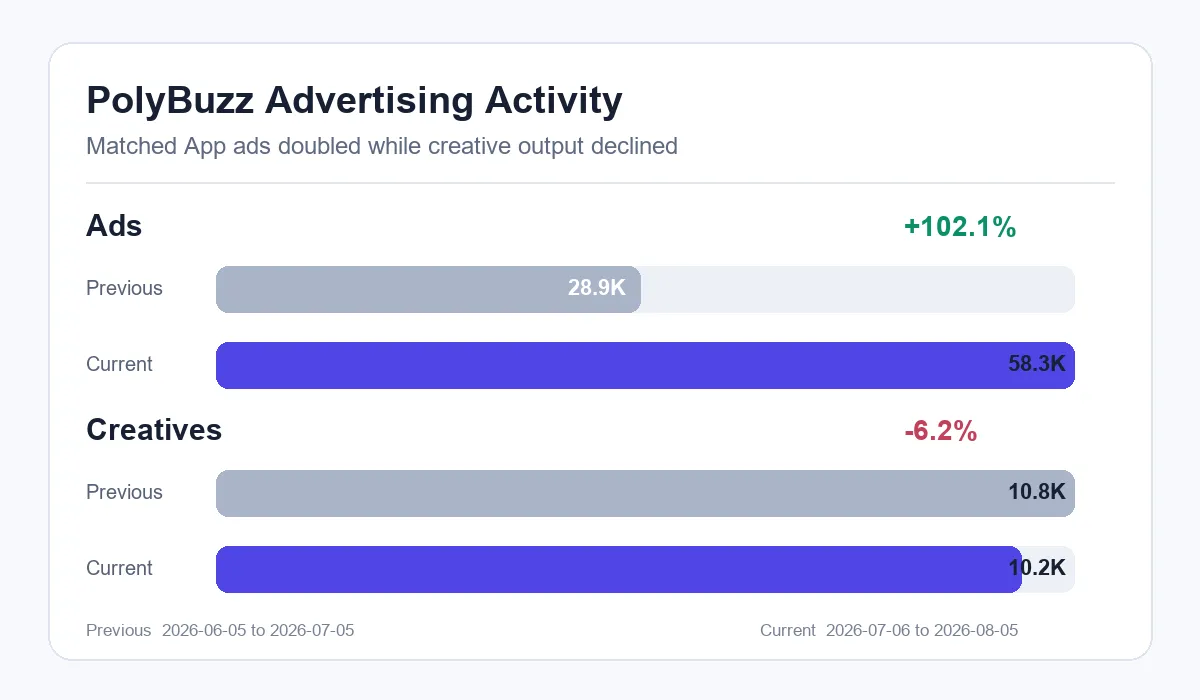
PolyBuzz advertising expanded without a larger creative pool. Matched App ads increased from 28,850 to 58,294, up 102.1 percent, while creatives declined from 10,835 to 10,166, down 6.2 percent. Growth teams should inspect whether a small number of long-running digital-person, character-chat, and end-card templates are carrying more delivery. The ad increase does not by itself show that the remaining materials became more effective.
What does doubled ad activity with fewer creatives show?
Creatives per 10,000 ads fell from 3,755.6 to 1,743.9, a 53.6 percent contraction. Observed advertising coverage expanded while distinct creative supply became more concentrated. This is a reason to review template reuse, language variants, and linked-ad growth. It is not evidence that one character, relationship scenario, or closing screen improved CPI or conversion.
The keyword polybuzz entered AppGrowing’s current TOP50 with 10 UV and 13 PV. That competitor lookup signal shows rising industry attention. Combined with the ad increase, it earns PolyBuzz a higher watchlist priority. The creative analysis is still needed to define what the team should monitor inside that priority segment.
Which PolyBuzz creative systems are being reused?
The aggclaw query matched 10,142 creatives and analyzed the Top 100 by observed impressions. Repeated openers included Amy introducing herself as a digital person, character cards with chat bubbles, romantic roleplay, AI boyfriend UGC scenes, and images using ranking or large character-count claims. The same Amy introduction appeared verbatim in at least five sampled creatives.
Mid-section proof concentrated on chat interfaces, character-card galleries, voice-call screens, multi-character browsing, and card-unlock mechanics. Closing frames repeatedly used the PolyBuzz wordmark, a gradient background, App Store and Google Play badges, and a download prompt. Four image creatives shared the same 768 run days and 500 linked ads, which identifies a long-running banner or end-card family.
How can teams tell whether a character hook adds a new concept?
Separate the creative into promise, interaction proof, and relationship outcome. A different face with the same chat flow, voice feature, and store-badge ending is packaging variation. If a new material demonstrates a different interaction capability or a new relationship task, treat it as concept expansion. If it only changes the character portrait or language, keep it in the existing template family.
The verified sample included English, Japanese, French, and German localization. Geographic expansion deserves monitoring, but language is not a new value proposition by itself. Compare whether each market preserves the same digital-person opener, visible chat interface, and two-store close. Then review whether the localized dialogue accurately sets up the function that appears on screen.
What should the next PolyBuzz watchlist record?
Capture ads, creatives, creatives per 10,000 ads, opening line, character type, relationship scenario, interface proof, voice function, language, and end-card family each week. Give priority to older templates whose linked-ad counts are increasing. Mark a separate lane for materials that introduce genuinely new interaction proof. This distinguishes concept expansion from broader distribution of the same production system.
Use a two-level classification. At the first level, separate the user task into companionship, romantic roleplay, character discovery, and voice interaction. At the second level, record character art, language, and spoken framing. Count a material as a new concept only when the first-level task or the visible function changes. This prevents a large cast of portraits from exaggerating the real breadth of the creative strategy and gives reviewers a consistent unit for weekly comparison.
Use the same task labels across markets so the watchlist identifies strategic change on consistent terms rather than treating every localized character as a separate idea.
Here’s a pattern I keep seeing. AI companion ads can look diverse because every character has a different visual identity. Yet the underlying script may still be identical. The character says hello, a chat interface appears, an emotional exchange follows, and store badges close the ad. A useful review counts changes in the interaction proof, not only changes in faces.
Not sure whether PolyBuzz is expanding creative concepts or distributing the same templates more widely?
Get a free benchmark check based on your specific app or game category.
The monitoring decision is clear. PolyBuzz belongs on a higher-frequency competitor list because industry attention and matched ads both increased. The falling creative count tells the team to focus on template concentration. Review the promise, visible interaction, and end-card relationship before commissioning more character variants.
