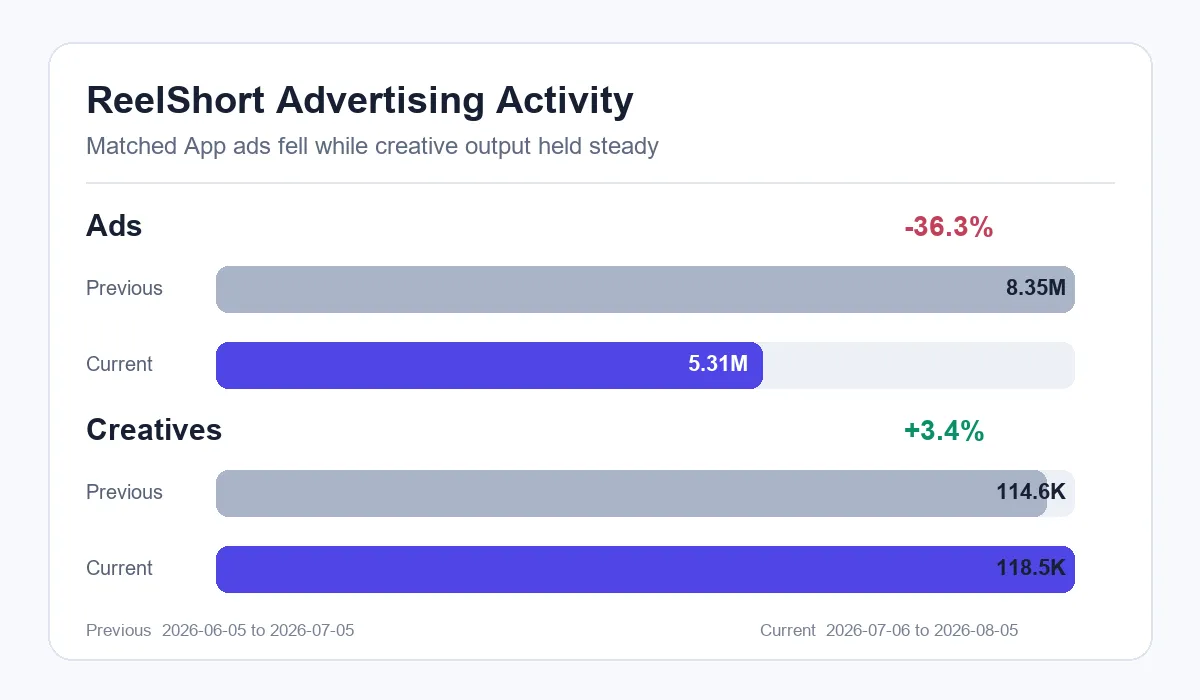
ReelShort is not showing a creative stop. It is maintaining a large production system while observed advertising activity cools. Matched App ads fell from 8,346,528 to 5,312,796, down 36.3 percent, while creatives rose from 114,613 to 118,455, up 3.4 percent. Short drama teams should move the review away from raw output volume and toward the story families that continue to receive localized cuts, repeated distribution, and conversion endings.
What does lower ad activity with steady creative output mean?
Creatives per 10,000 ads increased from 137.3 to 223.0, a 62.4 percent rise. The creative pool became denser relative to observed advertising activity. That can be consistent with broader low-volume testing, continued recutting, or fewer active ad units, but the current data cannot choose among those explanations. The actionable conclusion is to inspect retained stories and variant relationships before changing production volume.
The keyword reelshort also entered AppGrowing’s current TOP50 with 13 UV and 17 PV. That is a competitor lookup signal from industry users, not evidence of audience demand. When attention rises while advertising activity falls, the useful task is to identify which creative systems remain active enough to deserve a place on the watchlist.
Which story families are still being recut?
The aggclaw query matched 117,207 ReelShort creatives and analyzed the Top 100 by observed impressions. About 98 percent of that sample was vertical video. Five opening families recurred. They were high-conflict emotion, wealth and power contrast, romantic tension, fantasy spectacle, and identity swap or disguise. The mid-section usually supplied rapid dialogue scenes, visible status reversals, subtitles, and occasional game-like Level Up overlays.
Localization operates as a production system rather than a final translation step. The sample included Arabic, Spanish, Portuguese, and English. Wolf-shifter romance, billionaire disguise, pregnancy confrontation, and identity-reversal templates appeared in multiple localized forms. At least six sampled creatives were linked to 400 to 500 ads. Those relationships identify durable story families that should be compared across languages and endings.
How should teams review ReelShort CTAs and end cards?
Common closing structures used free, Gratis, or limited-time overlays, an unresolved cliffhanger, a ReelShort watermark, and prompts to watch initial episodes without payment. The ending works when it converts an unresolved story question into the next viewing action. Reviewers should record whether the cliffhanger was earned by the earlier scene, whether the offer matches the destination, and whether the localized CTA continues the same emotional conflict.
If one story template keeps accumulating linked ads across languages, test the conflict intensity, proof moment, and end-card handoff before replacing the story. If creative output keeps rising but linked-ad counts become widely dispersed, treat the batch as exploration and narrow the review to the clearest identity change and unresolved outcome. This rule separates repeatable narrative architecture from cosmetic subtitle variations.
What should the next short drama monitoring sheet contain?
Create one row per story family. Capture the opening conflict, character status, turning point, subtitle language, offer wording, end card, linked-ad count, and first observed date. Classify each new material as a new story, a recut of an existing story, or a language-only variant. That makes a pool of 118,455 materials usable for a weekly decision instead of leaving it as an overwhelming total.
Add a cross-language continuity pass. Select two or three market versions from the same story family and compare the timing of the conflict, essential identity information, subtitle density, first offer frame, and final cliffhanger. If a localized version changes the central relationship or removes the scene that proves the reversal, classify it as a structural change rather than an ordinary translation variant. This helps the team learn whether localization preserves the selling logic or creates a different narrative funnel.
Here’s a pattern I keep seeing. Short drama teams often produce many cuts without increasing the number of underlying promises. A better review counts story families first and files second. One billionaire-disguise story may generate dozens of language and duration variants. The family should remain one strategic unit until its opening conflict, reversal, or CTA meaningfully changes.
Not sure which ReelShort story families deserve a place on your short-drama watchlist?
Get a free benchmark check based on your specific app or game category.
The monitoring conclusion is specific. ReelShort’s lower ad volume calls for a cooldown review, but its steady creative output shows that the production machine remains active. Focus on recurring story families, localization depth, and the handoff from cliffhanger to CTA. Those are the units most likely to produce a useful competitor brief.
