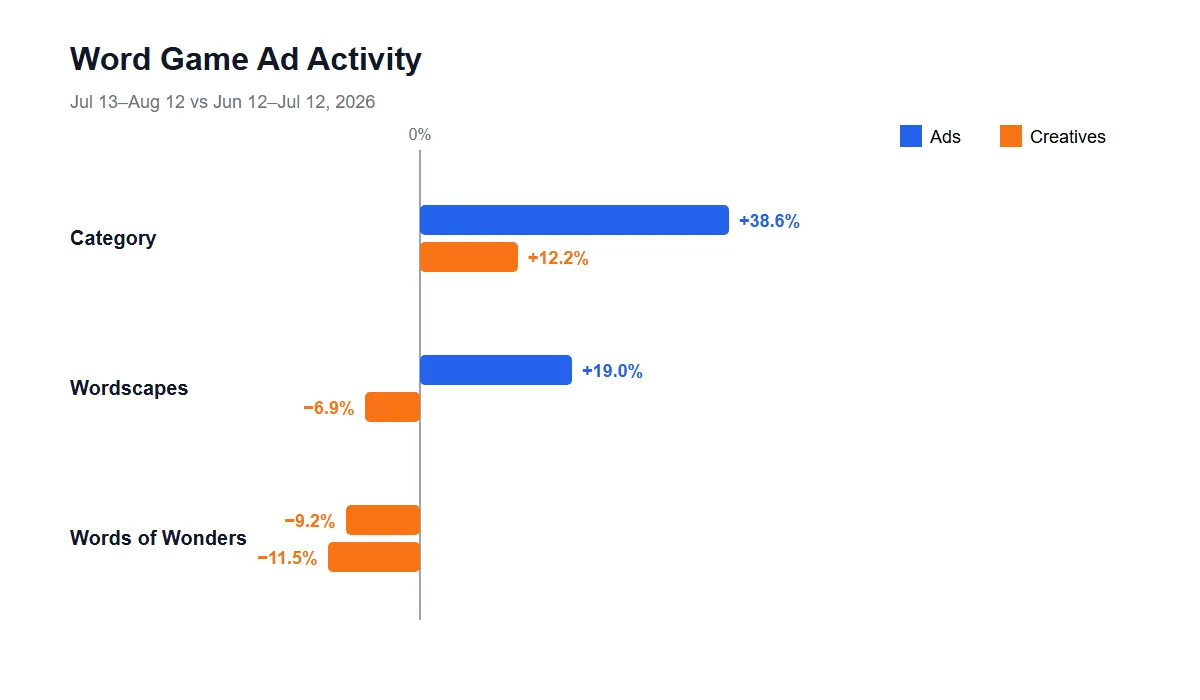
Word game category growth did not translate into uniform expansion among leading apps. From July 13 to August 12, 2026, category ad records rose 38.6 percent and creative records rose 12.2 percent. Wordscapes increased ad activity while reducing creatives, whereas Words of Wonders contracted on both measures. Teams should monitor each official entity and its proof structure instead of treating the category as one strategy.
Why does category growth hide competitor divergence?
Wordscapes ad records increased from 2,167 to 2,578, a 19.0 percent rise, while creatives declined from 504 to 469, or 6.9 percent. Words of Wonders moved in the opposite direction, with ads falling from 14,038 to 12,752 and creatives falling from 1,359 to 1,203.
The category expansion may therefore be coming from other titles or broader activity rather than joint acceleration by these two competitors. A category signal should determine where to look, not what conclusion to assign to every app.
Use a three-branch rule. If the category grows while an entity contracts, place that app in the retained-structure watchlist. If entity ads grow while creatives fall, inspect delivery concentration around a smaller number of scripts. If both ads and creatives grow, then treat new-concept expansion as the leading hypothesis.
How do the two games prove the same core mechanic?
Both competitors use gameplay recording as the basic proof layer, but the surrounding narrative differs. The aggclaw retrieval matched 351 Wordscapes materials and reviewed its top 100 by cumulative impressions plus 74 voice-over materials. Wordscapes frequently places the letter wheel inside beaches, gardens, school settings, and seasonal scenes. Human questions, nostalgia, and humor turn the puzzle into a personal experience.
Repeated Wordscapes families include the balance between challenge and relaxation, a ten-minutes-a-day habit, brain-age questions, only-a-small-percentage-can-solve-it challenges, and short comedy setups. The common bridge is personal change. The player relaxes, sharpens vocabulary, remembers an earlier experience, or escapes an awkward social moment through play.
The Words of Wonders retrieval matched 791 materials and reviewed its top 100 plus 49 voice-over materials. Its semantic sample relies more heavily on authority, identity, and world discovery. Neurologist-style warnings, cognitive anxiety, landmarks, flags, sleep, and lifestyle themes lead into the waterfall and letter-wheel interface. The authority family was prominent within the voice-over subset, but this is a sample observation rather than a performance ranking.
Which hooks and CTAs deserve separate tests?
Wordscapes tends to open with a human question, confession, or humorous interruption. Words of Wonders more often starts with an authority warning, identity statement, landmark visual, or difficulty promise. Wordscapes CTAs are commonly spoken and emotionally connected to the story, including play-now and free-download prompts. Words of Wonders more often uses a standardized icon-and-button end card after an authority or lifestyle argument.
Build a two-by-two test matrix. Put personal experience and external authority on one axis. Put relaxation value and challenge value on the other. Keep the gameplay recording and CTA constant while changing only the opening frame. This makes the test about the narrative bridge rather than several creative variables at once.
Add claim strength as a separate field. Relaxation, vocabulary practice, and puzzle difficulty can remain in the standard creative review. Brain-age language, neurologist advice, and health-improvement implications should enter an additional claim check. Do not assume that a stronger authority voice-over is more effective. First verify whether it has an evidence path and whether it connects naturally to visible gameplay proof.
What should the next competitor review contain?
Create a script-family sheet for each official entity. Add active days, linked-ad count, semantic coverage, opening type, gameplay proof, and CTA. For Wordscapes, monitor whether personal-change, brain-age, challenge, and humor families remain active. For Words of Wonders, monitor the reuse of authority, world-discovery, and lifestyle families, and route medical or absolute claims through a separate claim review.
Not sure how to compare Wordscapes and Words of Wonders without losing the category context?
Get a free benchmark check based on your specific app or game category.
The useful conclusion is not that one word game is better. The two leading entities use different narrative bridges to prove a similar core mechanic. Category movement sets monitoring priority, while entity-level material structure determines the creative task.
