Gossip Harbor drew more lookup attention and more observed official-package ad records while its creative records fell. The verified pattern is consistent with greater concentration in a smaller pool, not proven performance improvement. Teams should separate merge-gameplay proof from the emotional story families carrying reuse.
How can ads grow while creative volume falls?
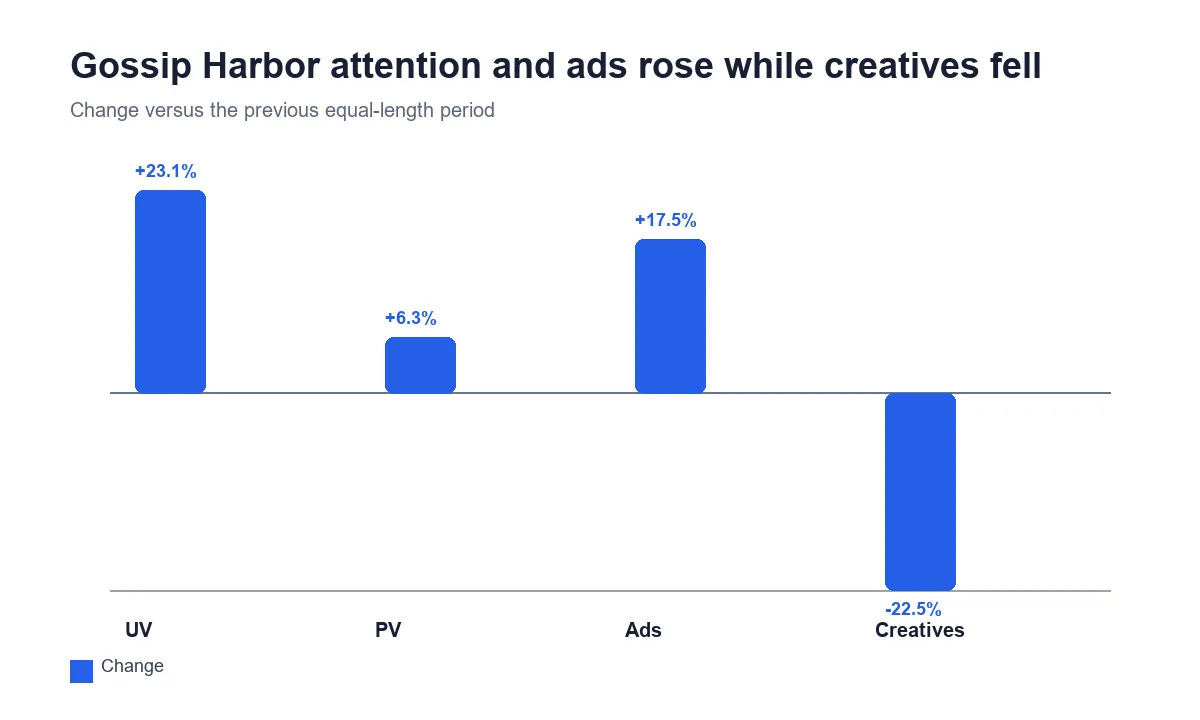
Gossip Harbor became more visible to marketers while its observed advertising activity concentrated into a smaller creative pool. Industry-search UV rose from 13 to 16, up 23.1 percent, and PV rose from 16 to 17, up 6.3 percent. Official-package ad records increased from 31,864 to 37,456, up 17.5 percent, while creative records fell from 4,865 to 3,771, down 22.5 percent. The supported diagnosis is concentration, not proven performance improvement.
The practical task is to identify which story and gameplay-proof units remained active, which variants disappeared, and whether the added advertising activity sits inside a few mature families. Ad growth alone does not reveal efficiency. A smaller pool can reflect reuse, longer-running assets, fewer experiments or a combination that requires material-level review.
A concentration review can start with three questions: did ad activity increase, did the creative pool expand, and did family coverage broaden? Here the first answer is yes and the second is no. The third requires semantic inspection, which is why the aggclaw sample is necessary alongside the trend webhook.
Which structures are carrying current activity?
The official Gossip Harbor entity directly matched 3,302 materials in the aggclaw window, with 72 materials providing usable semantic descriptions. Image d77aa recorded 335,215,699 cumulative impressions and 1,120 active days. Video 50b00 recorded 298,558,030 and 1,099 days. These long-running examples show why a review limited to newly observed assets would miss much of the creative memory.
Recurring openings include meta dialogue about fake ads versus the real game, a mother-and-daughter crisis, divorce or family rupture, a damaged winter home, and direct merge-grid recording. The merge board proves a simple action. Renovation before-and-after scenes provide emotional payoff. Relationships and unresolved conflict extend attention beyond the mechanic.
Cumulative-impression leaders should be used to recover long-term creative memory. They are not evidence that the same volume occurred in the current 31-day period. The useful observation is structural: durable assets repeatedly connect a comprehensible merge action to repair progress, relationship tension and an unresolved next step.
Need a verified benchmark for this category or competitor?
Ask for a free review using your own app, category and monitoring question.
Why separate gameplay proof from story families?
The gameplay layer uses food, dessert or animal icons, guided taps, order collection and immediate score feedback. The story layer uses broken rooms, fireplaces, temperature meters, mothers and daughters, marriage conflict and rescue bonds. One execution can replace the emotional opening while preserving the same merge body. Another can retain the crisis but swap the merge edit.
Use two connected labels. The gameplay-proof label records the merge action, feedback and renovation result. The story fingerprint records the relationship, crisis, objective and cliffhanger. Count an execution as a new concept only when both layers change materially. A new actor, subtitle or opening line inside the same fingerprint is a variant, not a new theme.
A two-layer fingerprint makes reuse easier to audit. The gameplay layer can contain board state, merge gesture, order progress and renovation payoff. The story layer can contain relationship, crisis, location and cliffhanger. Changing only one layer usually creates a variant; changing both can justify a new concept label.
How should teams test whether concentration continues?
Review ad activity, creative activity and family coverage together in the next equal-length period. If ads keep growing while creatives keep falling, inspect linked-ad counts and edit variation inside mature families. If both rise, widen the scan for new story fingerprints. If both fall, retain the longest-running proof units and study which variants exit.
The current watchlist should prioritize the fake-ad challenge, mother-and-daughter renovation, merge-to-repair payoff and family-conflict families. This unit is more useful than total material count because it connects delivery direction to the content structures a creative team can actually reproduce or challenge.
For the next equal window, compare family coverage with linked-ad breadth and the total creative count. Continued ad growth with a shrinking pool should increase concentration-review priority. If both measures grow, scan for genuinely new fingerprints. Keep effectiveness, spend and audience conclusions outside the report unless separate evidence is supplied. Document every family decision beside a representative material ID so another reviewer can reproduce the classification.